The Army’s Dual Burden – Sheltering IDPs and Facing Militant Attacks in Manipur
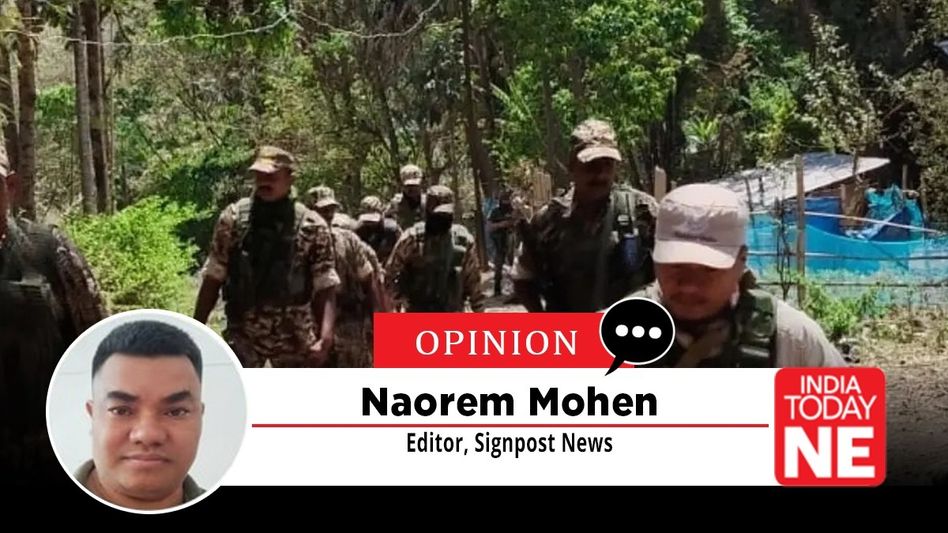
The 19th Garhwal Rifles of the Indian Army has shouldered an extraordinarily complex mission in Manipur. Deployed in the sensitive Torbung-Kangvai-Phougakchao sector, this unit has emerged as one of the few neutral institutions in Manipur’s prolonged ethnic conflict.

- Mar 27, 2026,
- Updated Mar 27, 2026, 4:55 PM IST

The 19th Garhwal Rifles of the Indian Army has shouldered an extraordinarily complex mission in Manipur. Deployed in the sensitive Torbung-Kangvai-Phougakchao sector, this unit has emerged as one of the few neutral institutions in Manipur’s prolonged ethnic conflict.
For months, it has provided shelter, protection, and humanitarian aid to Internally Displaced Persons (IDPs) from both Meitei and Kuki communities, often under trying circumstances. However, this impartial guardianship comes at a heavy price.
On the night of March 25, 2026, Kuki militants launched a coordinated assault not only on nearby Meitei villages but directly on the joint Army-CRPF post at Phougakchao Awang Leikai. The attack exposed the Army’s dual burden: acting as a humanitarian buffer while confronting armed aggression in a terrain that favors hit-and-run tactics.
The Manipur violence that erupted on May 3, 2023, has displaced tens of thousands and claimed hundreds of lives. Even after nearly three years, large pockets of the state remain volatile, with peripheral villages like those in Torbung repeatedly targeted.
In this time of fear and mistrust, central forces, particularly Army units like the Garhwal Rifles, represent the constitutional promise of impartial protection. Their role goes far beyond combat. They have repeatedly stepped in to rescue and shelter civilians from both sides when local tensions flare or when one community feels threatened by the other.
A striking example occurred in early March 2026 during the Yaoshang festival celebrations. A football match involving Meitei IDP camp residents and locals in Santhong Awang Leikai turned sour due to community rejection and rising panic.
Around 150 Meitei IDPs, including women and children, fled with whatever belongings they could carry. They sought refuge at the 19th Garhwal Rifles camp near Phougakchao Ikhai Thokchom Leikai Community Hall in the Kangvai-Torbung area.
The battalion responded without hesitation or bias. Officers and jawans set up temporary tarpaulin shelters, arranged clean drinking water, cooked fresh meals, provided first aid, and ensured round-the-clock security.
This was not an isolated incident. Earlier accounts from December 2025 and February 2026 also document the unit offering protection to displaced families from both Kuki (including Vaiphei) and Meitei communities in the same sector. Such even-handed actions have earned quiet respect from civilians on both sides of the divide, precisely because they stand apart from the partisan perceptions that often color local policing.
This humanitarian role forms the core of the Army’s “dual burden” in Bishnupur. On one hand, the Garhwal Rifles and associated central forces act as guardians enabling limited attempts at resettlement. Many Meitei families, whose homes were burnt or abandoned since 2023, have trickled back to vulnerable foothill villages like Phougakchao Ikhai Maning Leikai, Torbung Gram Panchayat wards, Heikon, Turel Mapal, and Kwakta.
These returnees live in modest, often non-concrete structures, hoping the presence of Army and CRPF posts nearby will deter further aggression. The Army’s visible neutrality provides psychological reassurance in an environment where trust between communities has eroded deeply.
On the other hand, this very presence makes the security posts targets. The midnight attack on March 25, 2026, illustrates the peril. At approximately 11:40 pm, suspected heavily armed Kuki militants opened fire from the Phouljang/Gothol and adjacent hill areas.
Around 350-400 automatic rounds and 150-180 single shots, supplemented by other ammunition, were directed toward the joint post of the 19th Garhwal Rifles and the 58th Battalion of the CRPF at Phougakchao Awang Leikai.
Some rounds landed perilously close to the camp. Minutes before the firing began, power supply to the entire Torbung area was reportedly cut, plunging villages into darkness, a tactic that amplified panic.
The militants did not limit their assault to the security post. They simultaneously targeted multiple Meitei villages along the foothills, raining bullets and explosives for about 30 minutes. The blasts shook houses in Phougakchao Ikhai Maning Leikai, Bazar Maning, Torbung wards, Heikon, Turel Mapal, Kwakta, and surrounding localities.
Many residents, including those who had only recently returned after years in relief camps, fled once again into the night, clutching infants and running blindly in the dark. The Army and CRPF responded with professional swiftness. Security personnel returned fire toward the source of the attack, leading to an exchange that lasted roughly 30 minutes.
No casualties were reported among the forces. Additional firing was heard from adjacent areas around 1:15 am on March 26, but the immediate threat to the post was neutralized.The aftermath saw determined follow-up action.
From the early hours of March 26, a combined security team including the Indian Army (Garhwal Rifles), CRPF, Manipur Police, and Indian Reserve Battalion (IRB), launched cordon-and-search operations in the firing zone and adjoining hill ranges, extending into parts of Churachandpur district.
These operations yielded significant recoveries in areas such as S Nabil and Loilamkot under Churachandpur Police Station: two single-barrel rifles, five 12-bore ammunition rounds, one handmade grenade, one PEK bomb, one 4-kg cylindrical IED (cordex-initiated), two 40mm bombs, two pompies, and two 30mm grenades.
Reports also indicated the razing of several illegal bunkers and at least one arrest linked to insurgent activity. Search and area domination efforts continued through the day and beyond, with security forces maintaining close monitoring to prevent escalation.
However, the incident revived painful memories of the May 2023 violence and subsequent cycles of attack and displacement. Similar attacks occurred in December 2025, when Kuki militants targeted resettling Meitei villages with bombs and gunfire, prompting security responses and arms recoveries.
Each time, returnees face renewed trauma, and the Army finds itself pulled between defensive combat duties and humanitarian responsibilities.
The Garhwal Rifles’ camp has become a de facto safe haven precisely because it is perceived as unbiased, a rare commodity in a conflict where narratives of “us versus them” dominate.
The dual burden carries operational, moral, and strategic weight. Operationally, the Army must maintain robust domination over infiltration routes from the hills while ensuring village-level security matches the speed of post defense.
The terrain, dense hills, narrow valleys, and proximity to the inter-district boundary, favors militants who can strike swiftly and melt away. The Indian Army’s record in internal security duties, including in Manipur, has historically emphasized minimum force, impartiality, and people-centric operations.
Units like the 19th Garhwal Rifles exemplify this tradition. Their jawans, often far from their Himalayan homes, perform rescue missions, distribute relief, provide medical aid, and stand as buffers between communities. In doing so, they absorb the anger and frustration of civilians who feel abandoned by the broader political process.
Attacks on such posts are not just tactical challenges; they are assaults on the very idea of neutral state authority and on the prospects of reconciliation. The people of Manipur, especially the vulnerable villagers in Torbung and similar security zones, have endured immense suffering. Tens of thousands remain in relief camps, their lives suspended between hope and despair.
The 19th Garhwal Rifles and other Army units continue to bear a disproportionate share of this burden, sheltering the displaced today, engaging militants tomorrow, and standing guard the day after. Their professionalism and impartiality offer a glimmer of stability in an otherwise fractured region.
However, stability alone is not peace. Until militants are consistently deterred from targeting both security forces and civilians, until IDPs can return without fear of renewed attacks under cover of darkness, and until the dual burden on the Army is lightened by broader governance efforts, the cycle will persist.
The Garhwal Rifles’ jawans deserve recognition for their sacrifices and restraint. More importantly, the people they protect deserve a future where the Army’s role shifts from emergency guardian to enabler of normal life.
The March 25 attack and its aftermath serve as a sobering reminder that in Manipur, the Indian Army walks a tightrope. It must defend itself and the innocent simultaneously, often with limited room for error.
Strengthening this capacity, through better resources, sustained operations, and political resolve, is essential if the dual burden is to eventually give way to durable peace. The guardians in Bishnupur have shown dedication; now the system must rise to support them and the people they strive to protect.
The views expressed in this article are those of the author and do not necessarily reflect the views of India Today NE or its affiliates.