What Divine Panthou wants Meitei children to know about ceremonial dress
At the 22nd Foundation Day of Ima Leishem Inaat Loishang, Divine Panthou recalled why he gave his blessing to a school where children could learn which garments belong to each occasion, how to wear them and why those distinctions matter.

- Nov 29, 2026,
- Updated Nov 29, 2026, 1:13 PM IST

- Girls learn to wear phanek while boys practise tying traditional khudei
- Mothers should not wear muka phi at their children's weddings
- Maibi attire changes between Ipan Thaba and Laibou Chongba observances
What should a mother wear to her son’s or daughter’s wedding? Divine Panthou raised this question when he addressed the 22nd Foundation Day of Ima Leishem Inaat Loishang (ILIL) at Panthou Ishaikol Nung, Nongpok Chingu Thong, Meitei Laikol, Thalo Sipi Lok in Selloi Langmaiching, Imphal East.
The mothers of the bride and groom each have a recognised place in a Meitei wedding. Under the custom he teaches, he said, it is inappropriate for either mother to wear muka phi on that occasion. He recalled Thambal Leikhok and Wangkhei phi as he spoke of the knowledge a family once drew upon when choosing a cloth and deciding how to drape it.
His concern deserves our attention. We may remember the names of our traditional garments long after we have forgotten who wears them and for which ceremony. Divine Panthou spoke of distinctions that families increasingly overlook, even during religious rituals.
The customary dress of a married woman carries a different significance from that of an unmarried young woman. Birth, marriage and death each have their own observances. When adults begin to use garments interchangeably, children can follow their example faithfully and grow up believing that what they have seen is the custom.
Consider a child who recognises the maibi, a Meitei priestess, at two different observances. When a family welcomes a newborn with Ipan Thaba, the maibi wears the attire proper to that ceremony. She dresses differently when she performs Laibou Chongba. The child knows who she is on both occasions. What an elder can explain is what she has come to do each time and why her dress changes with her duty.
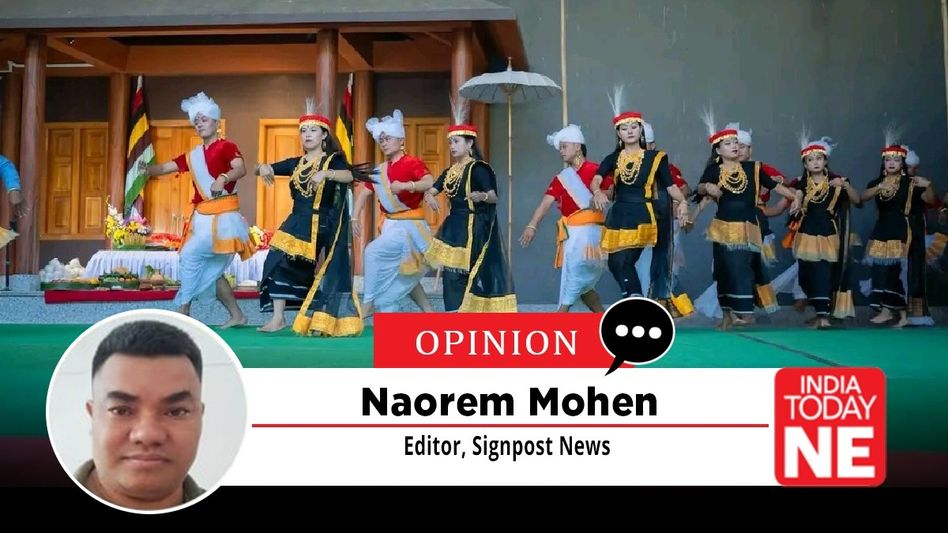
It was out of concern for what children would inherit that Divine Panthou gave his blessing to the opening of a school for them. At Ima Leishem Inaat Loishang, a girl learns to wear a phanek and a boy learns to tie a khudei. A child can handle the cloth, watch how it is arranged and practise until those hands can manage it on their own. From there, a teacher can introduce the customs that govern ceremonial dress. Children who will one day help their own families prepare for a wedding have a place to ask even the simplest questions now.
Divine Panthou also turned to the phunga, the family hearth, where a child may have bowed beside an elder many times before learning whom the family honours. He spoke of the ancestors of the sagei, the family lineage, and of the deities honoured in the home and its grounds. He named Wangbrel and Ireima when speaking of water, and referred to Mangang, Luwang and Khuman in explaining the times associated with household duties and worship. An elder who takes a moment at the hearth to tell a child whom the family remembers gives that familiar bow a meaning the child can carry into the next observance.
The anniversary was also a personal occasion for Divine Panthou. He recalled the ordinary human life he had lived and spoke of a Sunday, the first day of the Meitei month of Langban, when he experienced what he described as his divine manifestation through the voice of Tangja Lillai Pakhangba. From that day, he said, people came to know him as Wangkhei Pari and Wangkhei Panthou. He remembered offering prayers to Houleima Ima before founding the Ima Leishem Cultural Institute on November 7. The institute obtained government registration the following year.
Over the years, children at the Loishang have studied Meitei dance, song and the pena alongside religion. Two of Divine Panthou’s compositions featured in the anniversary programme, Chingngu Sayol Wangkhei Pari and the dance drama Eigi Tengtha Kanana Tabigani Taibangpalsida. The gathering also heard about Pari Inaat Silon Sindamsang, the cultural degree college that opened in August. It offers young people a way to continue into higher education with subjects they may first have encountered at home.
For Meitei families, the invitation in Divine Panthou’s message may come as quietly as a child sitting beside a mother while she gets ready for a wedding. There is time, as she unfolds the cloth, to say what it is called, who taught her to wear it and why she has chosen it today.
If we have forgotten some part of the custom, we can take the child along and ask someone who remembers. Years from now, when that child is helping a younger member of the family get dressed, both the knowledge and the memory of the person who shared it will have a place in that home.