
When Streets Fail, Tables Must Speak for Lasting Peace in Manipur
The question before us is whether we are wise enough to shift the theatre of struggle from the streets to the table—transforming agitation into negotiation—so that ordinary people are spared further hardship and peace can be restored, reconnecting both Kuki and Meitei communities.

- Dec 20, 2025,
- Updated Dec 20, 2025, 5:12 PM IST

For 31 months, street protests and agitations in Manipur’s conflicts have yielded little beyond suffering and stalemate. The question before us is whether we are wise enough to shift the theatre of struggle from the streets to the table—transforming agitation into negotiation—so that ordinary people are spared further hardship and peace can be restored, reconnecting both Kuki and Meitei communities.
Today, the fate of Manipur—our sacred land, now fragmented by claims and counter-claims—hangs in balance. Meiteis feel a profound helplessness: ancestral territories encroached, reserved forests cleared, and future generations at risk of marginalization due to past governmental missteps and ongoing illegal influxes.
The coordinated attacks on Meitei civilians in Churachandpur, Torbung, and Phougakchao Ikhai on evening of May 3, 2023, marked the eruption of a full‑blown ethnic war. Drones and locally made missiles were deployed against Meitei villages, leaving indelible scars on Manipur’s society. Innocent families were uprooted, and communities became starkly segregated along ethnic lines between the Imphal Valley and the surrounding hills.
By December 2025, the toll had risen to more than 300 lives lost and over 70,000 people internally displaced. The wounds remain raw, and fresh violence, almost after a year—such as the heavy gunfire and bombing on the night of December 16, 2025, in Torbung Sabal Maning Leikai and Phougakchao Ikhai in Bishnupur district, bordering Churachandpur—stands as a grim reminder that peace continues to elude us.
Though no casualties were reported in this assault, but it spread widespread panic among residents, many of whom had only recently resettled after prolonged stays in relief camps, highlighting the fragility of ongoing rehabilitation efforts.
In this prolonged crisis, one undeniable truth stands out: the central security forces—comprising the Assam Rifles, Border Security Force (BSF), Central Reserve Police Force (CRPF), other paramilitary units, and not least the state police—have played an important role in containing the worst excesses of violence. Deployed in massive numbers within days of the outbreak, they evacuated thousands from red zones and provided immediate relief to communities under siege.
Confidence-building measures are already being attempted on the ground. On December 19, the 19th Garhwal Rifles reached out to the people of Torbung in the aftermath of the recent attack by armed Kuki militants. Their initiative—engaging with and sensitizing the local population about steps being taken—helped ease fear, reduce mistrust, and calm prevailing tensions.
Such outreach demonstrates how the Army can play a constructive role in bridging divides. At the same time, it is essential to firmly identify and arrest the perpetrators who are trying to derail the peace process.
Meanwhile, outsiders, including security personnel, may sympathize intellectually but cannot fully grasp this existential anguish. They return to their homes in New Delhi or Pune; we remain here, guardians of a shrinking heritage.
Do we need a different approach to protests and agitations to succeed?
Unequivocally, yes. For the sake of our future generations, we must evolve. Street agitations, while cathartic, have yielded limited results in this crisis. They alienate the very forces we rely on for security and amplify perceptions of chaos.
Instead, imagine channeling that profound energy and nationalism into sophisticated advocacy: forming delegations to meet officers respectfully, hosting inter-community dialogues under neutral facilitation, and building alliances and gratitude initiatives.
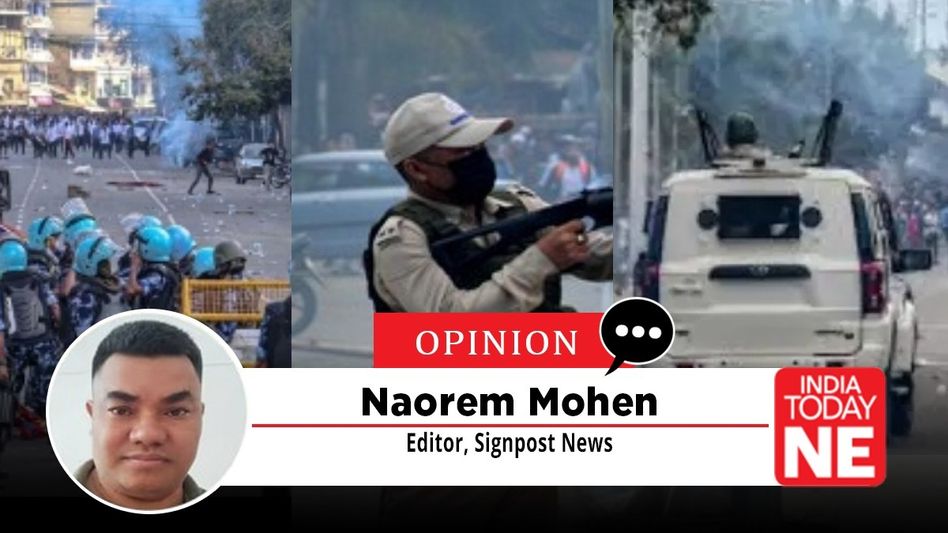
This is not to deny the hard realities. Perceptions of bias have always persisted, with reports highlighting differences in enforcement: in the Imphal Valley, demonstrations often met firmer responses—tear gas, pellets guns, lathi charged and arrests—while in hill districts such as Churachandpur or Kangpokpi, restraint appeared more evident. Often, Civil Society Organisation’s leaders have pointed to these disparities, suggesting that officers, unfamiliar with Manipur’s layered ethnic dynamics, may carry preconceived notions shaped by media narratives or official briefings.
A clear disparity exists in how grievances have been pursued by the two communities. Meitei responses have often manifested through mass street protests: rallies, highway blockades, and bandhs that place them directly in the line of fire. These actions, born of genuine anguish and a fierce sense of collective identity, too often escalate into chaos. The result is predictable—harsh crackdowns by security forces, further alienation, and reinforcement of external narratives portraying Meiteis as agitators rather than stakeholders in peace.
All these years, the Meitei response has often been street-based: passionate rallies, highway blockades, and vocal demands that sometimes escalate into confrontations. This hot-headed mobilization reflects our deep emotional investment in our land and identity, but it has also painted us, in the eyes of external forces, as agitators rather than partners in peace.
In contrast, the Kuki community has excelled in strategic lobbying—organizing prayer meetings in churches, drafting memoranda, and engaging directly with officers and policymakers. They chart plans quietly, build narratives effectively, and approach deployed personnel with structured dialogues.
This difference in style—one mob-driven and confrontational, the other prayerful and diplomatic—has influenced perceptions profoundly. While Meiteis flood the streets, Kukis have sat across tables, fostering relationships that shape on-ground decisions.
This lobbying gap has cost the Meitei community dearly. In the court of public opinion, both national and international, narratives have tilted. Allegations of illegal immigration from Myanmar, poppy plantations ravaging forests, and demographic shifts threatening indigenous rights—issues raised vehemently by Meitei leaders and civil society—often get dismissed or countered effectively through organized advocacy from the other side.
Even Bureaucratic officers and Army Colonel from metropolitan cities or northern India may view Meiteis and Kukis through different lenses—perhaps seeing one community as more “aggressive” or “indiscipline,” the other as more “organized” or “resilient.” Moreover, culture, etiquette, and even courage are interpreted variably by outsiders lacking deep‑rooted understanding of Manipur’s complex socio‑political fabric.
We need not lecture these officers on Manipur’s history—the intricate distinctions among Meiteis, Kukis, and Nagas; the debates over land rights; or the allegations of poppy cultivation and illegal influx devastating reserved forests and protected areas. These issues are well‑documented and endlessly debated. What matters now is how communities choose to engage with those tasked to protect them, and whether mistrust can be transformed into partnership for peace.
Building mutual respect requires deliberate effort. It means acknowledging the sacrifices of security personnel who have stood between civilians and carnage. Some even sacrificed their lives in line of duty, protecting the common people in the 2.7 years old ethnic conflicts. The future engagement must be proactive, not reactive—structured dialogues, memoranda, and respectful representation rather than confrontational blockades. Only then can trust be rebuilt brick by brick.
Therefore, the lesson is clear: agitation alone cannot secure justice. To be heard, grievances must be translated into negotiation, advocacy, and structured dialogue. Communities must learn to combine passion with strategy, ensuring that the cry for survival and identity is not drowned out by the optics of chaos but elevated through the language of policy, evidence, and partnership.
A shining example of this shifted strategy emerged just days after the December 16 incident. On behalf of Imagi Meira, President Thokchom Sujata submitted a formal representation to Governor Ajay Kumar Bhalla demanding the issuance of a White Paper on the attack.
The representation which was submitted on 19 December marks a decisive break from Manipur’s tradition of street agitation. In the wake of the December 16 attack on Torbung Sabal Maning Leikai and Phougakchao Ikhai, the women’s organization chose differently, a dialogue over disruption, urging the Presidential Rule governance to issue a White Paper detailing the incident, the weapons used, the security response, and long‑term safeguards for civilians.
Why such a shift from street to table, from fierce agitations to negotiations stem from past incidents. During the Shirui Lily Festival in May 2025, security forces at Gwaltabi checkpoint allegedly forced a Manipur State Transport bus carrying journalists to conceal “Manipur,” sparking outrage, boycotts, and protests—yet deepening divisions without resolution. Similarly, the Manipur Sangai Festival in November 2025 was marred by boycotts and clashes, with IDPs and groups like COCOMI chanting “Home first, festival later.” Lathi charges and tear gas followed, the event limped on, but the administration remained unmoved, leaving common people burdened and hopes displaced.
Against this backdrop, Thokchom Sujata urges a decisive shift “from street to table”: structured dialogues, memoranda, and respectful engagements that build alliances rather than chaos. Her post-attack representation to Governor Ajay Kumar Bhalla—demanding a White Paper on the Torbung incident—exemplifies this new approach, seeking transparency and solution from the administrations.
Earlier also, she was advocating for a more effective and widely acceptable path for people’s movements—one that seeks holistic solutions without endangering the vulnerable or derailing peace. She is unsparing in her critique of the endless bandhs and blockades, called “a hundred times” with negligible outcomes, which have inflicted disproportionate suffering on ordinary citizens. Abrupt road closures and market shutdowns harass commuters, vendors, and daily laborers, while simultaneously draining the state’s fragile economy.
For Sujata, such tactics not only fail to move higher authorities but also erode public trust, highlighting the urgent need to replace disruptive agitation with constructive engagement.
“These actions torture ordinary citizens and IDPs clinging to one word—peace,” she argues, noting they rarely influence higher authorities. The futility of such tactics is evident.
Such initiatives build trust with authorities and security forces, dispel speculation, and reaffirm constitutional values of transparency and public accountability.
By bypassing chaotic street actions and instead leveraging formal channels, Imagi Meira positioned the Meitei community as a partner in constructive dialogue for peace and reconciliation. More importantly, they demonstrate that agitation can evolve into negotiation—transforming protest from a source of instability into a force for reconciliation.
Manipur demands maturity: Streets to tables, mobs to dialogues, suspicion to solidarity with protectors. This isn't surrender—it's wisdom. For children, elders, shared destiny—we must change.
MORE NEWS












Copyright©2025 Living Media India Limited. For reprint rights: Syndications Today
