When the State Gives Its Word, Peace Depends on Keeping It
Governor Ajay Kumar Bhalla’s appeal of February 20, 2025, marked a significant administrative and moral moment in Manipur’s search for peace. He called upon members of all communities, particularly youths in the Valley and Hills, to surrender looted police weapons and illegally held arms within seven days.

- Jun 22, 2026,
- Updated Jun 22, 2026, 12:06 PM IST

Governor Ajay Kumar Bhalla’s appeal of February 20, 2025, marked a significant administrative and moral moment in Manipur’s search for peace. He called upon members of all communities, particularly youths in the Valley and Hills, to surrender looted police weapons and illegally held arms within seven days.
More importantly, he gave a clear assurance that no punitive action would be initiated if such weapons were returned within the stipulated time. After the deadline, he said, strict action would follow for possession of such weapons.
That assurance was not an ordinary administrative sentence. In a conflict-torn society, it was a pledge by the state. It created the basis for trust. It allowed those holding arms to step back without fear. It gave community leaders a reason to persuade young people to cooperate. It also gave the government a rare opportunity to convert fear into compliance and compliance into the beginning of peace.
The issue has now acquired fresh urgency following the arrest of several Arambai Tenggol members during the past few days. On Sunday, Imagi Meira President Thokchom Sujata issued a five-day ultimatum, demanding their release.
Speaking at a protest site in Kwakeithel, Sujata argued that many of the youths had taken up arms only after the outbreak of violence on May 3, 2023, when communities felt compelled to defend themselves amid a breakdown of public order.
She maintained that these youths later responded to the Governor’s appeal and surrendered weapons in good faith, believing the assurance that no punitive action would follow. Imagi Meira has now warned that if the authorities are serious about restoring peace, they must honour the spirit of that assurance and release those recently arrested.
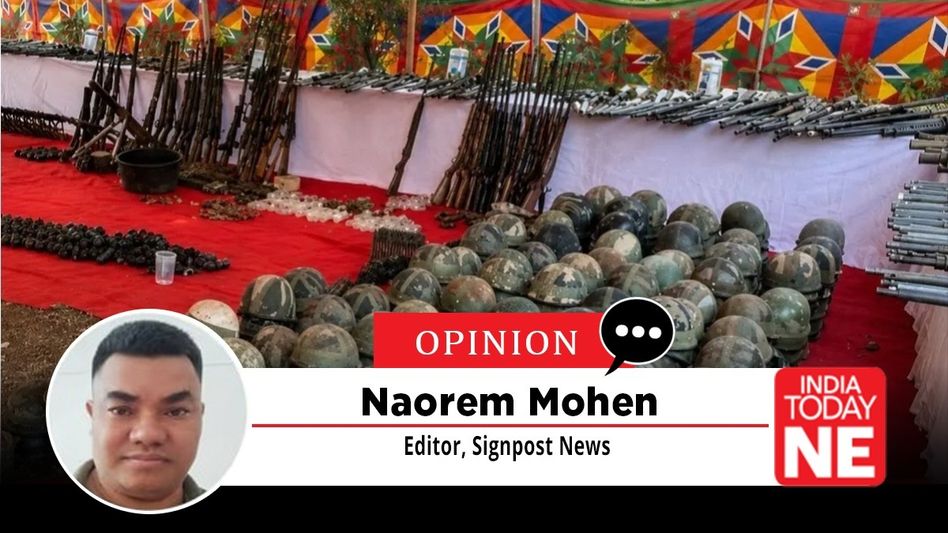
This is why the surrender of weapons by Arambai Tenggol leaders, along with civilians, must be viewed in its proper context. A day after placing certain terms and conditions before the Governor, top leaders of the Meitei group, along with civilians, surrendered more than 300 weapons at the Banquet Hall of the 1st Manipur Rifles in Imphal.
For a state where weapons had entered civilian spaces after the collapse of public order, this was not a minor event. It was a public act of compliance with the Governor’s appeal. It also carried political meaning.
The act suggested that even in a highly polarised situation, armed community actors could respond to the authority of the state when the state spoke with clarity and offered a credible assurance. It demonstrated that persuasion was still possible, that discipline had not entirely disappeared, and that a route back to constitutional order could still be opened if the state acted with seriousness.
The statement of Puyam Tomcha Meitei, President of the All Manipur Bar Association, reflected this sentiment when he described the surrender as a historic day and a positive initiative. His emphasis was not only on the quantity of arms returned, but on the fact that Arambai Tenggol had come out openly and responded to the Governor’s call. In a society where distrust has become a daily habit, such public response matters.
The problem begins when this assurance appears uncertain in practice. The state gave its word. Citizens responded. That sequence must not be allowed to collapse.
If those who surrendered weapons within the Governor’s time frame, or those who helped persuade others to surrender, are later subjected to punitive action without a clear distinction between separate criminal allegations and the act of surrender itself, the credibility of the entire peace process will suffer.
The question is not whether the law should operate. It must. The question is whether the state can invite surrender under an assurance of no punitive action and later create the impression that cooperation has become a source of vulnerability.
Peace cannot be built on ambiguity. The Governor’s words were precise. Weapons returned within the stipulated period would not invite punitive action. Strict action would follow only after the deadline against those still found in possession of illegal or looted arms. This distinction must be preserved if future appeals for surrender, dialogue, and cooperation are to retain any meaning.
Any departure from this understanding will send a damaging message to the ground. It will tell young people that surrendering arms may expose them, while withholding cooperation may protect them. Such a message would be disastrous for Manipur. No state can restore order if those who cooperate begin to believe that the state’s word is temporary.
This does not mean blanket immunity for all acts committed during the conflict. Serious crimes require investigation. Victims from every community deserve justice.
The distinction is crucial. A person who returned a weapon within the announced period did so under the Governor’s assurance. If that person is later proceeded against merely for that possession prior to surrender, the assurance becomes meaningless. If there is credible evidence of a separate grave offence, the government must state the legal basis clearly and proceed through due process. The difference between these two situations must never be blurred.
Manipur’s current crisis has already damaged public confidence in institutions. Since May 2023, communities have lived under insecurity, displacement, segregation, and mutual suspicion. Young people from different sides entered roles that should have belonged to the state because the normal machinery of protection failed to reassure citizens. This was not a healthy condition. It was a sign of institutional breakdown.
When the Governor offered a route for voluntary surrender, the state was attempting to reverse that breakdown. It was asking armed youths to return to constitutional order. Such a process cannot be managed only through threat. It requires trust, sequencing, and visible fairness.
The appeal made by Arambai Tenggol speaks from this anxiety. It argues that the youths of Manipur did not choose conflict, but were pushed into extraordinary conditions when law and order collapsed, homes were attacked, and families had to defend themselves.
That argument will be contested by others, especially by communities that suffered violence and hold Arambai Tenggol responsible for fear and insecurity. Those grievances cannot be dismissed. But the larger point remains valid for the peace process: disarmament cannot succeed if those who surrender feel unprotected by the assurance that brought them forward.
Equally disturbing is the growing perception of selective enforcement. More than a thousand people from the Meitei community have reportedly been arrested or prosecuted under various provisions of law, while only a much smaller number, roughly around one hundred, from the Kuki community have faced similar action.
Several armed groups and volunteers operating in other areas are also widely perceived to have escaped comparable scrutiny. The continued free movement of groups such as the Village Volunteer Eastern Zone reportedly with arms has strengthened this sense of imbalance.
If left unaddressed, such perception will deepen mistrust and widen the divide between communities at a time when the state should be narrowing it.
The government must address this not through rhetoric, but through transparency. It should publish periodic figures on surrendered weapons, recovered arms, arrests, prosecutions, and operations across all districts and communities, within the limits of security requirements. Facts are the best answer to suspicion. Silence allows each community to create its own version of truth.
The Governor’s assurance must therefore become the foundation of a more structured peace process. Those who surrendered weapons within the notified period should receive written or publicly verifiable protection from punitive action related to that surrender. Those facing separate criminal allegations should be informed of the specific charges and given due process.
Those willing to return to normal life should be guided into rehabilitation, education, livelihood, and counselling programmes.
This is not softness. It is statecraft.
A punitive approach alone will not solve Manipur’s armed crisis. The youths who entered conflict conditions must be given a path back to ordinary citizenship. Many have lost education, employment, and family stability. Some may have acted out of fear.
Some may have been pulled by community pressure. Some may have crossed legal lines. A mature state must distinguish between categories instead of treating all young people as permanent offenders.
Reintegration is essential. Without it, surrendered youths may become alienated.
Alienated youths become vulnerable to renewed mobilisation. Manipur cannot afford another cycle in which fear produces arms, arms produce confrontation, and confrontation produces more distrust.
At the same time, community organisations must also act with discipline. Responding to the Governor’s appeal was a constructive step. That step must be followed by a firm commitment to remain within constitutional and lawful boundaries. No organisation can claim to support peace while preserving parallel authority. The surrender of weapons must lead to the surrender of coercive power as well.
The Central Government and the State administration now face a delicate responsibility. They must enforce the law without breaking trust. They must pursue justice without punishing cooperation. They must reassure victims without discouraging surrender. They must act firmly against illegal arms while protecting the credibility of the assurance given for timely surrender.
Manipur’s peace process cannot be symbolic. It must be credible on the ground. If the Governor’s assurance is honoured in letter and spirit, more people may come forward. If it appears uncertain, future appeals will carry little weight. Trust once broken is difficult to rebuild.
The way forward is clear. The State government must publicly reaffirm that no punitive action will be taken against those who surrendered weapons within the stipulated time frame, in accordance with the Governor’s assurance.
It must clarify that this protection applies to the act of possession and surrender covered by the appeal, not to separate grave offences established through evidence. It must ensure equal enforcement against illegal arms across the Valley and Hills. It must create a youth rehabilitation framework. It must communicate regularly and transparently.
The state gave its word. Citizens responded. That sequence must not be allowed to collapse.
In Manipur, peace will not return merely because arms are deposited. Peace will return when people believe that surrender is safer than defiance, law is fairer than revenge, and the state’s assurance is stronger than fear.
Governor Ajay Kumar Bhalla’s pledge created such an opening. It must now be protected with seriousness, consistency, and institutional honesty.