When the Tricolour Enters the Manipur University Campus, Patriotism Must Become Public Duty
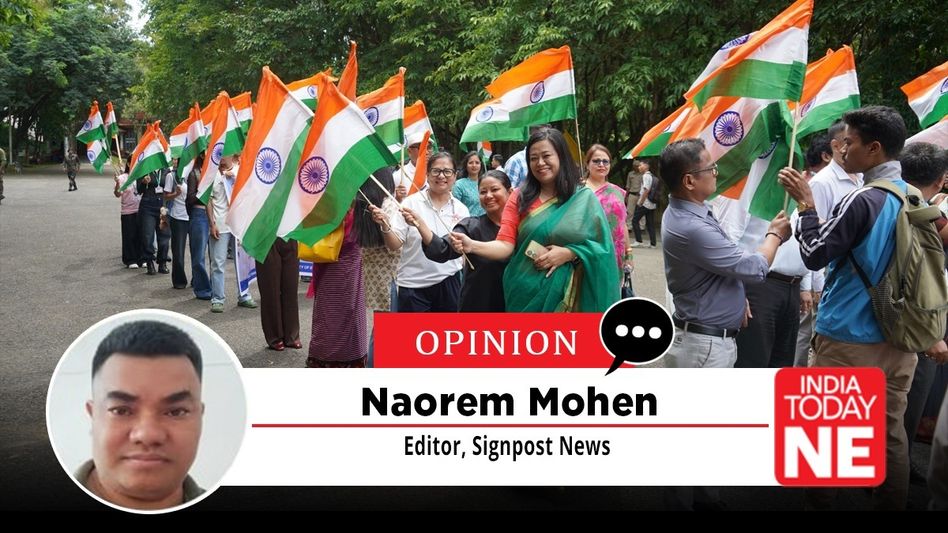
There are moments when a university campus briefly steps out of its routine academic rhythm and becomes a larger civic space. On August 12, 2026, Manipur University witnessed one such moment when the Har Ghar Tiranga Yatra and the Pipe Band performance of the 33 Assam Rifles brought together the University community and personnel of the Assam Rifles at the Biodiversity Park near Centenary Hall.

- Aug 13, 2026,
- Updated Aug 13, 2026, 11:16 AM IST

There are moments when a university campus briefly steps out of its routine academic rhythm and becomes a larger civic space. On August 12, 2026, Manipur University witnessed one such moment when the Har Ghar Tiranga Yatra and the Pipe Band performance of the 33 Assam Rifles brought together the University community and personnel of the Assam Rifles at the Biodiversity Park near Centenary Hall.
At one level, it was a ceremonial programme. The Tricolour was carried from the Administrative Block to the Biodiversity Park. Patriotic compositions were performed. University officers, teachers, staff, NSS volunteers and members of the Assam Rifles came together in a shared expression of national pride. The programme concluded with Vande Mataram and the National Anthem.
But to dismiss the event as only a ceremonial observance would be to miss its larger meaning.
In a state like Manipur, where questions of identity, belonging, security and public trust have often carried deep emotional weight, such occasions must be understood with greater seriousness. A patriotic programme on a university campus is not merely about flags, songs and applause. It is also about what kind of citizenship we are preparing among young people, what kind of public responsibility institutions are cultivating, and what meaning we attach to the nation beyond slogans.
The presence of Prof. R.K. Hemakumar Singh, Vice-Chancellor in-charge of Manipur University; Prof. M. Premjit Singh, Registrar; Colonel Radha Krishna, Commandant of 33 Assam Rifles; Prof. Ch. Ibohal Singh, Dean of Students’ Welfare; and Prof. Laishram Santosh Singh, Programme Coordinator of the NSS Cell, gave the programme an institutional character. Other University officers and faculty members, including Y. Santikumar Singh, Dr. Sakila Nongmeikapam, Dr. Lamabam Pinky and Kshetrimayum Birla Singh, also joined the event along with NSS volunteers and members of the University community.
This mattered because patriotism becomes more meaningful when it is carried by institutions, not merely by individuals. A university is not only a place where degrees are awarded. It is a space where the mind of a generation is shaped. When a campus participates in a national programme, it is also making a statement about civic education, public memory and shared responsibility.
The 33 Assam Rifles Pipe Band presented compositions that carried messages of courage, sacrifice, unity and devotion to the motherland. Kadam Kadam Badhaye Ja reminded the audience of determination and the forward movement of soldiers who serve under difficult conditions. Jai Janmabhoomi gave emotional expression to the idea that the motherland is not simply a map. It is memory, culture, history, soil, language and sacrifice held together by generations.
Vijay Bharat honoured the valour of the armed forces. Ae Watan Ae Watan, slow-march compositions and military tunes reflected discipline, coordination and the solemn tradition of men and women in uniform. Desho Ka Sartaj Bharat celebrated India’s civilisational richness and cultural diversity. The Drum Roll gave the programme a stirring military character. Sare Jahan Se Achha Hindustan Hamara reminded everyone that India’s strength has always rested not on sameness, but on the capacity of different languages, cultures and regions to imagine themselves within a common national home.
This is where the deeper message lies. India is not held together by force alone. It is held together by institutions, constitutional values, emotional bonds, shared sacrifices and a continuous effort to recognise one another across differences. A song like Sare Jahan Se Achha carries its power precisely because it speaks to the dignity of a country where plurality is not a weakness. It is one of the foundations of national life.
For Manipur, this lesson is urgent. The state has known too much suffering from mistrust, social division and violence. Communities have suffered. Families have been displaced. Young people have grown up seeing fear where they should have seen confidence. Public spaces have too often become arenas of suspicion. In such a time, programmes that speak of unity and responsible citizenship must not remain shallow exercises. They must become opportunities for honest reflection.
Patriotism in Manipur cannot mean shouting slogans while ignoring the pain of fellow citizens. It cannot mean waving the Tricolour while remaining indifferent to injustice, corruption, public disorder or social hatred. It cannot mean reducing love for the country to a one-day performance. The Tricolour demands more from us.
It demands discipline in public life. It demands respect for law. It demands responsibility from institutions. It demands that citizens refuse to turn rumours into weapons.
It demands that young people learn to serve society before they seek power over it. It also demands that love for the motherland be reflected in conduct, action and thought.
This was rightly conveyed through the messages accompanying the performances. Patriotism must not be confined to slogans or ceremonial occasions. Love for the country must be visible in daily conduct, in respect for public property, in honesty in administration, in sincerity in study and work, and in one’s contribution to society. The armed forces defend the borders, but the moral defence of the nation also rests with citizens.
A student who studies with discipline is serving the country. A teacher who teaches with integrity is serving the country. A public official who refuses corruption is serving the country. A journalist who stands by truth is serving the country.
A citizen who protects harmony and rejects hatred is serving the country. A university that nurtures reason, civic duty and public responsibility is serving the country.
This is the broader meaning that Manipur University must draw from the Har Ghar Tiranga Yatra and the Pipe Band performance. The presence of NSS volunteers was particularly important. The National Service Scheme has always carried the idea that education must be connected with service. It teaches young people that citizenship is not passive. One does not merely inherit a nation. One participates in building it.
In a region like the North East, where the idea of India has passed through complex histories, cultural negotiations and political anxieties, patriotic education must be handled with sensitivity and depth. It should never become a mechanical display imposed from above. It must speak to local memory, dignity and participation. When young people in Manipur carry the Tricolour, they must feel that their own history, language, culture and aspirations are also respected within the Indian Union.
That is the beauty of a meaningful patriotic programme. It does not erase local identity. It connects it to a wider national belonging.
Manipur’s contribution to India is not minor. Its athletes have brought glory to the country, recent ones being the medals in Commonwealth Games. It's artists, scholars, soldiers, scientists and public servants have strengthened national life. Its cultural traditions have enriched India’s civilisational diversity. Its strategic location makes it central to India’s eastern vision. Its people have endured hardships that many parts of the country do not fully understand. Therefore, when Manipur celebrates the Tricolour, it must not do so as a distant observer of national life. It does so as a contributor to the national story.
The participation of the 33 Assam Rifles also carries a particular significance. The relationship between security forces and local communities in conflict-affected regions is often complex. It cannot be reduced to ceremony. Trust is built through conduct, restraint, discipline, communication and respect. Public programmes involving security forces and educational institutions can help create spaces of engagement, especially among students, but such engagement must always remain rooted in mutual dignity.
Respect for soldiers is not blind militarism. It is recognition of sacrifice. A democratic society must honour those who protect its security, while also upholding constitutional values, civil liberties and accountability. The two are not contradictory. In fact, they strengthen each other. Armed forces draw their moral legitimacy from the Constitution. Citizens draw their security from the courage of those who serve under the national flag. When both meet in a public space, the message must be one of trust, responsibility and shared duty.
The compositions performed by the Pipe Band carried this emotional grammar. Kadam Kadam Badhaye Ja spoke of movement and resolve. Jai Janmabhoomi spoke of attachment to the motherland. Vijay Bharat spoke of sacrifice. Ae Watan Ae Watan spoke of devotion. Desho Ka Sartaj Bharat spoke of pride in India’s richness. Sare Jahan Se Achha spoke of unity across diversity. Vande Mataram and the National Anthem gave the conclusion a solemn and collective character.
Such music has a way of entering public memory. A speech may be forgotten. A slogan may fade. But music, when performed with sincerity, can touch something deeper. It reminds people that the nation is not only an administrative arrangement. It is also a shared emotional inheritance.
Still, emotion alone is not enough. India does not need citizens who only become patriotic during public ceremonies. It needs citizens who remain patriotic when no camera is present. It needs students who understand that the future of the country depends on knowledge, discipline and character. It needs institutions that understand that national pride without institutional integrity becomes hollow. It needs public life where respect for the Tricolour is matched by respect for truth, justice and human dignity.
This is why Manipur University has a special role. As one of the most important educational institutions in the region, it must produce not only graduates, but responsible citizens. The classroom must teach reason. The campus must teach coexistence. Public programmes must teach civic duty. The University must remain a place where young minds learn that patriotism and critical thinking can coexist. Love for the country does not require silence before wrongdoing. It requires courage to improve the country.
A mature patriot is not one who only praises the nation. A mature patriot is one who serves it honestly, corrects it when necessary, defends its unity, protects its diversity and refuses to weaken it through hatred or irresponsibility.
That is the message which should remain after the flags are folded and the band instruments are put away.
The Har Ghar Tiranga Yatra and Pipe Band performance by 33 Assam Rifles at Manipur University should therefore be remembered not merely as an event held on August 12, 2026. It should be remembered as a reminder that national integration begins in everyday spaces: in campuses, classrooms, offices, neighbourhoods and public institutions. It begins when citizens choose discipline over disorder, service over indifference, unity over suspicion and responsibility over empty noise.
The Tricolour is not a decoration. It is a demand. It asks every citizen to rise above narrow selfishness. It asks institutions to act with dignity. It asks young people to build character. It asks society to remember the sacrifices of soldiers, farmers, workers, teachers, scientists, artists and ordinary citizens who have kept the country alive through their labour and faith.
On 12 August, at the Biodiversity Park of Manipur University, the sound of the Pipe Band and the movement of the Tricolour created a moment of collective pride. The real test begins after such moments end.
If the spirit of the programme encourages even a section of young people to think more deeply about citizenship, discipline, unity and service, it will have served a purpose far greater than ceremony. If it reminds institutions that patriotism must be matched by public responsibility, it will have meaning. If it helps citizens see the nation not as an abstract slogan but as a shared duty, it will have done justice to the Tricolour.
India does not become stronger through slogans alone. It becomes stronger when citizens act with integrity, when institutions function with responsibility, when communities respect one another, and when young people understand that the motherland is served not only at the border but also in the classroom, the street, the office, the village and the heart.
That is the patriotism Manipur needs. That is the patriotism India deserves.