While Seminars Discuss Good Governance and Road Safety, Villagers Repair Neglected Roads in Manipur
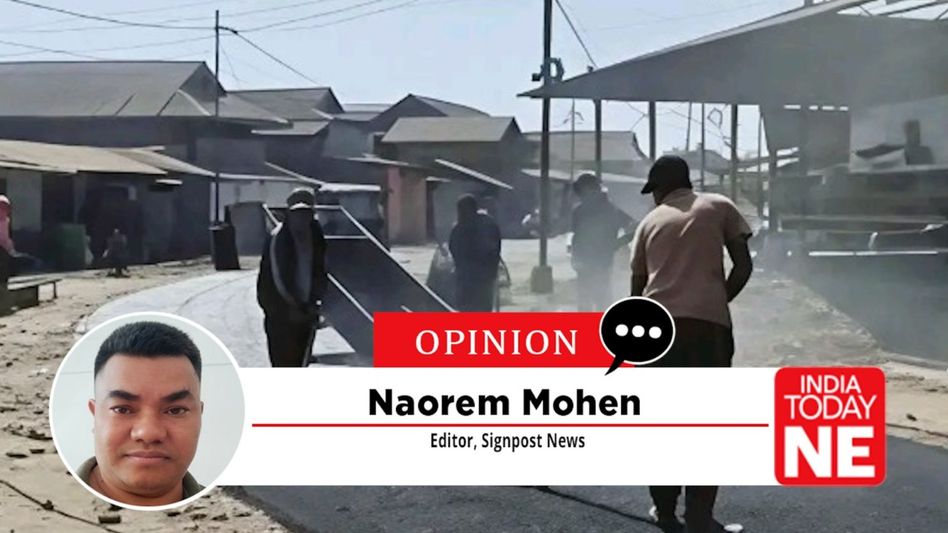
While authorities allocate funds for workshops and events on “good governance” and “road safety awareness,” the Leimapokpam villagers—over 2,000 households—have quietly taken the most practical step possible. They have shown what accountable, responsive leadership looks like—not through speeches, but through action. They leveled potholes, started blacktopping the neglected roads to define their future.

- Jan 14, 2026,
- Updated Jan 14, 2026, 3:38 PM IST

While authorities allocate funds for workshops and events on “good governance” and “road safety awareness,” the Leimapokpam villagers—over 2,000 households—have quietly taken the most practical step possible. They have shown what accountable, responsive leadership looks like—not through speeches, but through action. They leveled potholes, started blacktopping the neglected roads to define their future.
In the rural villages of Leimapokpam under Nambol AC in Bishnupur district, where the lingering effects of Manipur's prolonged ethnic violence have already inflicted severe economic hardship—disrupting livelihoods, inflating costs, and choking everyday commerce—the decision by over 2000 households to contribute Rs 1000 each toward repairing their lifeline road stands as an extraordinary act of courage and solidarity.
This is no small sum in the best of times, but amid the state's ongoing turmoil—marked by restricted movement of Meitei, intermittent clashes, displacement, and a crippled local economy that has left many struggling to meet basic needs—it requires nothing short of a lion's heart.
Yet these villagers, facing the harsh realities of reduced income, disrupted agriculture, halted trade, and the constant strain of insecurity, have risen to the challenge without hesitation.
Adding even greater depth to this collective effort, more than 600 government employees and other generous individuals from the community stepped forward with substantially higher contributions—ranging from Rs 2000 to as much as Rs 20,000 each.
Their willingness to give beyond the baseline, despite personal financial pressures in this difficult period, highlights a profound sense of shared responsibility and hope for better days.
This crowdfunding initiative is more than just a practical response to administrative neglect; it is a powerful symbol of resilience. In a society where violence has shattered normal life and eroded economic stability for years, these contributions reflect unbreakable community spirit—ordinary people pooling limited resources to reclaim safety, connectivity, and dignity for themselves and their neighbors.
Faced with years of administrative neglect on essential infrastructure, these communities have refused to remain passive. Instead, they have taken bold, collective steps to repair their own lifeline roads—proving that when governments prioritize symbolic initiatives over life-saving basics, citizens can rise to protect their safety, livelihoods, and dignity.
The Malom-Chingphu Road serves as a critical artery for Leimapokpam, Khunpham, Ishok, Wahengkhuman, and several surrounding villages in Bishnupur district. This approximately 4-km stretch, especially the portion between Wahengkhuman Keithel and Leimapokpam Primary Health Centre (PHC), had deteriorated into a hazardous mess, with deep potholes that endanger vehicles and riders, jagged protruding stones causing frequent punctures and breakdowns, impassable mud during the monsoon season, and thick clouds of dust in dry months that pose serious health risks through respiratory irritation and reduced visibility.
The consequences were far-reaching and painful. Commuters, often farmers carrying produce, students traveling to schools, patients heading to the local PHC or distant hospitals—faced daily perils of accidents, injuries, and vehicle damage.
Local commerce suffered. One vivid illustration was the near-impossibility of transporting fragile goods like eggs over the bumpy terrain, leading many shops in Leimapokpam to stop stocking them entirely—a small but symbolic blow to everyday nutrition and income.
For months turning into years, villagers pursued every formal avenue with remarkable patience and persistence. They submitted repeated representations to local authorities and relevant departments, detailing the dangers, economic losses, and urgent need for repairs.
The road had even been included under the central Pradhan Mantri Gram Sadak Yojana (PMGSY), a national scheme designed to provide all-weather rural connectivity—yet tenders were cancelled multiple times without resumption or clear explanation.
Appeals flowed season after season, from rainy quagmires to dusty hazards, but competent authorities remained unresponsive. Some community members speculated about underlying political factors, including possible "vendetta" against the area after a local candidate challenged the sitting MLA in past elections, though the result was undeniable.
Prolonged neglect despite citizens' tax contributions.This inaction stood in stark contrast to government spending patterns. Resources flowed readily toward festivals, cultural programs, and seminars—often focused on themes like "good governance" or "road safety awareness"—yet the most direct and effective road safety intervention—actually repairing accident-prone rural roads—remained chronically underfunded.
The irony was palpable. Awareness campaigns without safe roads offered little protection against real hazards.Frustration eventually gave way to decisive action.The local club in the village, united under the United Development Committee (UDC) and supported by diverse local groups—including clubs, youth organizations, and women's associations like Meira Paibi Lup—the villagers shifted from requests to self-reliance. Supporr was also extended from important figures like former Minister N Loken, who was the MLA of this Assembly Constituency.
Road leveling to fill potholes commenced as early as December 9 of the previous year, followed by blacktopping efforts coordinated by UDC secretary Asem Nawang, who stressed that the work was "long overdue" and that the community could wait no longer. Progress aimed for completion within month, steadily transforming a dangerous path into a safer thoroughfare.
Last year, on December 8, 2025, during a large public meeting at Leimapokpam Keithel—attended by representatives from Leimapokpam and Khunpham clubs, organizations, Meira Paibi members, and residents—they issued a firm five-day ultimatum to the government: repair the remaining dilapidated Ishok-Malom stretch, particularly Wahengkhuman Keithel to Leimapokpam PHC, or villagers would undertake the repairs themselves.
Leaders even warned of extreme sacrifices if needed—families surviving on just one meal a day to pool funds. Maibam Sharda of Meira Paibi spoke of years of unfulfilled hopes despite endless appeals, while UDC president Oinam Ibotomba questioned whether the locality was truly part of Nambol AC or Manipur, given the glaring absence of basic attention to a road serving as a lifeline for multiple villages.
The ultimatum was no idle threat. Rather, it was built on their proven ability to mobilize and act.This journey—from patient petitions ignored over months, to a bold ultimatum unmet, to proactive community-led repairs—exemplifies profound civic maturity. When administration fails to deliver core services despite resource claims and tax collections, citizens need not accept victimhood.
The people of Leimapokpam have shown that responsibility is reciprocal. Government must serve, but communities can—and should—step forward with unity, transparency, and non-violent resolve.
Their efforts carry inspiring lessons for Manipur and beyond. Grassroots unity, inclusive participation, and self-help can drive tangible development where bureaucracy stalls. It exposes systemic issues—misplaced priorities, delays, possible biases—while offering a replicable model.
Whether authorities now respond constructively or not, the community has already achieved a moral and practical victory by refusing neglect, embracing agency, and paving their own path forward—one determined contribution at a time.
Their story reminds us that true road safety—and genuine good governance—often begins not in seminars or distant offices, but in the hands of empowered citizens who refuse to wait. Salute to the resilient people of Leimapokpam, the architects of their own progress and beacons of community strength.
However, the story of the Leimapokpam villagers—who have pooled their hard-earned money to repair the dilapidated 4-km inter-village road stretch—raises several uncomfortable yet vital questions about accountability, transparency, and the true state of governance in Manipur.
Amid repeated cancellations of tenders under schemes like the Pradhan Mantri Gram Sadak Yojana (PMGSY), where funds were supposedly allocated for such rural connectivity projects, one wonders, will the authorities ever refund or reimburse the amounts these poor villagers have contributed out of sheer necessity?
Or has the money meant for this essential infrastructure already been siphoned off through opaque processes, inflated estimates, or questionable contractor dealings—as has been alleged in various rural road projects across the state?
Broader concerns loom even larger. Thousands of crores of rupees are sanctioned annually under central and state schemes for rural roads in Manipur, yet countless stretches remain in deplorable condition, forcing communities into self-help mode.
Despite high allocations—evidenced by ongoing PMGSY phases and other funding streams—implementation falters due to delays, procedural hurdles, contractor disputes, and systemic inefficiencies. This pattern of sanctioned funds not translating into on-ground repairs fuels legitimate skepticism about where the money actually goes.
A fundamental question arises. Do citizens still need to pay taxes if they are compelled to repair public roads themselves?
Taxes are collected with the implicit promise of basic services like safe, all-weather connectivity—services that directly impact safety, livelihoods, health, and economic activity. When villagers must crowdfund, issue ultimatums, and endure personal sacrifices to fill potholes and blacktop paths, it signals a profound failure in administrative delivery.
This is not merely an isolated case but a stark picture of failed administration at multiple levels. The unity and crowdfunding efforts of these economically modest villagers—over 2000 households contributing despite hardships—stand in sharp contrast to the inaction from those entrusted with public funds and responsibility.
Their determination highlights resilience and civic spirit, yet it also exposes a deeper systemic lapse. When grassroots communities must step in to provide what governments are mandated to deliver, trust erodes, and the social contract.
Until then, stories like Leimapokpam's will continue to inspire admiration for the people while serving as a sobering reminder of governance gaps that must be bridged.