Why CM Yumnam Khemchand’s Decision to Hold a Seminar on NRC-Census Deserves Full Support
It is heartening to see Chief Minister Yumnam Khemchand adopting a sincere and thoughtful approach towards the sensitive NRC and Census issue by deciding to organise a seminar that brings together experts, stakeholders, and experienced voices.


- Apr 26, 2026,
- Updated Apr 26, 2026, 2:09 PM IST

It is heartening to see Chief Minister Yumnam Khemchand adopting a sincere and thoughtful approach towards the sensitive NRC and Census issue by deciding to organise a seminar that brings together experts, stakeholders, and experienced voices.
This move reflects his genuine enthusiasm to clear widespread confusions surrounding the relationship between Census, NPR, NRIC, and Foreigners Tribunals, while ensuring that no community feels hurt or alienated in the process.
By choosing dialogue over confrontation, the Chief Minister Khemchand has shown mature leadership, especially when we remember the Assam NRC experience that consumed thousands of crores of rupees over several years yet resulted in the exclusion of numerous genuine indigenous citizens due to documentation gaps and procedural complexities.
After all, the NRC exercise is not meant for any individual or sectional benefit, but for the long-term security, demographic integrity, and collective welfare of every citizen of Manipur. Unity and informed consensus on this vital issue will serve the state far better than hasty decisions or prolonged standoffs.
Today, the people of Manipur stand at a critical crossroads. On one hand, there is deep and legitimate concern over the abnormal population growth figures recorded in the 2001 and 2011 Censuses, particularly in certain hill sub-divisions. Many fear that any future delimitation based on such data could distort political representation and further marginalise indigenous voices.
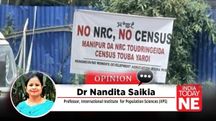
On the other hand, persistent worries about illegal immigrants entering through the Myanmar border — allegedly involved in poppy cultivation, forest encroachment, and activities linked to militancy — have fuelled strong demands for a National Register of Citizens (NRC) or similar mechanism before any fresh headcount.These anxieties are not imaginary. Protests by student bodies and civil society organisations have repeatedly echoed the slogan “No Census without NRC.”
MP Dr. Angomcha Bimol Akoijam and others have highlighted the need to first update the National Register of Indian Citizens (NRIC) under the 2003 amendments to the Citizenship Act, 1955, and strengthen Foreigners Tribunals. Their demand is very clear and everything is to protect our demographic integrity and indigenous rights before conducting the Census 2027, whose house-listing operations in Manipur are scheduled for September 1–30, 2026 (with self-enumeration from August 17–31).
However, after carefully examining the legal framework, Assam’s hard-earned experience, and the practical tools available, a rushed “NRC-first-then-Census” sequence is not the only path — and it may not be the wisest one either.
A rushed “NRC-First-Then-Census” approach may not serve Manipur’s best interests because it risks repeating Assam’s painful lessons, where the 2019 NRC excluded over 19 lakh people after years of effort and massive costs, yet many genuine citizens — including indigenous residents, women, children, and the poor — faced wrongful exclusions due to documentation gaps, name mismatches, and procedural issues, while tribunals remain backlogged and infiltration concerns persist without stronger border controls.
Conflict-hit state with ongoing displacement, such a sequence could lead to even higher errors, family separations, and deepened valley-hill divides, while indefinitely delaying the neutral Census 2027. The new digital Census offers fresh, accurate data to override flawed 2001/2011 figures for future delimitation, whereas a full NRIC is a long, resource-heavy process that does not automatically detect or deport “illegal immigrants” — that requires separate, parallel tools like expanded Foreigners Tribunals under the Immigration and Foreigners Act, 2025, rigorous Special Intensive Revision of electoral rolls, and robust border management.
Prioritising one over the other creates unnecessary circular delays; a balanced path of targeted immigration action now, sensitive phasing of the Census for better accuracy amid displacement, and careful verification later better protects indigenous identity, ensures reliable planning data, and minimises human and social costs for all communities.
We can address both problems more effectively through parallel, targeted actions that minimise human suffering while delivering credible results.
Much of the public discourse suffers from mixing up key concepts, leading to unnecessary fear and polarisation.The Census of India 2027 (governed by the Census Act, 1948) is a neutral administrative exercise. It counts all usual residents — Indian citizens as well as foreigners who have lived in an area for six months or more, or intend to do so. Its primary purpose is planning: schools, hospitals, roads, welfare schemes, and future delimitation. Census data is aggregate and protected by confidentiality provisions. It does not determine citizenship.
The National Population Register (NPR) is often prepared during the Census house-listing phase using the same enumerators for efficiency. It records basic details of all usual residents (citizens and long-term non-citizens). NPR serves as a foundational database under the Citizenship Act, 1955 (Section 14A) and the 2003 Rules.
The National Register of Indian Citizens (NRIC or NRC) is a subset of the NPR. After data collection, local registrars scrutinise citizenship claims with documents. Doubtful cases undergo verification, objections, and appeals. Only verified Indian citizens remain in the final NRIC. Importantly, exclusion from NRIC does not automatically mean the person is an illegal immigrant.
Many exclusions stem from genuine documentation gaps — spelling variations in names, women lacking independent papers linking to parents or husbands, poor rural or tribal families without legacy records, or children caught in parental disputes. This reality was starkly visible in Assam.
Foreigners Tribunals (FTs), empowered under the Immigration and Foreigners Act, 2025 (which modernised and replaced the older Foreigners Act, 1946), are quasi-judicial bodies with civil court-like powers. They can summon witnesses, examine evidence, and declare someone a foreigner after due hearing, with appeals to higher courts.
Crucially, FTs do not depend on completing an NRC. Referrals can come anytime from police, border forces, the Election Commission (via Doubtful Voters), or intelligence inputs. They provide the actual mechanism for identifying and deporting proven foreigners.
Special Intensive Revision (SIR) of electoral rolls is another ongoing tool that cleans voter lists and complements these efforts.
In simple terms for common citizens:
(a) Census counts who lives here for development and fair future delimitation.
(b) NPR builds a resident list.
(c) NRIC filters for verified citizens (a long, document-heavy process).
(d) FTs decide who is a proven foreigner (operable independently and right now).
The Census Act, 1948 explicitly allows the Centre to conduct the exercise “in the whole or any part” of India and to phase it according to local conditions. Manipur’s later schedule already reflects this flexibility.
Avoiding delimitation based on flawed old data
The unusually high decadal growth rates in some 2001 and 2011 hill sub-divisions raised serious questions. These figures led to repeated deferments of delimitation to maintain social balance. However, the upcoming Census 2027 — digital-first with self-enumeration and improved technology — offers a fresh, more accurate base. Future delimitation will rely on this new data, not the old ones.
Administrative boundaries have been frozen from January 1, 2026, to facilitate orderly enumeration. Conducting (or briefly phasing) the new Census directly resolves reliance on questionable past figures. Insisting on perfect verification before any counting risks a never-ending delay that harms planning and welfare of the state.
Identifying and removing illegal immigrants
Concerns linked to Myanmar inflows, narco-trade, and ethnic tensions are real and demand urgent action. Yet Assam’s NRC (2013–2019) offers sobering lessons. Despite Supreme Court oversight and a 1971 cut-off, it cost over ₹1,200 crore, took five to six years, and excluded 19.06 lakh people.
Many exclusions affected genuine citizens — especially indigenous communities, women, children, and the poor — due to paperwork realities. Tribunals became backlogged, and the process left dissatisfaction across communities. It did not fully resolve infiltration without strong, simultaneous border enforcement.
Even though the population of Manipur is small, but volatile ethnic issues and displacement camps, a rushed full-scale NRIC carries even higher risks of wrongful exclusions of our own indigenous people, family separations, and deepened divisions.
Therefore,we do not need an all-or-nothing choice. A smarter approach involves parallel actions like immediate steps on immigration control (no waiting required).
The state must prioritise robust border management by complete fencing, strictly regulate cross-border movement, and enhance intelligence and patrolling to stop fresh inflows.
Expand Foreigners Tribunals in Manipur under the 2025 Act and fast-track referrals for suspected cases. This provides due process for deportation where evidence warrants.
Complete Special Intensive Revision (SIR) of electoral rolls with full rigour to clean voter lists now.
Launch widespread documentation drives, especially for women, children, and tribal areas, to update Aadhaar, birth certificates, and linkage papers. This protects genuine citizens from future verification hardships.
Given ongoing slow paced of IDP resettlement, and law and order situations, a short, targeted deferment of Manipur’s house-listing phase (if normalcy does not return by September 2026) is reasonable under the law. However, indefinite postponement would harm data accuracy for schemes and future delimitation. Once conducted, the fresh 2027 data becomes the reliable foundation.
If a comprehensive register is pursued later, base it on the new Census/NPR data rather than outdated records. Design it with safeguards: community participation, help desks, special provisions for vulnerable groups, and lessons from Assam to reduce errors. A “credible NRC” must secure land and identity for indigenous people without repeating past pitfalls.
The Khemchand government can formally urge the Centre for expedited FTs, border upgrades, rigorous SIR, and flexible Census phasing with a clear timeline. All stakeholders — valley and hills, political parties, and CSOs — should unite around these practical demands rather than rigid sequencing that risks further uncertainty.
Assam showed that even a court-monitored NRC did not magically solve all infiltration issues. Genuine indigenous and marginalised residents often suffered most from documentation gaps. Tribunals struggled with backlogs, and social costs were high. In Manipur’s conflict-affected context, rushing a similar exercise could exacerbate tensions instead of healing them.
Foreigners Tribunals, strengthened borders, SIR, and documentation drives offer quicker, targeted tools to act against illegal presence today. The new Census provides the updated demographic picture needed for fair delimitation and planning.
We deserve both accurate counting for equitable development and resolute protection of our indigenous identity and resources. A rigid “NRC-first” insistence, while emotionally resonant, may delay essential governance tools while risking the very exclusions we fear for our own communities.
As we continue to grapple with deep fears over delimitation based on flawed old census data and growing population imbalances, there is renewed hope that the seminar proposed by Chief Minister Yumnam Khemchand will serve as a much-needed guiding light for the state.
If organised successfully with the participation of domain experts, experienced administrators, and representatives from all communities, this platform has the potential to make everything crystal clear — separating facts from fears, black from white, and emotional rhetoric from practical realities.
By providing transparent insights into the true relationship between Census, NPR, NRIC, and Foreigners Tribunals, and by honestly discussing the hard lessons from Assam’s NRC exercise, the seminar can help build an informed consensus that safeguards indigenous rights while ensuring accurate demographic data for the state’s future.
Let us place high hopes on this initiative, as it promises to replace confusion and confrontation with clarity and unity, ultimately paving a balanced path that protects the long-term interests of every stakeholders of the state.