Why Manipur Needs Village Defence Training Like Jammu & Kashmir?
As the Indian Army equips villagers—including fearless women—in Jammu & Kashmir's Doda district with modern rifles and guerrilla tactics to stand firm against cross-border threats, a proven model of grassroots resilience shines bright.

- Jan 03, 2026,
- Updated Jan 03, 2026, 9:48 AM IST

As the Indian Army equips villagers—including fearless women—in Jammu & Kashmir's Doda district with modern rifles and guerrilla tactics to stand firm against cross-border threats, a proven model of grassroots resilience shines bright.
In Manipur's vulnerable foothill villages, where fresh gunfire shattered hard-won resettlement just weeks ago in Torbung and Phougakchao Ikhai, the same empowerment could deter attacks, protect returning families, and forge lasting peace on India's eastern frontier.
Security remains the paramount concern for families who have bravely returned to their homes after three long years in relief camps, as well as for those anxiously awaiting resettlement. In this critical phase, where fresh attacks continue to shatter fragile hope, empowering these villagers with professional training to defend themselves is the only viable option—one that will make any aggressor think twice before striking again.
In late December 2025, amid ongoing counter-terrorism operations in the Chenab Valley, the Army initiated specialised guerrilla warfare training for around 150 Village Defence Guards (VDGs), including women volunteers, from 17 remote villages in the Bhalessa area.
Conducted at Shingini panchayat, approximately 90 km from Doda's headquarters, this intensive programme equipped participants with skills in handling modern automatic rifles—upgraded from outdated .303 models—self-defence techniques, minor combat tactics, bunker construction, and repelling attacks in challenging mountainous terrain.
Women volunteers played a prominent role, showcasing enthusiasm and proficiency in weapon handling and tactical drills. VDG members highlighted how the training boosted confidence, especially recalling the terror threats of the 1990s.
This initiative complements large-scale operations against infiltrated militants, many of Pakistani origin, exploiting the porous border. By empowering locals as the first line of defence, VDGs provide critical intelligence and deterrence, holding ground until professional forces arrive.
The Doda model revives a framework born from the 1965 and 1971 wars, when civilians were armed to counter infiltration. Today, with upgraded weaponry and inclusive training, it demonstrates that trained civilians enhance stability, discouraging attacks and fostering community resilience against external aggression from Pakistan.
A similar precedent exists in recognition of martial traditions through the unique exemption granted to the Kodava community in Karnataka's Kodagu (Coorg) district.
Under Section 41 of the Arms Act, 1959, Kodavas—regarded as a martial race with deep-rooted cultural ties to firearms—and Jamma landholders are exempted from licensing requirements for certain weapons, a privilege originating in British-era rules and upheld by Indian courts as constitutionally valid.
This allows them to possess rifles and shotguns for self-protection, crop guarding against wildlife, and cultural rituals, without the scrutiny applied elsewhere. Firearms are integral to Kodava identity, symbolising valour and heritage, much like the kirpan for Sikhs. This exemption has never been linked to misuse, reinforcing community responsibility and deterrence in a hilly, isolated region.
India's legal system supports citizen participation in defence. The Arms Act permits licensed firearms for self-defence, while the Home Guards assist in internal security and border protection.
Sections 34-44 of the Bharatiya Nyaya Sanhita (BNS) affirm the right to private defence. These provisions recognise that the state cannot provide instant protection everywhere, particularly in border areas.This approach is urgently needed in some of the foothill villages of Manipur, facing similar cross-border vulnerabilities from Myanmar.
Also Read: Is KZPG the New Political Party of Manipur or Mere Fantasy of a Delhi Lawyer?
The Manipur violence, ignited on May 3, 2023, along the Churachandpur-Bishnupur border, saw Kuki armed groups initiate attacks on Meitei homes in areas like Torbung and Phougakchao Ikhai, burning properties and triggering retaliation. Had organised defensive capabilities existed then, the escalation might have been contained.
Nearly three years on, fragility persists. In mid-December 2025, families resettling in Torbung and Phougakchao Ikhai after prolonged relief camp stays faced fresh gunfire and bombings within days, forcing many to panick and flee once again for safety. These buffer-zone villages—Ikou, Dolaithabi, Koutruk, Phayeng, Kadangband, Serou, and others—remain exposed to Kuki militant activities and instability spilling from Myanmar.
The aftermath of May 2023 has been particularly devastating for the youth. Young men from both Meitei and Kuki communities, driven by vengeance for lost family members and homes, have taken up arms. Many joined insurgent factions, swelling their ranks amid a resurgence of militancy.
Unemployment, displacement, and distrust in security forces pushed these vulnerable youths toward radical paths.Had security forces intervened decisively in the early phases—dominating sensitive areas, protecting all communities impartially, and building trust—the drift toward militancy could have been minimised.
Instead, perceived biases eroded faith, leaving youths feeling abandoned and susceptible to manipulation by powerful groups. These armed young men now pose a risk to peace efforts; hardened by trauma, some may resist reconciliation, perpetuating cycles of violence.
Despite differing narratives surrounding the conflict, the Meitei community's loyalty to the nation remains unquestionable, exemplified by their longstanding and significant contributions to India's defence Forces. Even there are several officers and sepoys in the Kuki side, serving Nation.
Manipur, with a population of around 3 million, boasts the highest per-capita contribution of officers to the Indian Armed Forces among all states—nearly 350 officers serving nationwide. Meitei soldiers serve across regiments, often alongside Kuki colleagues in the same units, demonstrating harmony and camaraderie that transcends ethnic lines.
This martial tradition echoes historical valour, where Meitei warriors defended their kingdom for centuries, and continues today in protecting the nation's borders.One significant risk in the path to peace lies in the potential legitimisation of militant organisations by bringing them to the negotiation table and rebranding them as mainstream political entities.
Such a step could profoundly undermine the core principles of India's political system, which must remain impartial, free from communal biases, and committed to national unity and the welfare of all citizens. These militant groups, often formed to advance the interests of specific communities, are inherently focused on narrow agendas rather than the broader good of the nation.
True reconciliation demands impartial governance, equitable development, and empowerment of civilians—not concessions that reward militancy.
The role of Manipuri women is written in bold letters in history through the iconic First Nupi Lan (Women's War) of 1904 and the legendary Second Nupi Lan of 1939, where they fearlessly rose against colonial exploitation and injustice.
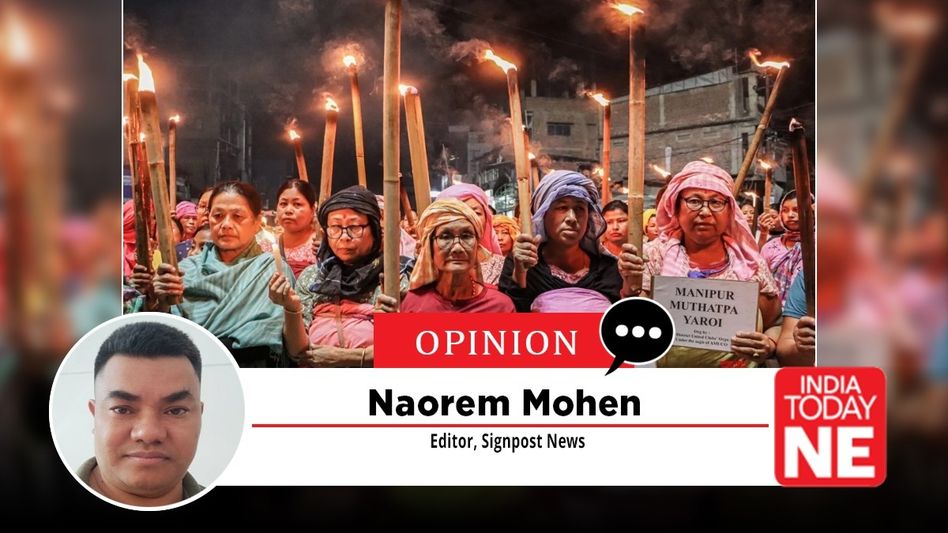
The younger generation carried forward this indomitable spirit through the Nisha Bandh movement, a powerful social campaign against drug and alcohol-related crimes. This vigilant force evolved in the late 1980s into the formidable Meira Paibi—the torchbearers—who stood guard not only against social evils but also against repressive actions by law enforcement agencies under the controversial Armed Forces (Special Powers) Act, 1958.
For the past three years, the fearless Meira Paibis have taken to the streets night after night—unarmed yet undaunted—standing against external aggression and repeated attacks on the innocent civilians. They demand no personal gain or communal privilege; their only cry is to defend their ancestral land, homes, and people with unwavering resolve.
If these extraordinary women, already a symbol of Manipur's unbreakable spirit, were empowered with structured Army-led training like the women Village Defence Guards in Doda, they could become a formidable force for deterrence. Such empowerment would not only protect vulnerable foothill villages but also bring the lasting peace that Manipur desperately needs.
When communities believe they can defend themselves effectively, mutual respect grows—knowing the other side is equally capable deters aggression and fosters deterrence-based stability.
Let the innocent villagers of foothills in Manipur be given the rightful opportunity to defend the ancestral lands their forefathers have toiled, shed sweat, and spilled blood for over centuries.
Generations of Meitei have valiantly protected their kingdom and homeland, standing firm even during the pre-planned attacks of May 3, 2023. The Indian Army must now extend the same empowering training to these resilient communities as it does to Kashmiri youths in Doda—equipping them with skills and tools to secure their future.
This is not just about defence; it is about justice, dignity, and ensuring that history's guardians continue to safeguard their legacy in a united India.
Critics may argue arming civilians risks escalation, but Jammu & Kashmir's experience and Coorg's longstanding tradition prove otherwise. Trained and responsible civilians reduce chaos by preventing opportunistic attacks and buying time for reinforcements.
Peace cannot be enforced top-down alone; it requires bottom-up resilience. By adopting the Doda model for village defence, drawing from Coorg's cultural firearms tradition, leveraging the unparalleled strength of the Meira Paibis and ensuring impartial security, the state can break the vengeance cycle.
In Manipur, this would safeguard resettlement, deter cross-border elements, and contribute to National Security in the first place.