Why MP Sanajaoba’s Call for Immigration Cleanup Before Census Is More Relevant Than Ever
In Manipur, where ethnic fault lines, border vulnerabilities, and demographic anxieties converge into near-constant crisis, one parliamentary voice cuts through with unflinching clarity and persistence. Maharaja Leishemba Sanajaoba, Rajya Sabha MP and titular king of Manipur, has repeatedly elevated the state's existential concerns to the national stage.

- Mar 12, 2026,
- Updated Mar 12, 2026, 11:35 AM IST

In Manipur, where ethnic fault lines, border vulnerabilities, and demographic anxieties converge into near-constant crisis, one parliamentary voice cuts through with unflinching clarity and persistence. Maharaja Leishemba Sanajaoba, Rajya Sabha MP and titular king of Manipur, has repeatedly elevated the state's existential concerns to the national stage.
His August 11, 2025 Special Mention, "Demand for detection, identification & deportation of Illegal Myanmarese & Bangladeshis from Manipur before the commencement of National Census & De-limitation Process", has proven prophetic and urgently relevant. As protests erupt in Imphal over plans to conduct the Census without first addressing illegal immigration, with chants of "No NRC, no census" echoing across social media and streets, this intervention stands as a prescient warning and a model of principled representation.
On that August day in the Rajya Sabha, MP Sanajaoba laid bare the perils of proceeding with the Census amid unchecked influx. He cited the Ministry of Home Affairs' May 19, 2025 directive ordering states to detect, identify, and deport illegal Myanmarese and Bangladeshi nationals within one month, a mandate largely ignored by the Manipur state government.
"It will be very unfortunate for the Indigenous People of Manipur if the Census Operation is carried out before detection, identification and deportation," he declared, warning of impending social unrest and the forfeiture of constitutional rights for native Manipuris in the delimitation process.
Census data is foundational as it shapes developmental planning, resource distribution, and electoral boundaries. Including undocumented populations risks artificial inflation of figures, distorting representation and eroding indigenous claims to fair political voice.
MP Sanajaoba bolstered his argument with irrefutable historical anomalies that have long fueled suspicion of demographic engineering. Between 2001 and 2011, three Senapati sub-divisions—Mao Maram, Paomata, and Purul—recorded an average population surge of 202.88%, far beyond natural growth patterns.
From 1991 to 2001, several hill sub-divisions showed abnormal increases of 40% or more, including Chakpikarong at 100.18% and Machi at 65.46%. These irregularities, contested for years without rectification, underscore the need for rigorous verification.
Advocating a 1961 cut-off year for legal residency, MP Sanajaoba urged the Union Government to prioritize deportation to ensure the Census reflects genuine realities and prevents manipulation of future delimitation.This call, once framed as forward-looking caution, has become a rallying cry in March 2026.
The protests in Imphal demanding an NRC-style process before any headcount, echoes the MP's exact logic: no accurate Census without first removing illegal elements that skew data and threaten indigenous security.
Recent reiterations by Maharaja Sanajaoba himself, amplified in media and his social channels, keep the pressure on, reminding Delhi and Imphal alike that unresolved infiltration risks reigniting unrest in a state still healing from ethnic strife.
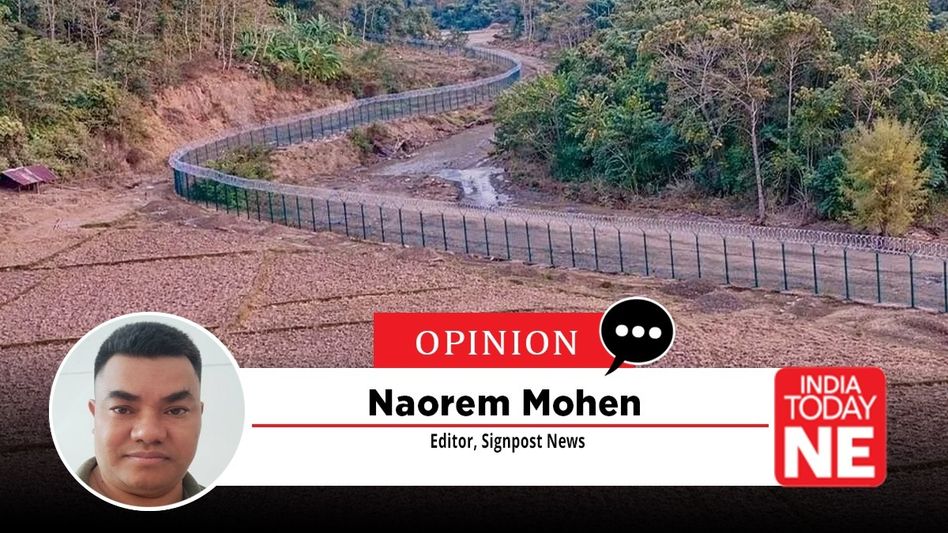
Building directly on this demographic safeguard, MP Sanajaoba returned to the Rajya Sabha on March 11, 2026, with another incisive Special Mention like "Concern Over Repeated Disturbances of Indo-Myanmar Border Fencing along Manipur Sector." Here, he exposed how the same porous frontier enabling illegal entry now actively sabotages hardening efforts.
Manipur's 398 km border with Myanmar, the longest segment of the 1,643 km Indo-Myanmar line, has seen fencing accelerate since the Free Movement Regime was scrapped and construction ramped up post-2024.
Over 30 km completed by September 2024, yet the Manipur sector suffers the most disruptions where iron poles cut twice in Chandel in December 2025, vandalism and equipment theft in Tengnoupal in August 2025, 47 poles (150 meters) damaged in Chandel in January 2026, and eleven IEDs detected in Tengnoupal up to February 2026.
These willful acts, MP Sanajaoba stressed, are not mere vandalism but grave threats to national security, likely tied to interests profiting from border porosity, insurgents, smugglers, infiltrators.
Urging thorough investigation and swift action to complete fencing unhindered, Sanajaoba linked the two speeches implicitly where unsecured borders facilitate the influx he warned about in August 2025, while sabotage delays the very defenses needed to curb it.
Together, these interventions reveal a legislator who sees Manipur's crises holistically, demographic shifts fueled by infiltration, physical border threats undermining security and uses Parliament's tools relentlessly to demand accountability.
In a state where representation in Delhi can fragment amid local rivalries, his approach stands exemplary, with data-driven (Census tables, incident logs, MHA directives), persistent (themes revisited across months), and solution-focused (deportation first, fencing completion now).
High engagement, strong attendance, targeted questions on cultural preservation, stalled projects like the National Sports University, and historical grievances, further distinguishes him from peers who often limit advocacy to occasional local noise.
The stakes are immense. Parliament bridges regional fears to national policy. By insisting on deportation before Census, Sanajaoba protects against distorted delimitation that could entrench imbalances. By spotlighting fencing sabotage, he compels scrutiny of enforcement failures.
Maharaja Leishemba Sanajaoba's record offers a blueprint for Northeast legislators. He prepare rigorously, argue with evidence, persist across sessions, and prioritize indigenous welfare fused with national interest.
As Manipur grapples with protests demanding "No NRC, no census," border sabotage, and lingering ethnic scars, MP Sanajaoba 's voice provides not just hope but a path forward, relentless, factual, and unapologetically protective of the homeland.