Why MTU’s Blind School Initiative Is Not Charity, But a Public Safety Necessity
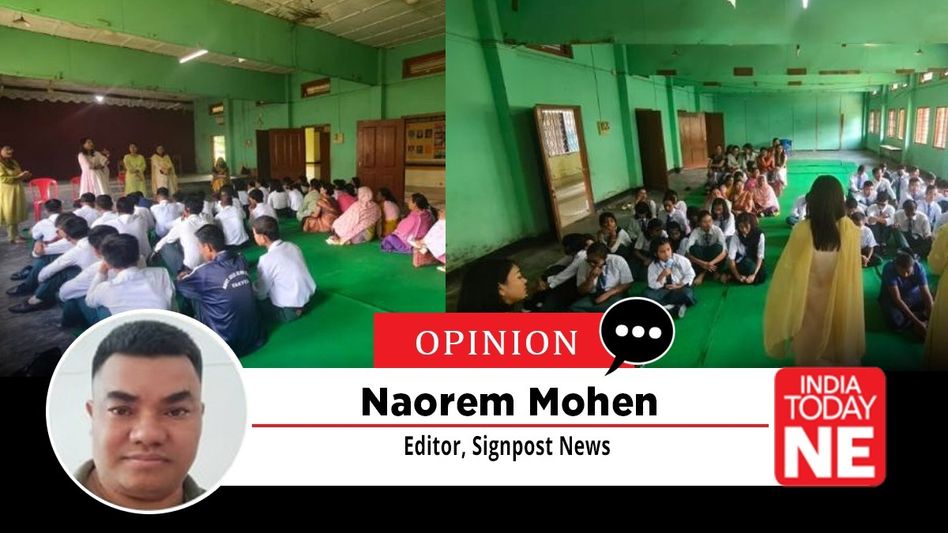
The recent visit of Manipur Technical University’s Disaster Management Cell to the Government Ideal Blind School at Takyelpat shows why disaster preparedness must become inclusive, accessible, and institutionally embedded in Manipur’s education system.

- Jul 25, 2026,
- Updated Jul 25, 2026, 11:57 AM IST

The recent visit of Manipur Technical University’s Disaster Management Cell to the Government Ideal Blind School at Takyelpat shows why disaster preparedness must become inclusive, accessible, and institutionally embedded in Manipur’s education system.
At first glance, it may appear to be a routine outreach programme by a university cell. In reality, it represents something far more important. It brings into focus a neglected question in public safety: who gets access to life-saving knowledge before disaster strikes?
The Government Ideal Blind School, functioning under the Social Welfare Department of the Government of Manipur, is not merely another educational institution. It serves children and young people whose learning needs, mobility patterns, communication methods, and emergency vulnerabilities are different from those of sighted students.
Any disaster preparedness programme that fails to recognise this difference is incomplete. Any safety policy that assumes all citizens can read printed warnings, see evacuation signs, identify danger visually, or respond to general announcements equally is structurally unfair. This is why the MTU initiative is a must, not a gesture of goodwill.
During the visit, the MTU team provided students with “Do’s and Don’ts for Common Disasters” printed entirely in Braille. The material, sourced from the library of the National Institute of Disaster Management in Rohini, gave visually impaired students direct access to basic disaster safety information in a format they can read independently.
This point must not be missed. Accessibility is not achieved when information exists somewhere in an office file, on a website, or in a printed booklet meant for the general public. Accessibility is achieved only when the intended person can use that information without depending entirely on others.
For visually impaired students, Braille disaster manuals are not supplementary learning materials. They are tools of dignity, autonomy, and survival.
Manipur is not free from disaster risks. Earthquakes, floods, landslides, fires, storms, and other emergencies are part of the region’s lived reality. The state lies in a seismically sensitive zone. Its terrain, rainfall patterns, urban congestion, fragile public infrastructure, and limited emergency response capacity make preparedness a public necessity. In such a setting, disaster awareness cannot remain confined to able-bodied citizens, urban schools, government drills, and formal circulars. It must reach those who are most likely to be left behind during moments of panic.
Despite mandatory rules requiring accessibility for persons with disabilities in malls, offices, shops, banking establishments, and various public and private institutions across the state, such facilities remain largely inadequate in practice. Ramps, tactile paths, accessible signage, trained staff, emergency support systems, and disability-sensitive safety protocols are either absent or poorly maintained in many places.
This gap between rule and reality makes the MTU Disaster Management Cell’s initiative at the Government Ideal Blind School especially important. It shows that inclusion must move beyond formal compliance and become part of everyday public safety planning.
The visually impaired face distinct risks during disasters. They may not see smoke, falling objects, damaged pathways, warning lights, evacuation maps, water currents, fire exits, or approaching danger. They may depend on sound, touch, memory, guided movement, and trusted human assistance. In crowded emergency situations, even small delays can have serious consequences. A blocked corridor, an unfamiliar evacuation route, a missing handrail, or a shouted instruction without clear direction can turn vulnerability into tragedy.
Therefore, disaster preparedness for blind students cannot be a simplified version of general disaster education. It requires a different pedagogy.
This is where the MTU Disaster Management Cell’s approach becomes significant. The team did not merely distribute materials and leave. It conducted an interactive session to assess the students’ current understanding of disaster preparedness and to understand the challenges they face during emergencies. This was a responsible method. Policy often fails when it is designed from above without listening to those affected by it. By engaging directly with students and teachers, the MTU faculty recognised that inclusive Disaster Risk Reduction must begin with lived experience.
The proposed development of a specialised Disaster Risk Reduction pedagogy training manual for visually impaired individuals is therefore the most important part of the initiative. If implemented seriously, this manual can become a model for other special schools, inclusive education centres, social welfare institutions, and disaster management authorities in Manipur and beyond.
Such a manual must not be treated as a symbolic document. It must be practical, tested, locally relevant, and repeatedly improved. It should include non-visual learning methods, spatial orientation exercises, tactile mapping, guided evacuation drills, role-based classroom protocols, peer support systems, accessible warning formats, and multisensory instruction. It should also train teachers, wardens, caregivers, school staff, and local disaster response volunteers. In emergencies, the preparedness of students depends heavily on the preparedness of the people around them.
The collaboration with teachers at the Government Ideal Blind School is therefore essential. Teachers understand the students’ abilities, anxieties, routines, movement patterns, and learning styles better than any outside expert. Their involvement can prevent the manual from becoming an academic exercise detached from classroom reality. In special education, the most useful interventions are those built from close observation, patient engagement, and respect for the learner’s agency.
MTU’s decision to donate two copies of the Braille manuals to its own library also carries institutional significance. It acknowledges that accessibility should not be limited to the site of outreach. Universities must also transform their own spaces. A technical university that teaches engineering, management, disaster studies, and public systems must expose its students and faculty to inclusive design, disability rights, and accessible public safety. A Braille disaster manual in a university library is more than a book. It is a reminder that knowledge has ethical responsibilities.
The initiative also raises a larger question for the Government of Manipur. Why should such accessible disaster materials be rare enough to appear exceptional? Every school for children with disabilities should have disaster safety materials in accessible formats.
Every district disaster management authority should maintain resources in Braille, audio, tactile, pictorial, local language, and easy-to-understand formats. Every school safety audit should include disability access. Every mock drill should test how children with visual, hearing, mobility, intellectual, or multiple disabilities are protected.
Disaster management cannot be considered complete if it counts buildings but not bodies, infrastructure but not impairment, evacuation routes but not accessibility.
The Social Welfare Department, Education Department, State Disaster Management Authority, higher education institutions, and local bodies must treat this initiative as a starting point. Manipur needs a coordinated framework for inclusive disaster preparedness in educational institutions. The Government Ideal Blind School can become a pilot institution for such a framework. If the model is carefully documented, it can be expanded to other vulnerable groups and institutions.
There is also an important public message here. Disability inclusion should not be approached as charity. It is a matter of rights, governance, and public accountability. The visually impaired are not passive recipients of sympathy. They are citizens entitled to equal access to safety, knowledge, training, and institutional care. A society that speaks of development while leaving some children unprepared for emergencies has not understood the meaning of public responsibility.
The proposed comprehensive disaster awareness programme in the near future must therefore be designed with seriousness. It should include practical drills, tactile route familiarisation, emergency communication exercises, teacher training, student feedback, coordination with fire and emergency services, and periodic review.
The school building itself should be assessed for accessible evacuation routes, railings, sound-based alerts, safe assembly points, emergency lighting for low-vision users, and clear obstacle-free pathways.
It is equally important that the programme does not remain a one-day event. Disaster preparedness is not built through a single lecture. It is built through repetition, confidence, habit, and institutional culture. Students must practise what to do during earthquakes, fire incidents, floods, and other common hazards.
Teachers must know who needs assistance, who can move independently, which routes are safest, and how to maintain calm. Administrative staff must maintain emergency registers, contact systems, and coordination plans. Preparedness becomes meaningful only when it is embedded into daily school life.
Mangibala Huirem, Headmistress of the Government Ideal Blind School, deserves appreciation for supporting this initiative. Institutional heads often determine whether outside interventions remain ceremonial or become useful. Her cooperation gives the programme a chance to take root inside the school’s actual learning environment.
MTU also deserves credit for recognising that a technical university’s public role extends beyond classrooms, laboratories, and degrees. Universities in Manipur must become knowledge partners for society. They must work with schools, communities, government departments, and vulnerable groups. In a state facing environmental, social, and institutional challenges, higher education cannot remain isolated from public need.
This initiative is modest in scale, but large in meaning. It shows how academic knowledge, government institutions, and social responsibility can meet at the point where they matter most: the safety of children.
The real test now is continuity. The Braille manuals must lead to training. Training must lead to drills. Drills must lead to institutional protocols. Protocols must lead to policy adoption. Policy adoption must lead to statewide replication. Only then will the initiative move from a commendable event to a durable public safety model.
For the Government Ideal Blind School, the MTU initiative is a must because it addresses a gap that should never have existed. It gives visually impaired students direct access to disaster knowledge. It respects their ability to learn, prepare, and respond. It recognises their specific vulnerabilities without reducing them to helplessness. It invites teachers into the process. It pushes the university toward inclusive responsibility. It offers the government a practical model for disability sensitive disaster preparedness.
Manipur must take this seriously.