Why Universities Need Leadership Training
Academic excellence can produce outstanding teachers and researchers. But running a university also requires the ability to manage people, resolve conflict, accept responsibility and build teams. Those skills cannot simply be left to seniority and experience.

- Oct 01, 2026,
- Updated Oct 01, 2026, 2:15 PM IST

Can leadership be taught?
The question deserves attention inside Indian universities, where an accomplished teacher or researcher can one day find himself or herself heading a department, managing an institution or taking decisions that affect hundreds of colleagues and students.
A good researcher may become a Head of Department. A professor may become a Dean. A senior academic may eventually become a Director, Registrar or Vice-Chancellor. Years of scholarship may prepare them exceptionally well for teaching and research, but administration suddenly demands something more: managing people, resolving disputes, taking difficult decisions, building teams and accepting responsibility when things go wrong.
Academic excellence and administrative leadership are related. They are not the same skill. That is why leadership training in universities deserves to be taken seriously.
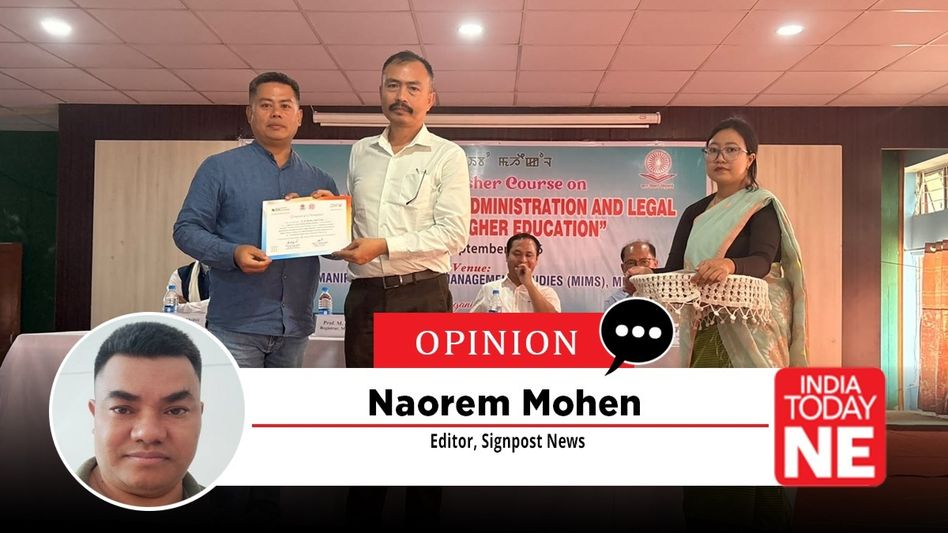
The recently concluded two-week Multidisciplinary Refresher Course on “Leadership, Academic Administration and Legal Excellence in Higher Education” at Manipur University offered an interesting window into this question. Held from September 16 to 28 by the UGC Malaviya Mission Teacher Training Centre, under the Ministry of Education, Government of India, the programme brought together 53 participants from different universities and institutions, including participants from the University of Calicut in Kerala.
What made the programme particularly relevant was the mix of subjects it attempted to bring under one roof. Leadership and academic administration sat alongside communication, mental well-being, conflict resolution, financial management, transparency, cyber law, research ethics, resource mobilisation and institutional governance. The official schedule itself shows how widely the course interpreted the responsibilities of those who lead higher education institutions.
That wider understanding of leadership matters. Universities understandably invest heavily in academic expertise. Teaching and research remain at the heart of higher education.
But a university is also a complicated human institution. Departments, examination branches, finance sections, research centres and administrative offices have to work with one another every day. Decisions have to be made, disagreements resolved and limited resources shared.
An outstanding scholar can still struggle to manage a team. Someone can know university regulations thoroughly and still be unable to listen to a junior colleague. An administrator may possess considerable authority without earning the confidence of the people working around him or her. This is where leadership training becomes relevant.
Finance Officer Prof. Laishram Rajendrakumar Singh made the point during the valedictory programme that leadership qualities can be developed through experience and training. He identified trust, accountability, resourcefulness and teamwork as important foundations of effective leadership.
These may sound like familiar management words. Inside a university, however, they have very practical consequences.
An unresolved interpersonal dispute can damage an entire department. Poor communication between two branches can delay an academic process. An officer unwilling to take responsibility can keep a file moving from one table to another. A senior administrator who does not trust colleagues can create an institution where everyone waits for instructions rather than taking initiative.
Leadership is visible in these everyday situations, not merely in major policy decisions.
The course became more interesting because leadership was approached from different professional experiences rather than from academic theory alone.
Lt Gen K. Himalay Singh (Retd.) addressed the role of leadership and academic administration in institutional building. Th. Brojen Singh (Retd. IPS) spoke on leadership through practical experience and later conducted two sessions devoted to conflict resolution.
Those subjects are particularly relevant to universities. Academic institutions may not resemble the military or police, and they should not be administered as such. But questions of responsibility, decision-making, crisis management, communication and conflict resolution cross institutional boundaries.
The academic side of leadership received equal attention. Prof. N. Rajmuhon Singh, former Vice-Chancellor of Dhanamanjuri University, examined quality teaching and research through the role of institutional systems and leadership, while Prof. Memcha L., Dean of the School of Social Sciences at Manipur University, dealt with leadership theories and practices.
Prof. Arvind Kumar, former Dean of the Atal Bihari Vajpayee School of Management and Entrepreneurship at JNU, addressed the role of academic leaders in building future-ready universities. He also dealt with institutional distinctiveness, strategic positioning and best practices in Indian higher education institutions.
Together, these sessions raise a larger question: what exactly should an academic leader be prepared for today? Certainly more than signing files.
Perhaps the most important part of leadership training is also the easiest to overlook: people.
A university may have excellent statutes, ordinances and administrative procedures, but institutions ultimately function through human relationships. That explains why the programme included communication, interpersonal relationships, stress management, mental well-being, employee engagement and motivation alongside governance and administration.
Dr. R.K. Lenin Singh, former Head of Psychiatry at RIMS, addressed stress management and mental well-being for workplace productivity. Dr. Kh. Somorendro Singh, former Director of ICM Guwahati, dealt with effective communication and later employee engagement and motivation.
Prof. L. Jibonkumar Sharma of MIMS, Manipur University, took up transformational leadership for excellence in higher education institutions. The combination is significant. Leadership cannot be separated from the people being led.
Prof. R.K. Bhubon Singh, Director of the UGC-Malaviya Mission Teacher Training Centre, Manipur University, said the programme had attempted to bring together a wide range of areas, including the legal and administrative dimensions of higher education, so that participants could benefit from a broader understanding of institutional functioning. He acknowledged that covering every aspect within two weeks was difficult, but expressed satisfaction that participants had benefited from the course. He also thanked them for their active participation and patience throughout the programme.
His observation also underlined a practical limitation of leadership training: no two-week course can cover every challenge an administrator will encounter. Its value lies in widening perspectives and giving participants tools they can continue to develop after returning to their institutions.
Prof. Ch. Ibohal Meitei, Programme Coordinator, spoke during the programme about interpersonal conflict and the need to understand and manage ego within institutional relationships. Towards the end, he posed a question that went beyond what participants had written in their notebooks: had anything changed in their outlook, mindset, way of thinking and interaction with colleagues?
That is a far more demanding test than completing a course. A person may know every provision of a university statute and still fail to lead people. A department can have accomplished scholars and still become dysfunctional because professional disagreement has turned personal. Rules can organise an institution. People still have to make it work.
University structures are hierarchical. Vice-Chancellors, Registrars, Deans, Directors, Heads of Departments, professors, officers and staff occupy different positions and exercise different degrees of authority.
But designation and leadership should not be confused. A chair can provide authority. It cannot automatically command trust.
Prof. Rajendrakumar illustrated this through his recollection of his own research days and his relationship with his mentor. Responsibility was entrusted to him, and when that responsibility was fulfilled, trust increased. Greater trust brought greater responsibility and opportunity. The lesson travels easily from mentorship to administration.
An administrator who demands accountability from colleagues must also be accountable. Someone who expects others to respect deadlines must respect their responsibilities. A person leading a team needs to know not merely the weaknesses of colleagues but also their strengths.
This becomes even more important in institutions working with limited resources. Leadership cannot always wait for ideal manpower, perfect infrastructure or unlimited finances. Resourcefulness — another quality emphasised during the programme — becomes part of administration itself.
There is also a tendency in hierarchical institutions to associate leadership only with the person occupying the highest chair. Universities do not work that way.
A Vice-Chancellor cannot run a university alone. Neither can a Registrar, Dean, Finance Officer or Head of Department. An institution succeeds, stagnates or struggles through the combined actions of many people. That makes teamwork more than a management slogan.
Understanding the abilities and limitations of colleagues, assigning responsibilities intelligently, trusting people to perform their roles and accepting collective responsibility are all part of institutional leadership.
The diversity of participants in the Manipur University programme added another useful dimension. Faculty members and administrators from different institutions could compare experiences and discover that a problem appearing unique to one university may already have been handled differently somewhere else.
The participants’ feedback offered perhaps the clearest indication of what stayed with them. Dr Yumkhaibam Rajesh, Assistant Professor from Manipur University, valued the range of resource persons and particularly the sessions that connected leadership with practical experience, communication and institutional life. He also appreciated that presentation materials were shared with participants, allowing the learning to continue beyond the course.
Dr Surekha Longjam of Manipur University of Culture said the programme had contributed not only to becoming better administrators and leaders, but also better human beings. She highlighted life skills, situational leadership and personality development, while suggesting that future courses include field visits or physical activities to break an otherwise demanding schedule.
Abdullah from University of Calicut, Kerala brought an outsider’s perspective. Despite initial concerns about travelling to Manipur, he said his two-week experience at Manipur University and around the Imphal Valley was positive. He praised the university’s hospitality, the academic exposure and the warmth of fellow participants, and said he would share that experience with colleagues and family back home.
Prakash from Dhanamanjuri University reflected on the wide intellectual range of the course, recalling sessions on the Indian Knowledge System, stress management, financial planning and other areas. For him, the refresher course had enriched not only knowledge but perspective.
Devendra Singh of Manipur Technical University drew attention to this benefit during the feedback session. Participants were not merely listening to resource persons; they were also learning from one another.
Together, their feedback suggests that the course worked at more than one level. Participants returned with lessons on leadership and administration, but also with new professional relationships, different perspectives and experiences that could travel back with them to their own institutions.
Such exchanges matter in higher education. Universities have much to learn from other universities. The success of leadership training cannot ultimately be measured by the number of lectures delivered, participants registered or certificates distributed. Its real test begins when people return to work.
Does an administrator listen more carefully before making a decision? Does a Head of Department prevent a professional disagreement from becoming a personal battle? Does an officer take responsibility instead of passing a difficult file to another table? Does a senior professor mentor a younger colleague differently?
Does a team solve a problem together rather than search for someone to blame?
These may appear to be small changes. Across 53 participants returning to different universities and institutions, they are not necessarily small. They can alter the working culture of an institution.
Registrar Prof. M. Premjit Singh reflected during the programme on the need to refresh one's mind even after spending years in academic life. The observation is important because experience is invaluable, but experience can also create routines that are rarely questioned.
A refresher course creates an opportunity to question those routines. Universities invest heavily in buildings, laboratories, libraries, technology and academic programmes. They must invest just as seriously in the people who are expected to lead them.
A university can have impressive infrastructure and poor administration. It can have distinguished scholars and an unhealthy working environment. It can possess detailed regulations and still struggle to make timely decisions.
Leadership is what often connects these different parts of institutional life. So, can leadership be taught?
Perhaps no classroom can manufacture a leader. But people can certainly be trained to communicate better, listen more carefully, manage conflict, accept accountability, build teams and understand the people working around them.
And that may be the more important question for Indian higher education.
Universities should not wait until someone occupies a senior chair to discover whether that person knows how to lead.