Why We Must Remember the Dead: Divine Panthou’s Message of Love Beyond Death
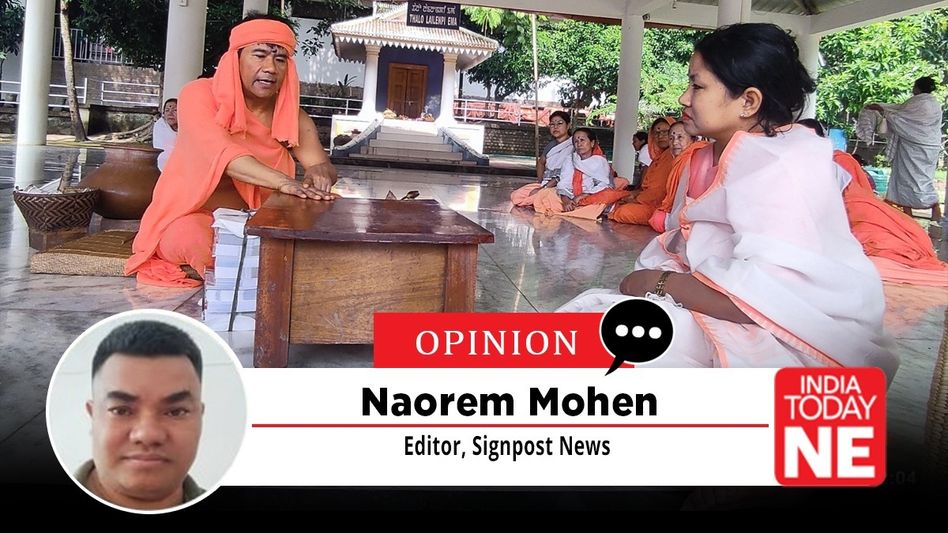
There are moments when a spiritual teaching does not begin with scripture, ritual or an elaborate explanation of faith, but with a memory that refuses to disappear. Divine Panthou’s latest message is rooted in such remembrance, in the experience of losing people whose presence may no longer be physically felt but whose memories continue to live within us

- Oct 04, 2026,
- Updated Oct 04, 2026, 5:08 PM IST

There are moments when a spiritual teaching does not begin with scripture, ritual or an elaborate explanation of faith, but with a memory that refuses to disappear. Divine Panthou’s latest message is rooted in such remembrance, in the experience of losing people whose presence may no longer be physically felt but whose memories continue to live within us.
His reflection carries a simple but profound understanding of human existence: we do not remember the departed merely because custom or religion asks us to perform certain rites after death; we remember because there was love, because there was a relationship, and because the physical absence of a person cannot erase the place that person once occupied in our lives.
Divine Panthou speaks from personal memory, recalling moments associated with those who have departed and acknowledging that there are experiences he has never been able to forget. Years may pass and circumstances may change, but certain memories remain with extraordinary clarity because they are tied to affection, pain and human attachment.
This is why, in his understanding, remembrance cannot be separated from love. We remember those whom we have loved, we continue to respect those whose lives touched ours, and even after their physical presence is gone, something of that relationship survives within us. For Divine Panthou, honouring the departed therefore becomes more than a ritual associated with death; it becomes an expression of gratitude for a life that once existed alongside our own.
From that deeply personal reflection emerges the central spiritual thought of his message: death is the disappearance of the physical body, not the disappearance of the soul. Throughout his journey in religion, Divine Panthou says he has continued to pay respect to those who have departed, offering flowers and remembrance to the souls of the dead because he does not regard physical death as the complete extinction of human existence. The body has its limits and must one day disappear, but the soul, in his teaching, does not vanish with it.
This distinction between the temporary body and the enduring soul gives remembrance a meaning far deeper than mourning, for it tells us that respect for another human being should not end at the boundary between life and death.
Such a teaching inevitably acquires another meaning when heard in Manipur today. For more than three years, this land has carried an enormous burden of death, displacement, separation and grief, and almost every community has families who remember someone who did not return home. Public discourse often reduces such tragedies to numbers — the number killed, injured, displaced or missing — but behind every number is a name, behind every name is a family, and behind every family are memories that statistics can never record.
A mother remembers a voice, a father remembers a face, a child remembers a touch, and a friend remembers conversations that will never happen again. Those memories do not belong to one community or one side of a conflict; they belong to the universal experience of being human.
This is why Divine Panthou’s message deserves to travel beyond the boundaries of religion. To respect someone who has died does not require us to forget history, abandon the pursuit of justice or pretend that differences never existed. It asks us instead to recognise something more fundamental — that death should not strip a human being of dignity. When even the dead are viewed through the divisions of ethnicity, community, faith or politics, society loses something far more precious than an argument. It begins to lose the capacity to recognise another human life as worthy of grief and respect.
There is also a lesson for the living hidden within Divine Panthou’s words. If love is what makes us remember someone after death, then the real question is not only how we honour those who have gone but what kind of memories we are creating while we are still alive. Human beings leave behind more than possessions, photographs or names.
We leave behind the consequences of how we treated others. Hatred leaves memories, violence leaves memories and cruelty leaves memories, but compassion, kindness, service and the courage to protect another human being also leave memories. Long after the body disappears, these may become the true measure by which a life continues among those who remain.
The traditions of Manipur have always carried a deep relationship between the living, the departed and the ancestors, where remembrance is not simply an act of looking backwards but an acknowledgement that the present generation stands within a much longer human journey. We inherit our families, histories, land, traditions and responsibilities from those who lived before us, just as another generation will one day inherit what we leave behind.
Seen from this perspective, remembering the departed is also a reminder of responsibility: we are temporary custodians of a world that existed before us and will continue after us, and the values we practise today will eventually become part of the memory through which future generations understand us.
Divine Panthou’s message ultimately returns us to a truth that is spiritual but also profoundly human. The body cannot remain forever, yet the meaning of a human life need not disappear with it. The soul, in his teaching, does not vanish when the body is gone, while among those who remain, love continues through remembrance and respect. Perhaps this is why remembering the dead matters so deeply: it reminds us that a human being is more than a body and that a relationship is more than physical presence.
For a wounded Manipur, there may be an even greater lesson in this teaching. We have spent years mourning people after they have died, carrying their photographs, remembering their names and grieving over lives that cannot be brought back. Perhaps the more difficult responsibility now is to learn how to value human beings before they become memories.
If we can recognise dignity in the departed irrespective of the divisions created by the living, we should also be capable of recognising that same dignity in one another while we are still alive. That may be the most meaningful respect we can ultimately offer to every soul Manipur has lost.