
Will Chief Minister Yumnam Khemchand Singh Remember the Forgotten Plea of Nehpu Khongsai?
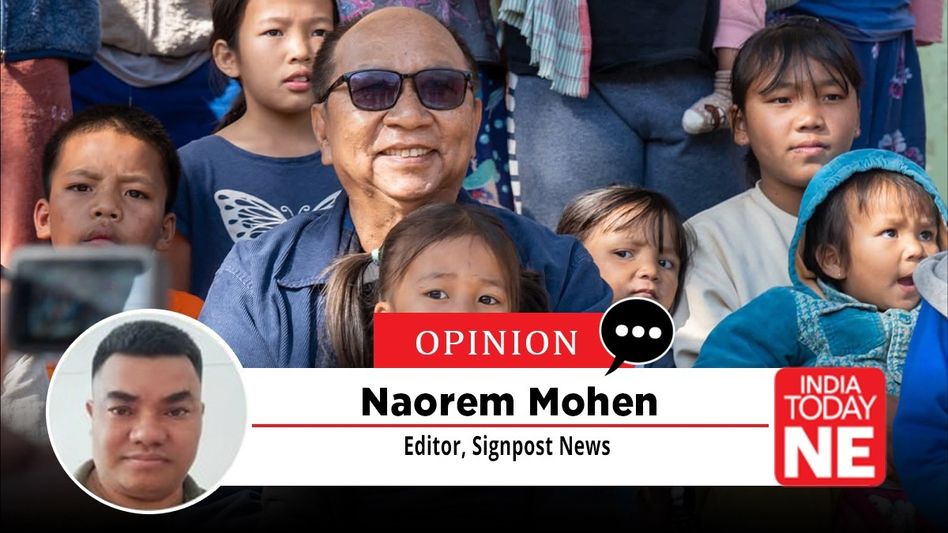
The image of Chief Minister Yumnam Khemchand Singh tenderly holding a different child during a recent "Pariksha pe Charcha" event stands in sharp and unsettling contrast to the deeply moving moment from December 8, 2025, when he cradled a little Kuki baby at the Litan Sareikhong relief camp in Ukhrul district.

- Feb 06, 2026,
- Updated Feb 06, 2026, 2:21 PM IST

The image of Chief Minister Yumnam Khemchand Singh tenderly holding a different child during a recent "Pariksha pe Charcha" event stands in sharp and unsettling contrast to the deeply moving moment from December 8, 2025, when he cradled a little Kuki baby at the Litan Sareikhong relief camp in Ukhrul district.
That earlier photograph, taken during his rare and courageous visit as a Meitei leader to a Kuki IDP camp amid the ongoing ethnic conflict, became a powerful symbol of tentative hope and human connection in a fractured Manipur.
It captured a fleeting but genuine bridge of empathy built through direct, face-to-face engagement with those enduring the harshest consequences of the violence that began on May 3, 2023.
However, now, as the newly formed government takes shape and national platforms call for photo opportunities aligned with broader narratives of education and inspiration, the shift to holding a different child in a more controlled, ceremonial setting raises a troubling question.
Has the raw, ground-level promise of reconciliation, born from listening to the suffering of real families in relief camps been quietly sidelined in favor of safer, more polished symbolism?
This visual juxtaposition is more than a matter of optics. It serves as a stark reminder that Manipur’s long road to healing cannot be paved with staged gestures alone.
Also Read: Bail Orders That Let Drug Peddlers Regrow in Churachandpur and Kangpokpi Districts of Manipur
True recovery demands sustained, unflinching commitment to the very people whose voices were once heard up close, whose pain was once acknowledged in person, and whose pleas were once met with a promise to carry them forward.
The recent swearing-in of the new Manipur government under Chief Minister Yumnam Khemchand Singh on February 4, 2026, has already entered the history books by breaking several long-standing records in the state’s political journey.
Coming after nearly a full year of President’s Rule imposed in February 2025, this administration arrives in the shadow of the devastating ethnic violence between the Meitei and Kuki communities that has claimed hundreds of lives, displaced tens of thousands as Internally Displaced Persons (IDPs), and inflicted lasting trauma across a state celebrated for its mosaic of 36 distinct communities.
Yumnam Khemchand Singh’s rise to Chief Minister is historic on multiple levels. He formally joined the Bharatiya Janata Party (BJP) in 2013, marking his entry into saffron party after earlier associations with other political parties. Despite not being the Seniormost BJP leader in Manipur at the time of his selection, the calculated and enduring connection to the RSS appears to have tipped the scales in his favor, earning him the backing of the central leadership and positioning him as a reliable, sangh parivar choice. This strategic alignment with the RSS has now borne fruit, culminating in his ascension to the highest executive post in Manipur on February 4, 2026.
A two-term MLA from Singjamei constituency, former Speaker of the Manipur Legislative Assembly, and former cabinet minister overseeing critical portfolios including municipal administration, housing, urban development, rural development, panchayati raj, and education, he brings considerable administrative experience to the role. His background as a Taekwondo black belt further symbolizes the discipline, focus, and resilience that Manipur so desperately needs at this hour.
Complementing this leadership is the appointment of Nemcha Kipgen as one of two Deputy Chief Ministers—a breakthrough on several fronts. She becomes the first woman to hold the Deputy CM post in Manipur’s history, dismantling a persistent gender barrier in a state where women’s political representation has historically lagged.
Equally significant, she is the first Kuki MLA to ascend to this high office. Representing Kangpokpi constituency, Nemcha took her oath virtually from Manipur Bhavan in New Delhi. The second Deputy CM, Losii Dikho from the Naga community, together with Nemcha, marks the first time since the BJP’s initial victory in 2017 that hill tribal leaders have been elevated to such prominent roles in a Meitei-led government.
Furthermore, Nemcha Kipgen, along with MLAs Ngursanglur Sanate and LM Khaute, became the first MLAs to participate in a session of the Manipur Legislative Assembly virtually from Delhi, highlighting both innovation and the ongoing challenges of physical representation in a divided state.
This carefully balanced cabinet, a Meitei CM with RSS credentials, a Kuki woman Deputy CM, and a Naga Deputy CM, supported by alliance partners including the National People’s Party (NPP) and Naga People’s Front (NPF) was sworn in at Lok Bhavan in Imphal. The inaugural cabinet meeting highlighted immediate priorities, peace, inclusivity, and development.
In his earliest media interactions as Chief Minister, speaking to reporters on February 5, 2026, Yumnam Khemchand Singh directly confronted the state’s most acute crisis. He declared that the rehabilitation of displaced persons would be the government’s foremost priority.
He also stated that the government would soon formulate a roadmap for the safe return of internally displaced persons (IDPs) to their homes in both hill and valley districts. “Our first priority will be to look after the problems of IDPs in both the hills and the valley. The biggest issue is that they are not able to return to their homes. The government will formulate a roadmap very soon,” the chief minister said.
These assurances offer a concrete promise of structured action to the thousands still languishing in relief camps, trapped by insecurity, destroyed homes, damaged infrastructure, and profound mutual distrust.
As a Meitei who holds unity, peace, and the all-round development of Manipur as non-negotiable ideals, I regard these historic firsts not merely as achievements to celebrate but as a solemn mandate, and a rigorous litmus test of sincerity.
The government’s true legacy will not be measured by the records it set on the day of its formation, but by whether it can decisively break the prolonged cycle of suffering that has gripped our state for nearly three years.The resettlement of IDPs remains the most urgent and defining challenge, especially in sensitive flashpoint areas such as Moreh town and Churachandpur.
Thousands of families, both Meitei and Kuki, continue to live in relief camps, enduring daily hardship, uncertainty, and emotional trauma. While official statements claim thousands have received some form of assistance, ground-level realities in districts like Churachandpur, Kangpokpi, and others reveal stubborn obstacles, inadequate roads, schools, and hospitals; lingering threats from residual militancy; insufficient rehabilitation packages; and deep-seated mistrust between communities.
Previous unrealistic deadlines, for example, large-scale returns targeted for March 31, 2026 have been widely criticized by IDP welfare committees, who insist on prioritized lifeline road repairs and more robust support for rebuilding homes and livelihoods.
Will this new government create yet another historic record by successfully resettling IDPs in these high-risk zones and genuinely fulfilling the spirit of the “Kangla Washak”—the powerful symbolic pledge that emerged from the 2024 protests at Kangla Fort, demanding justice, peace, and a return to normal life?
There is no time to lose. With assembly elections just 11-12 months away, the danger of populist distractions and short-term optics grows by the day. The narrow window for meaningful, irreversible progress demands urgency and focus.
When will Meiteis once again travel freely along the national highways without fear? When will Kukis feel safe enough to enter Imphal for markets, education, medical care, or family visits?
Restoring free inter-community movement, rebuilding eroded trust, and repairing the torn social bonds must be the absolute first priority—everything else flows from this foundation.
The mythological tale of king Sugriva in the Ramayana stands as a timeless cautionary parable. After being crowned king of Kishkindha with Rama’s help, he forgot his responsibilities and spent an entire season indulging in pleasures while his ally waited in anguish. Manipur cannot afford a Sugriva moment. This government must not allow itself to become enthroned yet forgetful, crowned yet complacent. This is their defining litmus test.
The visit to Litan Sareikhong relief camp on December 8, 2025, remains one of the most extraordinary and symbolically charged episodes of the entire conflict period. It was the first time a valley-based Meitei elected leader ventured into a Kuki IDP camp since the violence erupted. Held at the Litan Sareikhong Baptist Church, the camp sheltered around 505 displaced persons.
During that visit, Yumnam Khemchand Singh engaged directly with families preparing for Christmas, listened to their accounts of enduring two-and-a-half years of displacement, and asked about their needs.
Inside the camp, something truly remarkable occurred. A Kuki man named Nehpu Khongsai from S. Bongjang Village, Island Block, stood up in front of Yumnam Khemchand Singh. He poured out his heart with dignity and clarity: “We have been in the relief camp for almost three years now. We are suffering a lot and we would like to request the government to help us return to our original homes.”
His words carried the weight of collective exhaustion, gratitude for any assistance already received, and a simple, desperate yearning to return to normal life. Nehpu’s testimony was not filtered through organizational statements or political agendas; it was the unadorned voice of someone who had lived the hardship every day.
During that same visit, photographs captured Khemchand holding a little Kuki baby in his arms, a gesture that briefly offered hope for reconciliation across the divide. While some Kuki organizations later described the visit as “uninvited” or politically motivated, Nehpu Khongsai’s plea remains an authentic, irrefutable cry from the ground.
Now, as Chief Minister, Yumnam Khemchand Singh must remember them. He must remember Nehpu Khongsai. He must remember the faces behind the plea. The recent “Pariksha pe Charcha” moment—where he was photographed holding a different child in a setting aligned with national themes of education and inspiration highlights the very real danger of forgetting the gritty, uncomfortable realities of relief camps in favor of safer, more broadcast-friendly symbolism.
His first major visit to the hills as Chief Minister must be to Litan Sareikhong. He must return to that same camp, meet those same families, sit once more with Nehpu Khongsai if he is still there, and act decisively on the request that was made directly to him: help us return to our original homes.
Only by honoring that specific, personal commitment can the government begin to build the credibility needed to extend its roadmap to other camps across both hills and valleys.
Politics makes bold action possible. The Centre may pursue its own strategies and timelines, but it has sometimes failed to read the true pulse of the people on the ground.
What Meiteis, and indeed every Manipuri truly want and hope for from this government must be studied with utmost care. No more time wasted on superficial celebrations while real suffering continues.
Across the state, people are murmuring that “there is no time for dance.” Will we see the Chief Minister “shaking his legs” again at the Kut festival in 2026? Let us hope for something far more meaningful.
That CM Yumnam Khemchand Singh dances once more alongside Paolienlal Haokip or representatives from Kuki communities at Kut, symbolising renewed harmony, and shares local wine at the Hun festival somewhere in the hills in April this year.
Let Nemcha Kipgen attend these festivals in person, not virtually, her physical presence in Kangpokpi would carry a powerful message of courage and inclusion.This government has already set records in its formation.
Now it must set records in healing. Swift, sincere implementation of the promised IDP roadmap, restoration of free inter-community movement, rebuilding of shattered infrastructure, and genuine dialogue across divides, this is the path forward.
I extend my best wishes but hold the leadership firmly accountable. The people will watch closely, remember vividly, and judge by deeds, not titles or photographs alone. May this administration rise to the moment, transforming historic firsts into an enduring peace that finally brings our beloved homeland back together.
The views expressed in this article are those of the author and do not necessarily reflect the views of India Today NE or its affiliates.
MORE NEWS











Copyright©2026 Living Media India Limited. For reprint rights: Syndications Today
