
Will Kuki MLAs Back a New Government When They Meet Amit Shah in Guwahati?
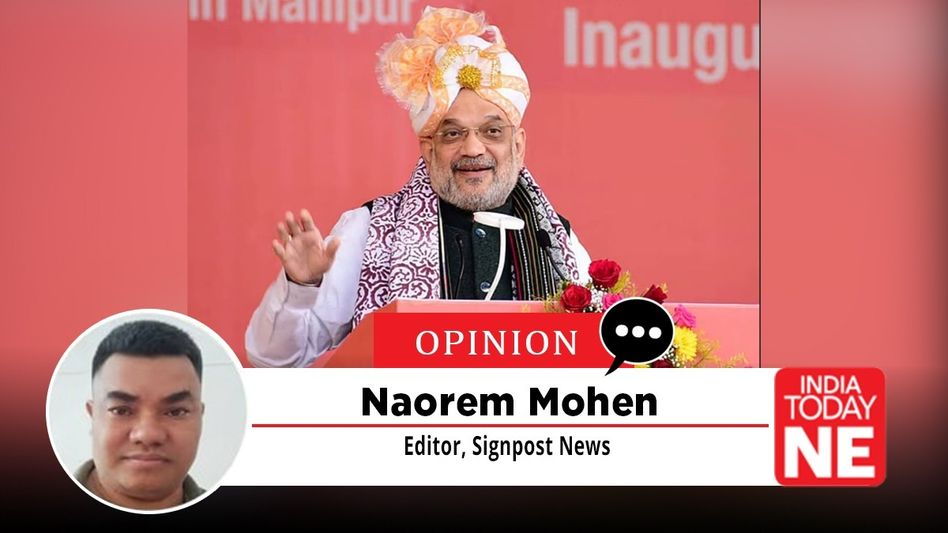
As Manipur teeters on the edge of yet another missed opportunity for peace and self-governance, Union Home Minister Amit Shah's scheduled meeting with the 10 Kuki MLAs in Guwahati on January 30, 2026, stands as a critical juncture.

- Jan 27, 2026,
- Updated Jan 27, 2026, 8:52 PM IST

As Manipur teeters on the edge of yet another missed opportunity for peace and self-governance, Union Home Minister Amit Shah's scheduled meeting with the 10 Kuki MLAs in Guwahati on January 30, 2026, stands as a critical juncture.
Amit Shah's January 30 meeting is thus not mere protocol but a significant step in a fragile process. It highlights the delicate balance. New government formation demands compromise across ethnic lines, yet concessions risk perceptions of favoritism.
With President's Rule, which was imposed on February 13, 2025 is nearing its one-year constitutional limit in the middle of February 2026, the pressure to restore a "popular government" is immense.
However, this high-stakes engagement is unlikely to yield unconditional Kuki support for a new government unless the Centre addresses core demands for security and political settlement demands that have only grown sharper amid recent flare-ups like the ZUF Kamson group's activities in K Songlung, in Kangpokpi district.
It is important to note that in March 2025, Union Home Minister Amit Shah firmly stated that the Centre would not entertain the Kuki's key demand for a separate administration in tribal-majority areas under Union Territory status, describing it as completely non-negotiable.
He conveyed this position directly to Manipur Governor Ajay Kumar Bhalla and other senior state officials during a high-level security review meeting.
Given this clear and resolute stance from the Ministry of Home Affairs, the recent meeting in Guwahati involving the 10 Kuki MLAs appears unlikely to revive or advance the separate administration demand. Instead, it seems geared toward facilitating the formation of a popular government in the state, which would mark a positive step toward political stability and normalcy in Manipur.
The MHA has already addressed several concerns previously raised by Kuki representatives, including the imposition of President's Rule, the removal of N. Biren Singh from the Chief Minister's post, and the renewal of the Suspension of Operations (SoO) agreement with Kuki militant groups. With these significant steps taken, there appears to be little remaining justification for further escalation of demands—what more could the Kuki leadership realistically expect at this stage?
In Manipur, the BJP commands numerical strength with 37 MLAs (including seven Kuki), but legitimacy demands inclusion across ethnic lines. Excluding the Kuki bloc definitely risks renewed blockades, unrest, and accusations of valley-centrism, precisely what the Home Ministry seeks to avoid.
The 10 Kuki MLA represent a significant role in selecting the new leader. Insider within the Central leadership hints that every effort was going on since last month to choose a new leadership for Manipur which will be the only hope to revive the government. Their cooperation is indispensable for any broad-based government, yet their stance is conditioned by community-wide consultations.
On January 13, 2026, in Guwahati, representatives from the Kuki-Zo Council, Suspension of Operations (SoO) groups like KNO and UPF, and 5 MLAs resolved that support for government formation hinges on a written, time-bound commitment from the Centre and future state leadership to negotiate a separate Union Territory (with legislature) for Kuki majority hill areas, ideally before the Assembly's 2027 term ends.
Unfortunately, recent incidents amplify these tensions. The abduction and execution of Meitei youth Mayanglambam Rishikanta Singh in Churachandpur, reignited deepened ethnic divides. The deceased was staying with his Kuki wife Chingnu Haokip, in Tuibong village of Churachandpur district.
Then, on January 26, 2026—Republic Day—a faction of the Zeliangrong United Front (ZUF, led by "Kamson") claimed responsibility for arson in K Songlung-II in Kangpokpi district. The group justified the burning of farm houses and structures as action against illegal poppy cultivation, narcotics, and encroachments in claimed ancestral Zeliangrong territory.
In the Guwahati meeting, the ZUF - Kamson incident will undoubtedly dominate discussions, as several Kuki CSO like COTU and SAHILCA have issued strong condemnation and warnings to the PR administration. They may press Amit Shah for commitments to rein in such actions, and advance political dialogue.
At this juncture, the Centre's separate engagements with Kuki stakeholders, contrasted with more limited direct access for Meitei MLAs have fueled perceptions of imbalance. Critics question this selective focus. Why prioritize separate sittings with Kuki MLAs while seemingly sidelining or not granting appointments to Meitei MLAs?
An BJP legislator has described this as implying that government formation hinges on "Kuki blessings," which could embolden hill leaders, widen ethnic gaps, and signal appeasement. Why not Amit Shah convene all 37 BJP MLAs collectively to decide the Assembly's fate?
From another perspective, voiced by an Imphal-based CSO spokesperson, the Saiton Nganukon bomb blast and cold blooded murder of a Meitei in Churachandpur are key factors worrying the Home Ministry. Ending President's Rule requires stability. Amit Shah's meeting serves as a direct message to Kuki leaders to avoid escalation or collaboration with disruptive forces.
The Home Ministry, viewing Kuki cooperation as key to ending President's Rule without parliamentary extensions emphasize stability, rehabilitation, and normalcy. Amit Shah's personal involvement—following his January 16, 2026, late-night discussion with former CM N Biren Singh and prior MHA reviews—signals a stern directive. That is, to deliver commitments to avoid derailing progress.
However, the Centre has shown no public willingness to concede on the Union Territory demand, a red line for many Kuki stakeholders. This mismatch suggests the meeting may produce incremental steps—joint statements on peace, rehabilitation, or dialogue frameworks—but not full endorsement.
Indications strongly suggest conditional or partial engagement from the Kuki side rather than any full, immediate, or unconditional backing for a new Manipur government. The Kuki MLAs are unlikely to extend blanket support without firm, written assurances on their longstanding political settlement demands.
On his part, Amit Shah is anticipated to press firmly for de-escalation measures, including distancing from disruptive elements. The focus will likely center on creating conditions for ending President's Rule. In the best-case scenario, the talks could yield incremental progress, such as a joint statement affirming commitment to peace, thereby keeping the door open for future government formation steps post-meeting.
In the worst-case scenario, however, a stalemate could arise if the preconditions clash irreconcilably, forcing a prolongation of PR beyond mid-February 2026 and further heightening uncertainty, ethnic tensions, and public fatigue across the state.
The Central Government loses nothing whether a government is formed in Manipur or not. It is the state leaders who are truly suffering the consequences if they fail to regain power.As elections approach, both Kuki and Meitei MLAs must clearly understand what their real priority should be.When Kuki MLAs meet Amit Shah, their single-minded focus must be on government formation — no ifs, no buts, no excuses.
MORE NEWS











Copyright©2026 Living Media India Limited. For reprint rights: Syndications Today
