Will Kuki Welcome Malem Thongam's Christmas Message of Peace and Hope?
As Christmas arrives—a sacred season celebrating the birth of the Prince of Peace, Lord Jesus Christ, whose teachings emphasize forgiveness, goodwill, and love for all—will Kuki Christian communities in Kangpokpi warmly welcome Malem Thongam’s non-violent peace gesture: a Meitei transgender activist’s courageous 3,000-km cycling pilgrimage from Delhi to Imphal amid Manipur’s ethnic tensions?

- Dec 18, 2025,
- Updated Dec 18, 2025, 12:15 PM IST

As Christmas arrives—a sacred season celebrating the birth of the Prince of Peace, Lord Jesus Christ, whose teachings emphasize forgiveness, goodwill, and love for all—will Kuki Christian communities in Kangpokpi warmly welcome Malem Thongam’s non-violent peace gesture: a Meitei transgender activist’s courageous 3,000-km cycling pilgrimage from Delhi to Imphal amid Manipur’s ethnic tensions?
During this festive time honoring the Prince of Peace, who urged loving one’s neighbor and turning the other cheek, true Christians in Kuki areas might reflect: does opposing this symbolic act of unity align with compassion, humanity, and the Christmas spirit?
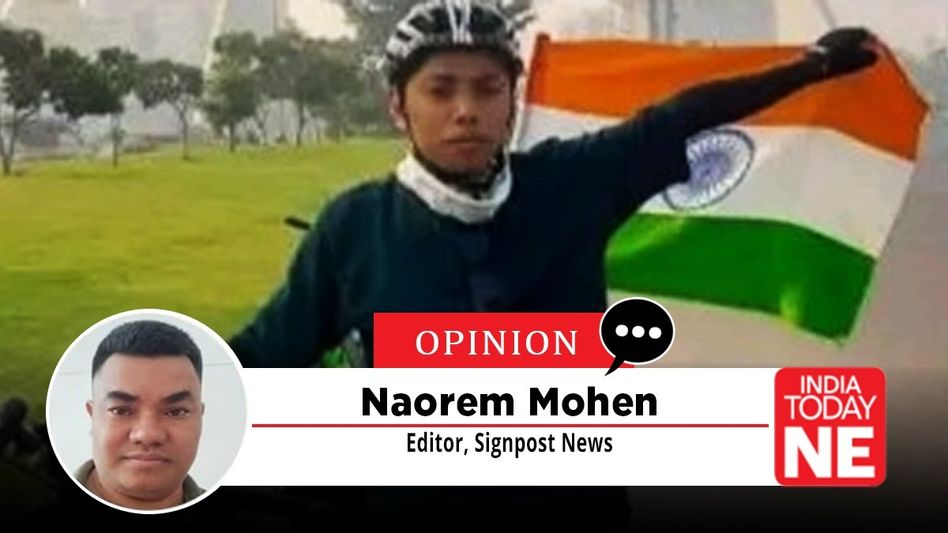
Malem Thongam, a 26-year-old transgender activist from the Meitei community, embarked on an extraordinary 3,000-kilometre "Cycling for peace in Manipur" from Delhi's Qutub Minar on October 2, 2025. Her mission: to pedal across the nation, spreading a message of unity, healing, and coexistence amid the devastating conflict that has ravaged Manipur since May 2023.
Having reached Mao Gate in Senapati district on December 17, with discussions ongoing for her final leg through Kangpokpi toward Imphal, Malem's non-violent mission arrives precisely during this sacred Christmas festive season.
This solitary mission, rooted in Peace (promoting harmony, non-violence, and solutions to bridge communal, regional, or ideological divides to foster sympathy and coexistence), Inclusion (embracing all regardless of caste, religion, ethnicity, gender, language, or geography, ensuring no one is left behind with equal opportunity, respect, and representation), and Nationwide Impact (transcending regional boundaries to inspire awareness and unity across India)—stands as a powerful call for healing in a state scarred by over two years of conflict.
Yet, as Thongam reached Mao Gate in Senapati on December 17, 2025, and prepares for the symbolic final leg through Kangpokpi toward home, the Committee on Tribal Unity (COTU)'s stern warning against her passage on December 19—invoking security concerns and the sacred Christmas season—reveals a troubling reluctance to embrace genuine reconciliation.
If COTU and its supporters have proudly waved the very same tricolor for 31 months during protests and welcomes for national leaders, will they now extend the same respect to this flag carried by a messenger of peace? Malem has been proudly carrying the Indian tricolor flag as a symbol of unity and shared nationhood!
Almost three years to complete the Manipur violence that have claimed more than 300 lives, displaced over 70,000 people, razed villages, and entrenched deep mistrust between the Meitei and Kuki communities. Thongam, a survivor herself, insists she speaks not for one side but for all Manipuris—a daughter of a wounded land crying out for reconciliation.
Malem Thongam's journey has been nothing short of inspirational, drawing overwhelming support from diverse sections of society along her route. Starting from Delhi, she cycled through Uttar Pradesh, where medical staff and police in places like Sitapur extended warm assistance and solidarity. In Bihar, particularly Patna, peace volunteers rallied around her cause, moved by her plea for humanity to rise above ethnic, religious, and caste divisions.
Reaching West Bengal, she was felicitated by the Manipuri community in Kolkata, who hosted her and amplified her call for the nation not to "look away" from Manipur's suffering. In Guwahati, Assam, her arrival sparked widespread admiration, with locals and media hailing her resilience.
Even as she pushed into Nagaland, accompanied by Meitei women from Kohima, the support continued—police escorts ensured her safe passage to Mao Gate in Senapati district on December 17, 2025.
At every halt, Malem Thongam has been greeted with open arms: citizens pledging solidarity, officials acknowledging her non-political stance, and communities transcending regional boundaries to endorse her message.
"This is not a stunt," she has repeatedly said. "It is a prayer for peace." Her journey has ignited nationwide conversations about the state's silent humanitarian crisis—orphaned children, assaulted women, abandoned elders, and families trapped in relief camps.
Transgender communities across India and abroad have voiced support, recognising her as a fearless advocate who bridges divides.
Yet, as Malem approached the most symbolic and perilous leg—the 204-kilometre stretch from Dimapur through Nagaland and into Manipur via Senapati and Kangpokpi, aiming to reach Imphal on December 19—this wave of national goodwill collided with the harsh reality of Manipur's fractured ground.
On December 17, 2025, the Committee on Tribal Unity (COTU), a prominent Kuki organisation in Kangpokpi district, issued a stern public warning urging authorities to suspend her planned passage through the area on December 19, from 8 am to 3 pm. Citing "serious security and communal concerns" and the coincidence with the Christmas festive season, COTU declared the district "extremely sensitive" and disclaimed responsibility for any "untoward incident," placing the onus squarely on the government.
This is no mere administrative caution—it is a grave assault on a peaceful initiative and a direct violation of fundamental rights. Malem Thongam is not a provocateur; she is a lone cyclist carrying a banner of reconciliation, unarmed except with hope.
By threatening to block her path, COTU is effectively imposing a de facto curfew on free movement, denying an Indian citizen her constitutional right under Article 19(1)(d) to travel freely throughout the territory of India. In a sovereign democratic republic, how can a community organisation dictate who may or may not traverse a national highway?
This obstruction exposes the grim persistence of unauthorized buffer zones and unofficial diktats that have turned Manipur into a patchwork of no-go areas, where Meiteis fear areas of Kuki and vice versa. Irresponsible actions like this not only undermine peace initiatives but also tarnish the moral high ground often claimed in the conflict.
More damningly, COTU's action raises profound questions about their commitment to peace. If Malem Thongam's pilgrimage is deemed a threat capable of sparking "communal tension," what does that say about the fragility of the so-called peace-loving and advocate of human rights stance they claim?
True reconciliation requires dialogue, not barriers; it demands welcoming gestures toward healing, not warnings that deter them. Blocking a transgender activist's non-violent, inclusive mission—especially one that explicitly transcends community lines—betrays a deeper resistance to unity.
Is COTU, by this move, signalling opposition to genuine peace efforts that do not align with narrower agendas?This timing, during the Christmas season, adds a layer of irony and hypocrisy.
Christianity, the predominant faith in Kuki areas including Kangpokpi, teaches forgiveness, love for one's neighbour, and peace on earth—core messages embodied in the birth of Christ. Yet, here we see an organisation invoking festive sensitivity to justify excluding a fellow Indian seeking harmony.
Is this in line with Christian ideology of compassion and turning the other cheek? Or does it contradict the spirit of humanity that Christmas celebrates, prioritising division over the Prince of Peace's call for reconciliation?
Malem Thongam's courage contrasts sharply with the silence—or complicity—of those in power. Elected representatives from Manipur, including MLAs and MPs meant to serve all constituents, have uttered not a word in defence of her right to free movement or in condemnation of this obstruction.
Why this deafening quietude? In a democracy, leaders must uphold constitutional freedoms, especially when a vulnerable activist risks her safety for the greater good. The central government's earlier restriction—permitting her cycle only up to Assam—already highlighted security apprehensions, yet Thongam persisted with formal requests for escorts.
Now, as she stands at Senapati's doorstep, amid ongoing discussions, the nation watches: Will authorities ensure her safe passage, or bow to pressure and halt a symbol of hope?
Malem Thongam's pilgrimage is more than a physical journey; it is a moral challenge to Manipur's divided soul and India's conscience. Supported by thousands from Delhi's bustling streets to Senapati's hills, her pedal strokes echo a universal plea: Let humanity prevail.
Blocking her is not just a crime against one individual—it is an atrocity against peace, against constitutional rights, against the very idea of a united India. If organisations like COTU truly desire healing, they should welcome her with open arms, not warnings.
And if our leaders value democracy, they must speak up now. As Christmas approaches, let us remember that true peace begins with allowing messengers of goodwill to pass unhindered.
Malem Thongam deserves to complete her journey home safe and with pride—not just for her sake, but for Manipur's future. In this season of hope and light, the choice is clear: Let Malem Thongam cycle forward—unhindered—for genuine peace in Manipur.