Revisiting nationalism through India’s historical past, politics and an Assam prediction
Review | With a Foreword by Uttar Pradesh Chief Minister Yogi Adityanath and a Preface by Himanta Biswa Sarma, the Chief Minister of Assam, the book reiterates in many ways the factors and traits that have helped shape the country today.
- Mar 10, 2026,
- Updated Mar 10, 2026, 9:41 AM IST
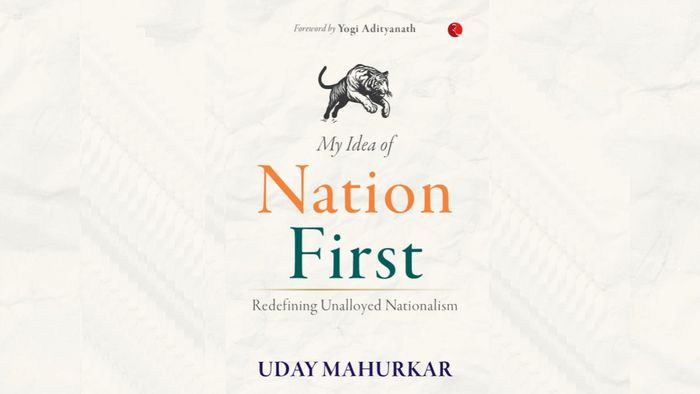
'My Idea of Nation First: Redefining Unalloyed Nationalism' by Uday Mahurkar is undoubtedly and clearly a book about politics, patriotism and India's history which goes back even to pre-Independence.
With a Foreword by Uttar Pradesh Chief Minister Yogi Adityanath and a Preface by Himanta Biswa Sarma, the Chief Minister of Assam, the book reiterates in many ways the factors and traits that have helped shape the country today.
In order to understand the bygone days, Mahurkar lays special emphasis on influential names like Swami Pranavananda, B. R. Ambedkar, Mahatma Gandhi, Jawaharlal Nehru, Chhatrapati Shivaji, Vinayak Damodar Savarkar, Bhagat Singh, Maharana Pratap, among others. It's clear how much the author has done his research and study in writing this book which no doubt is very interesting and a critical attempt to reiterate India's becoming.
As much as the book derives from major talk of the day like the whats and hows after Independence, it also focuses on a lot of communalism, Hindu-Muslim unity as well as political appeasement.
Interestingly, the book also includes a passage dedicated to Assam, something that would immediately resonate with readers familiar with the region’s long and complicated history of migration and identity. The author presents this almost as a historical prediction.
"In 1941, when Muslims from East Bengal started migrating to the Brahmaputra Valley in unusually large numbers, Savarkar was the first leader from outside Assam to warn that this influx would result in a threat to Assamese culture as well as India’s northeast frontier in the future."
The passage attempts to frame the issue as a warning that history has now proven correct. By highlighting the warning of Vinayak Damodar Savarkar and contrasting it with the response of Jawaharlal Nehru, the author presents the debate in a rather dramatic and political tone. However, the argument simplifies what is actually a far more complex history of migration and identity in Assam.
One thing that sets me apart, personally, is the author's idea of focusing a lot on the betrayal back then – something readers will have to read the book to fully understand – and also on what he sees as developments today, particularly post the intervention of PM Modi.
However, the author does not only point the flaws, he ensures he lauds moves and people where necessary. For instance, this extract clearly showcases the rule of Chhatrapati Shivaji which many still might not acknowledge.
"Shivaji’s true greatness in Indian history is missed by most historians. A glaring miss by historians in their evaluation of Shivaji is not considering the extent of his kingdom when he died in 1680..."
Also Read: 'River Traveller' is one man’s quiet pursuit of the mighty Brahmaputra
On the other hand, most passages in the book feel argumentative rather than critically reflective – the book stands as a very personal account of the author, one that many people would relate with while others might find the content too much to digest.
Some extracts invite a debate as the tone is openly accusatory. "There is a race going on between the left and non-Rashtriya Swayamsevak Sangh (RSS) ideologues and historians to prove that B.R. Ambedkar was an antithesis of the RSS and vice versa"
Other similar references to figures like Ramachandra Guha and ideas linked to Vinayak Damodar Savarkar are used more to support a political stance than to explore Ambedkar’s complex legacy.
'My Idea of Nation First' is not a simple everyday read; it attempts to deal with complicated historical relationships and ideological defences.
Sometimes, readers may find themselves questioning whether or not the argument in the book is one-sided and harsh.
"In Pakistan or Partition of India Ambedkar writes: The methods adopted by the Muslim invaders have left behind them their aftermath. One aftermath is the bitterness between the Hindus and the Muslims which they have caused. This bitterness between the two is so deep-seated that a century of political life has neither succeeded in assuaging it, nor in making people forget it."
The extract attempts to explain the historical roots of bitterness, though the language is deeply emotional and leaves little room for complexity or shared histories.
The book also talks at length about atrocities posed by Muslims on Hindus, pertaining to women, caste, politics, power and influence. It is clearly up to the readers whether they are comfortable reading such tense accounts about a relationship that remains sensitive even today.
Another chilling extract is rather unsettling: "Describing a picture of a darbar of Sultan Mohammed Bin Tughlaq on the day of Eid, Moorish traveller and religious preacher, Ibn Battuta wrote: As we were sitting in the darbar, Hindu girls of all hues, from daughters of kings and brahmins and from lower classes, were brought in groups in the darbar, made to dance and then distributed amongst the nobles in slavery and concubinage. I was presented with three such girls but I already had four. So I distributed some of these amongst my slaves."
The book also talks about decisions pertaining to China, Pakistan and other major developments that shaped the political and regional landscape of the country.
Moving further, the author also lists what he calls ten controversial acts of Mahatma Gandhi that left a negative imprint. There is also an entire section focusing on Pakistan, which again depends on readers’ perspectives and interests.
All in all, the book is not an easy read. It revisits several historical and political debates that shaped India. Personally, much of the narrative felt centred on communalism, something I did not quite relate to. However, readers who enjoy politics and India’s historical debates may find it engaging.