Manipur University’s two-day seminar asks how literature can keep the state’s living heritage alive
At Manipur University, a call to document living heritage raises a question for a state marked by displacement. What will the next generation know of a village if it inherits only the official record of what happened there?
- Nov 27, 2026,
- Updated Nov 27, 2026, 4:05 PM IST
The Department of English and Cultural Studies received around 100 papers for its two-day national seminar, “Contemporary Perspectives on Intersections of Literature, Language and Culture”.
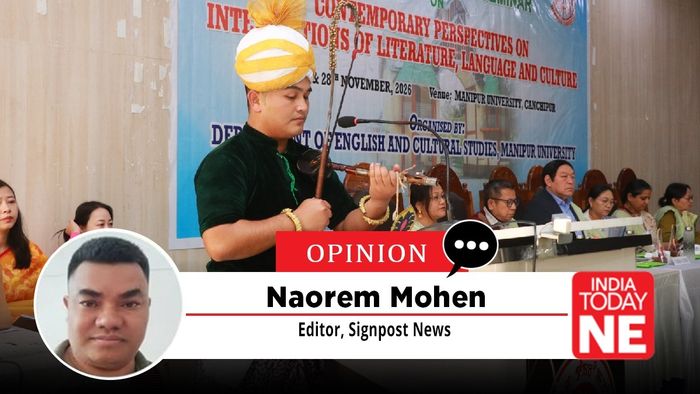
Before the speeches began at Manipur University’s national seminar on literature, language and culture on Friday, those gathered at Canchipur heard Yakairol performed with the pena. A report of the occasion can preserve that much in a sentence. A student reading it twenty years from now may have other questions. What did the words mean? Why was this piece chosen to open a gathering? What could a listener familiar with the tradition hear in the relationship between the voice and the instrument? Some of the people who can answer those questions are here among us. Whether we take the time to ask them will determine how much that future student can understand.
Poet and translator Dr. Robin S. Ngangom, Prof. Devjani Ray and Prof. Toijam Tampha Devi attended as Guests of Honour. Dr. Ph. Jayalaxmi, Associate Professor in the department, delivered the welcome address, and Dr. Ch. Diana Devi, Assistant Professor, proposed the vote of thanks.
Nearly 30 examine the folklore and belief systems of the Meiteis and other communities of Manipur. Prof. R. K. Ashalata Devi, who heads the department, observed that most of the papers submitted in Manipuri dealt with folklore. Among the contributors were students still in the third semester of their postgraduate studies. There is something hopeful in the fact that young people, given the freedom to frame a research question, should find one worth asking in a story they may first have heard at home.
For Manipur, that interest has a particular urgency. In her keynote address, seminar convener Prof. Nongmaithem Banita Devi spoke of the diminishing opportunities for younger people to learn songs and folktales from their elders. Displacement gives her observation a painful immediacy. A child may still have a grandmother to tell a story and yet be unable to walk with her to the field, stream or courtyard that gives a passage its meaning. What the elder could once explain by pointing now has to be reconstructed in words. For a child growing up away from the village, the name used at home for that stream may be the most intimate piece of geography the family can pass on.
This is where literature has a responsibility towards the issues Manipur is living through today. An official record can establish when a family left its village, how many members were displaced and where they found shelter. A mother remembering the last ordinary evening at home may begin somewhere else altogether, with a meal she was preparing or a promise she made to a child and expected to keep the following morning. Both accounts matter to an understanding of displacement. Yet it is often the second that goes unrecorded. Oral testimony, memoir, poetry and fiction each give people a different way to speak about an experience whose consequences continue long after the date entered in a register. Our writers and scholars can begin that work now, while the people concerned can choose what they wish to share, in which language and under whose name.
Prof. Toijam Tampha Devi, Dean of the School of Humanities, gave that responsibility a practical direction. Vice-Chancellor (in-charge) Prof. R. K. Hemakumar Singh had urged scholars to help document lesser-known aspects of Manipur’s cultural life.
Prof. Tampha Devi, who chairs the university committee preparing a report on the state’s intangible cultural heritage, said she could already see material relevant to the report in the seminar’s book of abstracts. She welcomed the idea of a dedicated seminar on Manipur’s intangible cultural heritage and expressed her willingness to take it forward with the cooperation of colleagues and researchers. She particularly welcomed the contributions from scholars of the hill communities. Their participation matters to any undertaking that proposes to speak of the heritage of Manipur as a whole.
Such a seminar could begin with a question for the people whose knowledge it hopes to preserve. If a singer agrees to have a song recorded, what does she want a future listener to know before hearing it? She may wish to explain who taught it to her, on what occasions it is sung, or why another village sings a passage differently. Those details belong alongside the words and the recording. They also leave room for two communities, or two elders within the same community, to remember differently. A university does a service to both when it allows each account to be heard in its own terms.
Language determines how much of that understanding reaches the reader. Prof. Tampha Devi herself began in Manipuri and explained that she would also speak briefly in English out of regard for Prof. Devjani Ray of Miranda House, University of Delhi. It was a small courtesy that gave the seminar’s theme a recognisable human form. Prof. Ray acknowledged the reach English gives a scholar across borders while asking whose knowledge receives less attention when English dominates publishing and higher education.
“Each language carries with it a distinctive archive of human experience,” Prof. Devjani Ray observed. Anyone who has tried to translate a family story will recognise what she meant. An elder may refer to someone by a kinship term that tells a local listener who had the right to tease whom, or why a particular remark caused hurt. An English reader given only the word relative could follow every event in the story and still miss the reason it was remembered. This gives particular weight to Prof. Nongmaithem Banita Devi’s appeal for care in translation. Keeping the original expression and letting the speaker explain it can preserve something that even a fluent translation might lose.
Prof. Devjani Ray also asked us to consider how literature shapes what a society remembers. A novel may follow one person’s life, she said, yet through that life a reader comes to know the customs, inequalities and beliefs that shaped an entire household. That insight matters in Manipur, where a child growing up away from an ancestral village may first encounter it through someone else’s account of the violence. A poem, a memoir or a story told in the family’s own language can give that child a sense of the village on an ordinary day, when the people who lived there had other things to talk about. One responsibility of documenting Manipur today is to leave room for people to say what they remember of home in the words they would choose for their own children.
Prof. Banita Devi raised the corresponding difficulty for the translator. A word that names a relationship may also tell a Manipuri listener how one person is expected to address or care for another. An English equivalent can identify the relative and lose the obligation. Sometimes the most faithful choice is to keep the original word and give the reader enough of the story to understand why it matters.
Prof. Tampha Devi also asked what becomes of a paper after its author receives a certificate. Her suggestion deserves to be taken up. Session chairs could give presenters specific comments, allow them about a week to revise their work and bring the revised contributions together in a volume for future students. For a postgraduate student working on a first paper, a chair who asks, “Did the storyteller explain why that word was used?” may open a line of inquiry the student had overlooked. A return visit to the storyteller can then improve the paper and give the person who shared the account a chance to correct a misunderstanding. That is a substantial outcome for an academic gathering.
The department has already made room in its postgraduate curriculum for folklore, oral literature, Northeast literature in translation and Manipuri literature in translation. It also plans to publish selected seminar papers in a special issue of a peer-reviewed journal. The Vice-Chancellor’s proposal for the humanities and social science departments to jointly organise an international seminar offers a further opportunity to take research from Manipur to readers elsewhere. As that audience grows, the university should also think about the reader closest to the source. A copy of a recording or a bilingual account returned to the family or village that shared it may find its most attentive reader there.
Years from now, a young person whose family was displaced may want to know what happened to the village. They may also want to know what it was like to belong there before anyone in the family had occasion to use the word displaced. What songs did people know? What names did they give the places they loved? What did their elders find funny enough to tell the same story again? These, too, are questions about Manipur’s history. The promise of the gathering at Canchipur lies in whether a future reader, asking one of them, will still be able to hear someone from home answer.