Why Do Kuki CSOs Never Listen to the Pain of Their Own IDPs?
As expected, within hours of Former Speaker and Minister Yumnam Khemchand visited the Kuki IDPs at Litan Sareikhong in Ukhrul district, three separate statements were issued, accusing the former Speaker of “opportunistic intrusion” when most men were away at work, claimed he only took selfies with unsuspecting children, and alleged valley media had “merged unrelated footage” to manufacture a false narrative of interaction.
- Dec 09, 2025,
- Updated Dec 09, 2025, 5:17 PM IST
As expected, within hours of Former Speaker and Minister Yumnam Khemchand visited the Kuki IDPs at Litan Sareikhong in Ukhrul district, three separate statements were issued, accusing the former Speaker of “opportunistic intrusion” when most men were away at work, claimed he only took selfies with unsuspecting children, and alleged valley media had “merged unrelated footage” to manufacture a false narrative of interaction.
Kuki Inpi Ukhrul District (KIU), the apex Kuki body in the district, called the visit “uninvited, unauthorised, and profoundly disrespectful”, accused Khemchand of political posturing.
A joint statement from KSO-Ukhrul, Village Authority, and Youth Club of Litan-Sareikhong distanced themselves completely from the visit and warned against “calculated actions” meant to gain visibility.
Supporting the above three Kuki CSOs, the Kuki-Zo Council (KZC), an unregistered body with no legal standing under the laws of the state, has also objected to the December 8 visit by a duly elected Member of the Legislative Assembly today, claiming that the MLA should have sought prior permission from its leaders, camp authorities, or district officials. Critics have pointed out that the KZC, which is neither a statutory body nor recognised by any legislative or governmental framework, has no authority to issue directives to an elected representative of the people. Such demands for “permission” from an unregistered organisation, they argue, are unwarranted and risk undermining the legitimate authority of elected MLAs while further straining the already delicate ethnic relations in the state
Notice what is missing in all three statements.Not a single word of concern for the IDPs who spoke on camera begging to go home. Not a single acknowledgement that the displaced themselves asked the government for help to return. Not a single line saying, “Yes, our people are suffering after 31 months — we will amplify their demand for safe return.
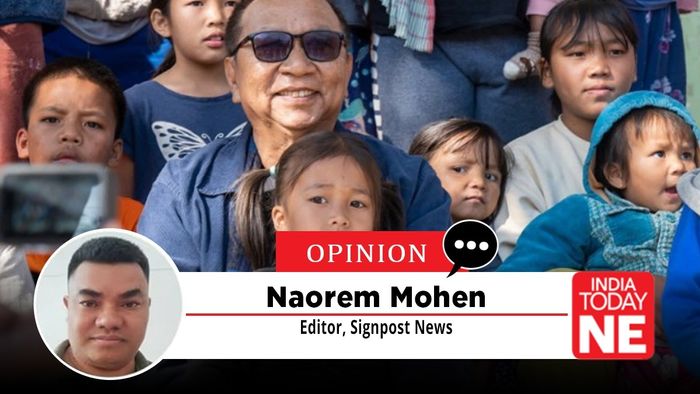
On 8 December 2025, Y Khemchand visited the Kuki IDPs staying in the relief camp at Litan Sareikhong Relief Centre in Ukhrul district. He was accompanied by two prominent Tangkhul Naga leaders — state BJP vice-president Hopingson Shimray and former ADC chairman Mark Luithing — both respected voices for peace in the Naga hills.
Children crowd around the visitors, some smiling shyly, some just staring with the hollow eyes that only prolonged displacement can produce. MLA Khemchand holding a cute kuki baby in his arms listens, nods, wipes away a tear, and promises to take their message to concerned authorities.
He speaks of Christmas as a season of forgiveness and peace. He reminds everyone that elders may quarrel, but children must not inherit enmity.
From the earliest days of the conflict, the longing has been identical on both sides of the divide: Kuki displaced families yearning to return to their homes and lives in the Imphal valley, just as Meitei displaced families have fought relentlessly to go back to their villages in the hills.
That common human ache has never disappeared, no matter how loud the slogans became.It was already clear as far back as July 2024. When Manipur Human Rights Commission Chairperson Justice UB Saha led a team to two relief camps in Kangpokpi and spent hours listening to the displaced, he came away with one overwhelming message.
At a press conference in Imphal he stated plainly: the IDPs at Kangpokpi repeatedly told him they wanted to return to their original homes in Imphal. There was no ambiguity, no rehearsed political line, only the same quiet plea that has surfaced again and again whenever the displaced are allowed to speak without fear. The desire to go home has always been there; only the willingness of certain organisations to carry that desire forward has been missing.
For thirty-one months the same whisper has floated down from the hills like smoke that will not clear: “When can we go home?”
In the valley it is a war-cry. COCOMI plants it on banners, Meira Paibee Imas lighted the streets to make it clearly seen by the President Rule administration, students choke the highway until the government coughs up another promise. Every leaking roof, every child studying under dim light, every delayed sack of rice is treated as an assault on Meitei honour, and the valley’s civil society fights the state tooth and nail, abuses ministers, blockades roads, drags authorities to the camps and forces them to eat the same watery dal.
They want the camps emptied, even if they have to burn Imphal down to make it happen.Cross the invisible border, created by some Kuki CSOs and the same whisper meets a wall of ice.
Twenty to thirty thousand Kuki-Zo souls live in relief camps, asking the same question softer, almost afraid, because they have learned what happens when they speak too loudly.
Instead of listening to the problems, their sufferings are photographed, packaged, flown to Delhi and Geneva as proof of “genocide”, but the moment the victims themselves say “we are ready to go back if you give us security,” the apex bodies swing into action to discredit, deny, and drown them out.
That machinery was exposed in broad daylight in the first ten days of December 2025. On 8 December, inside the Litan-Sareikhong relief camp in Ukhrul, something extraordinary happened. A Kuki man named Nehpu Khongsai stood up in front of former Speaker Yumnam Khemchand Singh and, in flawless Meiteilon (the language of the state that Kukis are supposedly forbidden to speak now), poured out his heart: “We have been in the relief camp for almost three years now. We are suffering a lot and we would like to request the government to help us return to our original homes.”
They are not victims in a conflict — rather, they are just pawns in a political project. No script, no gun to his head, no rehearsed slogans—just a human being speaking a language of shared history to another human being, begging for the simplest thing in the world: home.
Whenever CSOs intervene, they choose narrative over reality.That single incident at Litan is the whole conflict in miniature. In the valley, COCOMI would have turned Nehpu into a hero, printed his photograph on posters, dragged the Governor to his village site, and blockaded the secretariat until the first convoy of returning families rolled out.
However in the hills, Kuki Inpi, KSO, and the camp committee treated his honest longing like a dangerous virus that had to be quarantined immediately.
Remember August 2025, when CRPF DIG Manish Kumar Sachar emerged from weeks of camp visits and told reporters the only thing the displaced ever asked him for was to go home. Unfortunately, Kuki MLA Paolienlal Haokip slapped him down: “IDPs wishing to return home doesn’t mean they don’t have political demands. Security officials must stick to their job, not meddle in politics."
It is deeply distressing that displaced Kuki individuals, including innocent civilians who simply wish to return to their homes in the Imphal Valley and speak of peace, are compelled to issue public clarifications almost immediately after expressing their views.
In the latest instance, Kuki Nehpu Khongsai, who had briefly shared his longing for reconciliation and a safe return to his own house in the valley through social media and a media interview, was forced to release a clarification shortly afterward. This recurring pattern—where voices advocating for peace and normalcy from the Kuki people are swiftly silenced or made to retract their statements—reveals the immense pressure and fear under which internally displaced Kukis continue to live, even when all they seek is the basic right to go back home and live in harmony.
Every international Zoom call with “human rights defenders”, every representation to the Prime Minister’s Office, every memorandum to the World Organizations begins with photographs of those camps.That is why no Kuki CSO has ever organised a single rally, sit-in, or public hearing demanding accelerated rehabilitation and safe return of IDPs to mixed areas like Imphal, or the foothills.
That is precisely why not a single one of the ten Kuki MLAs has ever bothered to lobby the Outer Manipur MP or rally their supporters to move a calling-attention motion in Parliament about the appalling living conditions inside the relief camps they claim to champion. The suffering of their own people is not a tragedy to be ended; it is a resource to be managed, a grievance to be prolonged, and a photograph to be brandished whenever the demand for separate administration needs fresh emotional fuel.
This exposes the hypocrisy of Kuki CSOs and their ten suspended MLAs. For two and a half years these same organisations have kept thousands of their own people languishing in miserable relief camps, using their suffering as a bargaining chip for separate administration, yet the moment a senior Meitei leader risks his life to visit one camp and hear directly from displaced women and children, suddenly everyone is “meddling.”
Their real fear is not heavy security—it is the sight of camp residents speaking freely in Meiteilon, expressing a desire to return home, and shattering the narrative that every Kuki is permanently traumatised and separatist. The only politics being played here is the CSOs’ determination to keep their people as political hostages rather than let any genuine reconciliation take root.
In the valley the camps are a wound that must be closed at any cost. In the hills the camps are an investment. Every malnourished child, every mother clutching a faded photograph of their deceased sons, every plastic sheet flapping in the wind is capital.
Empty the camps and the demand for separate administration collapses overnight. Keep them full, keep the inhabitants frightened and on script, and you have an endless supply of tears to show the world.
Moreover, the Kuki CSOs’ dramatic outrage over Y. Khemchand’s visit to the Litan relief camp in Ukhrul is nothing short of territorial arrogance dressed up as victimhood. A sitting MLA and former Speaker—escorted by senior Tangkhul Naga leaders—took the enormous personal risk of driving from Imphal into the hills to meet displaced Kuki women and children, spoke words of reconciliation, and was rewarded with a public shaming for being “uninvited.”
It is widely discussed on social media that some Kuki groups appear uneasy whenever Naga leaders try to play the role of bridge-builders between communities. This discomfort seems reflected in the repeated phrasing of their statements — “limited movement allowed out of respect for Tangkhul peace commitment” — which many interpret as a subtle reminder: the Imphal–Ukhrul road stays open only as long as the Tangkhuls guarantee calm, not because anyone is genuinely welcome to restore broader people-to-people contact across the divide. The message, intentional or not, comes across as a caution against letting Naga goodwill go too far toward actual reconciliation.
The message is crystal clear: even in a Naga-majority district, Kuki organisations now claim the right to decide which elected representatives of Manipur can set foot in a relief camp that exists only because of the state’s tax money and security forces. This is not protocol; this is a power grab.
If Kuki bodies believe they alone own the displaced people they claim to protect, they have turned humanitarian spaces into private fiefdoms. They lecture about “trauma” and “sensitivity” while conveniently forgetting that the same camp residents include children who told Khemchand, in fluent Meiteilon, that they just want to go home—if only someone guaranteed their safety.
Yet instead of welcoming the first concrete outreach from a valley leader in two and a half years, Kuki organisations chose to slap him with statements about “unauthorised entry” and “excessive security.” The truth is simple: they don’t want reconciliation on anyone else’s terms. They want the camps to remain permanent symbols of grievance, political bargaining chips for their separate-administration demand, and no Meitei face—even one bearing olive branches—must be allowed to humanise the narrative.
This tantrum in Ukhrul district further proves the hardliners among the Kuki CSOs are the biggest obstacle to peace in Manipur today. They have effectively declared that ten suspended Kuki MLAs speak for the displaced, that valley politicians need their permission slips, and that Naga hospitality can be overruled whenever it inconveniences their politics.
The statements from Kuki CSOs are not really about protecting traumatised IDPs. They are indeed a cold warning to Nagas in Ukhrul and Kamjong: “Do not normalise contact with Meiteis. Do not become bridges. Stay on the Kuki side of the separatist project.”This is the core truth that the last two and a half years have laid bare: Kuki CSOs are not representatives of suffering people. They are custodians of a political project whose fuel is continued displacement.The IDPs are not their constituency.The Kuki IDPs are their most potent weapon.
Until they drop this siege mentality and allow genuine people-to-people contact without scripted outrage, the road home for those 173 Kuki IDPs families in Litan —and thousands more—will stay blocked by none other than their self-appointed guardians.
The state saw a Kuki man begging a Meitei leader to take him home. Meitei civil society wants every displaced family back in their village tomorrow, even if they have to drag the face the laathicharge and tear gas shells from the security forces.
Kuki civil society needs the camps to remain museums of grievance for as long as it takes to carve out a new utopian homeland. One side treats its displaced as citizens whose dignity is non-negotiable. The other treats them as exhibits—and the exhibits are not allowed to speak out of turn.
Let the people speak. Let the displaced return. Let peace begin with honesty, not with rehearsed statements issued under duress.
Manipur will heal the day its leaders compete to empty the relief camps rather than to keep them occupied as museums of grievance.Until that day, one question will continue to echo in every congested relief camps from Litan to Lamboikhongnangkhong:If our own organisations will not listen to our pain,
who are they really fighting for?