61 Years After the Hunger March, Can a Divided Manipur Recover Its Lost Unity?
The students who marched against an artificial rice scarcity in 1965 were defending a common right—the right of the people to live with dignity. Today, Manipur needs that collective spirit again to address the NRC–Census controversy, resettle displaced families and restore genuinely free movement on its highways.
- Aug 27, 2026,
- Updated Aug 27, 2026, 6:04 PM IST
The students who marched against an artificial rice scarcity in 1965 were defending a common right—the right of the people to live with dignity. Today, Manipur needs that collective spirit again to address the NRC–Census controversy, resettle displaced families and restore genuinely free movement on its highways.
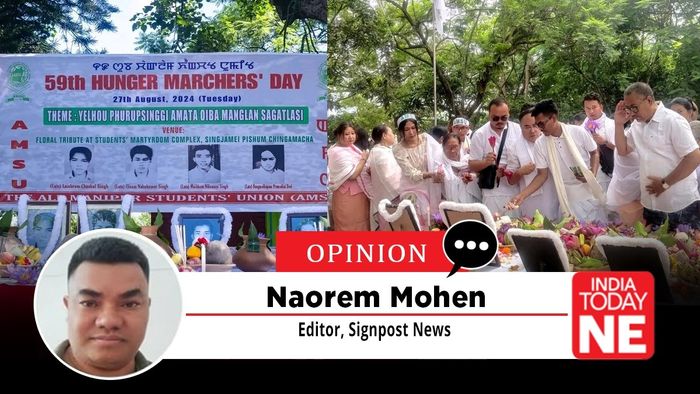
On the 61st Hunger Marchers’ Day, former Manipur Chief Minister N. Biren Singh paid tribute to Waikhom Nilamani, Oinam Nabakumar, Nongmeikapam Pramodini and Laishram Chaobhal Singh—the four young lives lost during the historic agitation against an artificial scarcity of rice in 1965.
His message carried an important sentence: their sacrifice must be honoured “not only with words” but through a commitment to the welfare, dignity and future of the people.
That statement should not remain ceremonial language. It should become the standard against which every government, political party, student body and civil-society organisation in Manipur is judged.
Hunger Marchers’ Day is not merely an occasion to remember four martyrs. It is also a reminder of what the people of Manipur once achieved through collective action—and what the State has gradually lost through division, mistrust and competing political interests.
In 1965, hunger was recognised as a common crisis. Today, even questions affecting Manipur’s collective future—the Census, the National Register of Citizens, the resettlement of internally displaced persons and the reopening of national highways—are being approached through divided ethnic and geographical positions.
The greatest tribute to the Hunger Marchers would therefore be to recover the spirit of unity that made their movement historic.
On August 27, 1965, students and ordinary citizens marched towards the official residence of the then Chief Commissioner. Manipur was facing an acute scarcity of rice, widely blamed on hoarding, profiteering and failures in the distribution system.
The protesters were demanding something elementary: the availability of food and a functioning ration system. Security forces opened fire.
Waikhom Nilamani, Oinam Nabakumar and Nongmeikapam Pramodini died that day. Laishram Chaobhal Singh succumbed to his injuries on September 26. The firing also left several others injured.
The incident helped produce a unified student platform, and the formation of the All Manipur Students’ Union is traced to a meeting held the following day.
The 1965 movement represented more than anger over the price or availability of rice. It asserted that access to food is inseparable from human dignity and that an administration must remain answerable when its policies fail the people.
It was also a movement born from a shared crisis. Those who marched did not ask whether hunger belonged to one locality, class or community. Artificial scarcity threatened the public, and the response was collective. The movement succeeded in becoming a defining chapter of Manipur’s history because it rose above narrow individual interests. That unity appears increasingly distant today.
Manipur’s present crisis is not limited to physical separation between communities. It has also weakened the State’s ability to build a common position on questions that will affect generations to come.
The continuing debate over whether an updated NRC should precede the Census is one example. The people need an institutional process they can trust—not another confrontation between communities.
Student organisations, civil-society bodies, elected representatives and experts from both the hills and the valley should therefore sit together and formulate a common minimum position. Agreement on every historical or political claim may not be immediately possible. Agreement on transparent procedures, protection of genuine citizens and prevention of fraudulent enumeration should be possible.
Nothing demonstrates Manipur’s loss of collective responsibility more painfully than the continued displacement of thousands of people.
More than three years after the violence that began on May 3, 2023, families from different communities remain unable to return to their homes. Children have grown up in relief camps. Families that once lived through farming, employment or small businesses remain dependent on assistance whose release is not always predictable.
Complaints over delayed ration money and the non-delivery of essential supplies have emerged from relief camps in both the hills and the valley.
Hunger has no ethnic identity. Displacement should not have one either. A displaced Meitei family, a displaced Kuki family or a displaced person belonging to any other community has the same fundamental need: safety, food, shelter, education, healthcare and the right to return home with dignity.
Manipur must stop treating IDP resettlement as the responsibility of only the community to which the displaced families belong.
Valley organisations must be able to demand the safe resettlement of displaced families in the hills. Hill organisations must be able to demand the safe return of displaced families to the valley. Political representatives must speak for every displaced citizen—not merely those regarded as members of their electoral or ethnic constituency.
The Government must prepare a transparent, village-wise and locality-wise resettlement roadmap with timelines, security assessments, reconstruction support and compensation. Resettlement cannot mean placing a few families in vulnerable areas for a photograph and later describing it as normalcy.
It must involve the restoration of homes, livelihoods, schools, healthcare, local administration and confidence between neighbouring communities.
Until displaced families can return safely, claims of restored peace will remain incomplete.
The same principle applies to Manipur’s national highways. The resumption of escorted bus services may be a welcome beginning, but selected buses moving under heavy security do not by themselves prove that free movement has been restored.
A highway is genuinely open only when ordinary citizens, regardless of community identity, can travel without fear of being stopped, identified, threatened or forced to return.
The Imphal–Dimapur and Imphal–Moreh highways are not the private property of any community, organisation or territorial authority. They are public roads connecting citizens, markets, hospitals, educational institutions and livelihoods.
No community should impose an informal ethnic permit system on a national highway. At the same time, no government should send civilians into sensitive areas merely to create an appearance of normalcy without first establishing adequate security and local confidence.
Reopening the highways requires more than deploying security escorts. It requires dialogue with communities living along the routes, enforcement of the law against anyone obstructing citizens, protection for passengers and drivers, and a public declaration explaining who may travel and under what security arrangements.
The ultimate objective must not be the movement of selected government-approved buses. It must be the safe movement of every law-abiding citizen.
Manipur cannot claim territorial unity while its citizens remain unable to travel through parts of their own State.
Even after six decades, Manipur remains structurally vulnerable in food production and distribution.
The State’s Economic Survey for 2024–25 estimated clean-rice production at 3,61,910 metric tonnes from the 2024 kharif and pre-kharif paddy crop. Paddy productivity was estimated at 2,470 kilograms per hectare, below the cited national average of 2,700 kilograms.
An earlier government survey estimated a foodgrain shortfall of about 2.67 lakh tonnes in 2019–20, with production of approximately 3.90 lakh tonnes against an estimated consumption requirement of 6.78 lakh tonnes.
Dependence on supplies from outside is not automatically a failure. But heavy reliance on highways vulnerable to blockades, conflict, landslides and political pressure places the entire population at risk. Interruption of movement can quickly become interruption of food.
Manipur therefore needs a comprehensive food-security policy involving irrigation, protection of agricultural land, assured markets, storage facilities, modern rice mills and support for cultivation in both the hills and valley.
The phrase “self-reliant Manipur” must be measured not through slogans but through how much food the State can sustainably produce, store and distribute.
N. Biren Singh was right to say that the martyrs must be honoured through a commitment to welfare, dignity and the future of the people.
Every leader offering flowers or publishing a commemorative message should be prepared to answer some direct questions.
Has Manipur reduced its foodgrain deficit? Are ration entitlements reaching beneficiaries without diversion? Are displaced families receiving assistance on time? What is the concrete roadmap for their resettlement? Can citizens from every community travel freely on the national highways? And can the Government conduct the NRC and Census through a transparent process trusted by all communities?
These are not partisan or ethnic questions. They concern Manipur’s collective survival.
The martyrs of 1965 do not belong to one organisation, political party or community. Their sacrifice belongs to the people. Every administration and every generation carries the responsibility created by it.
The four Hunger Marchers did not sacrifice their lives so that future generations could remember their names while remaining silent about present injustices. They stood against a system that failed the people. Their courage created unity at a moment of public distress.
Today, Manipur needs that spirit again—not to erase differences, but to prevent those differences from destroying the State’s shared future.
There must be a common commitment to conduct the Census and any NRC exercise lawfully and transparently. There must be a collective demand for the dignified resettlement of every displaced family. There must be an agreement that highways belong to all citizens and that no community can deny another community the right to travel.
Unity does not require every community to accept the same historical narrative. It requires everyone to recognise that Manipur cannot move forward while one section remains displaced, another feels demographically threatened and citizens are afraid to cross an ethnic boundary.
In 1965, the people marched together because rice was being denied to them. Sixty-one years later, Manipur must come together because peace, movement, truth and trust are being denied to everyone.
Floral tributes preserve memory. Speeches acknowledge sacrifice. But the truest homage to the Hunger Marchers would be a united Manipur in which no citizen must march for food, plead for resettlement, fear an honest enumeration or seek permission to travel through their own State.