Assam is remembering Sukapha to look East. Why is Manipur forgetting its own Eastern history?
Assam's plan to commemorate 800 years of Chaolung Sukapha's arrival offers Manipur an important lesson: India's Act East Policy needs not only new highways to Southeast Asia, but also the preservation of the old historical connections that once linked Manipur with the Pong/Tai-Shan world.
- Aug 16, 2026,
- Updated Aug 16, 2026, 12:59 PM IST
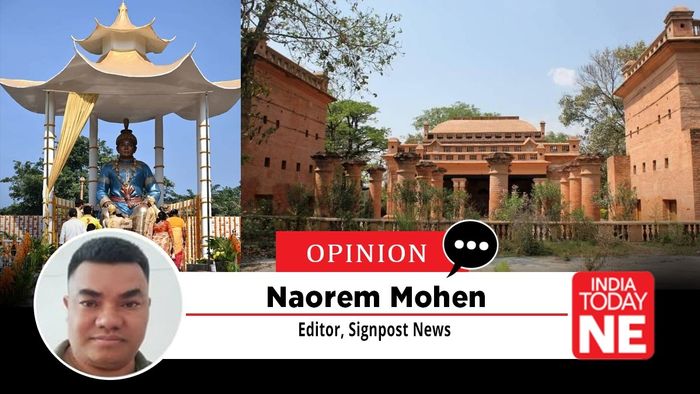
Assam's decision to commemorate 800 years of Swargadeo Chaolung Sukapha's arrival in the Brahmaputra Valley in 2028 should make neighbouring Manipur pause and reflect. Chief Minister Himanta Biswa Sarma has announced a grand programme to mark the historic milestone and showcase Sukapha's legacy and Assam's cultural heritage to India and the world. There is a larger message in that decision. Assam is not simply remembering an ancient ruler. It is recognising that history can become cultural capital and that an eight-century-old connection with the East can have contemporary meaning.
For Manipur, through which India's Act East ambitions physically travel towards Myanmar and Southeast Asia, that lesson is particularly relevant. Manipur does not have to invent a historical narrative connecting itself with the East. It already possesses one. Manipur Was Looking East Centuries Ago. Long before "Look East" and "Act East" entered India's diplomatic vocabulary, the Meitei kingdom maintained political, diplomatic and cultural relations with the Pong or Tai-Shan world lying to its east. These relationships survive in historical traditions and chronicles.
Accounts concerning the reign of King Kyamba, for instance, record an important relationship between the Meitei ruler and the Pong king Khekhomba. Historical traditions describe their joint campaign in the Kabaw Valley in the fifteenth century, exchanges of gifts and a subsequent understanding over territories and boundaries. Whatever disagreements historians may have over particular dates, genealogies and details contained in old chronicles, the broader historical reality is difficult to ignore: Manipur was deeply connected with political worlds lying east of its present international boundary. The mountains were not simply barriers. They were corridors. Kings negotiated across them. Armies marched through them. Communities migrated through them. Cultural practices, technologies and ideas travelled through them. The modern India-Myanmar boundary did not define the political imagination of those times. That historical geography should have given Manipur an extraordinary advantage when India began looking towards Southeast Asia.
Yet our contemporary discussion of Act East has become overwhelmingly centred on roads, bridges, border trade and Moreh. These are essential. But connectivity cannot be built with asphalt alone. History creates familiarity. Culture creates trust. And Manipur possesses centuries of both.
The memory of Pong in Manipur goes deeper than Pong Lambi. Historical traditions speak of Apong Ingkhol, or Pong Ingkhol, associated with the presence of people from the Pong/Shan world close to the political heart of the old Meitei kingdom. Accounts referring to the royal chronicle relate that Samlung, identified as the younger brother of a Pong king, came to Manipur and stayed for a prolonged period at Apong Ingkhol. The place is described in historical writings as lying east of Kangla — the seat of the Meitei kings. Whether every chronological detail preserved in these old traditions can be reconciled with modern historical scholarship is a legitimate subject for historians. But the memory itself is significant. A place associated with Pong existed close to Kangla.
That is an extraordinary historical image. It suggests that Manipur's engagement with the Tai-Shan world was not remembered merely as distant warfare somewhere beyond the Kabaw Valley. People associated with that world entered the social and political space of the Manipur kingdom itself. Apong Ingkhol also appears in accounts relating to later periods of Manipur's history, suggesting that the place continued to acquire new social and cultural associations over time. This is precisely what makes old place names valuable. They are historical layers preserved in geography. Pong Ingkhol and Pong Lambi therefore deserve to be studied together — not necessarily because one can immediately prove that every tradition surrounding them belongs to the same historical episode, but because both preserve the word "Pong" within Manipur's physical landscape.
For a state that today presents itself as India's gateway to Southeast Asia, that surviving vocabulary should provoke curiosity. What was Apong Ingkhol? Who lived there? Why was it associated with Pong? What historical relationship produced the name Pong Lambi? And what remains of these places today? These questions deserve archaeological, archival and historical investigation before urban expansion makes them impossible to answer. Manipur does not merely possess chronicles telling us that our ancestors looked East. The map of Imphal itself may still carry their memory. We do not have to search only in manuscripts to discover memories of Manipur's eastern connections. One survives in the landscape of Imphal itself. Pong Lambi, which passes through what is now the JNIMS complex at Porompat, has been at the centre of a long public dispute over access. JNIMS authorities closed the road around 2010. The closure eventually led to sustained opposition from residents of surrounding areas and the formation of a Joint Action Committee demanding that Pong Lambi be reopened. The agitation continued for years.
In September 2017, Pong Lambi was formally reopened at JNIMS Gate No. 3. At the reopening ceremony, the then JNIMS Director said that the road had been closed following an inspection by a Medical Council of India team and that it was being reopened on the instructions of the Chief Minister N Biren Singh because of the hardship faced by local people. For years, the debate surrounding Pong Lambi has therefore largely been about public access. But there is another question worth asking. Why is it called Pong Lambi? Place names are sometimes archives without walls. They preserve memories long after the political worlds that produced them have disappeared. If Pong Lambi preserves a memory associated with Manipur's long encounters with the Pong world, then its significance extends beyond whether vehicles and pedestrians can pass through a hospital campus. It belongs to a historical landscape that deserves research, documentation and interpretation.
This does not mean that the requirements of a modern medical institution should be ignored. Hospital security, patient safety and healthcare infrastructure are legitimate concerns. Nor does heritage conservation mean that every old road must remain physically unchanged forever. But when a road carries an old historical name, surely we should at least know the history before the memory disappears. A heritage marker explaining the history of Pong Lambi would cost little compared with the enormous sums India is investing in physical connectivity under Act East. Its symbolic value, however, could be immense. There is an irony here. We are spending enormous resources searching for new roads to the East while barely remembering the stories carried by the old ones.
This is where Assam's Sukapha initiative offers a lesson. The point is not to compare Sukapha with a Manipuri king. Nor should Manipur manufacture a parallel celebration simply because Assam is organising one. The lesson is about what a society chooses to do with its history. Assam is taking an event from 1228 and asking what it can mean in 2028. That is an imaginative use of historical memory. Sukapha's journey belongs to the larger Tai world from which political and cultural movements extended across regions that today lie in Northeast India, Myanmar and southwestern China. Manipur's historical engagement with the Pong/Tai-Shan world belongs to that broader eastern geography too. This is precisely where history and India's Act East Policy can meet. Act East Needs a Cultural Corridor: India's engagement with Southeast Asia through Manipur should not end with the India-Myanmar-Thailand highway, an integrated check post or calculations of border trade. Infrastructure creates physical connectivity.
But cultural diplomacy can create something highways cannot — a sense of historical neighbourhood. Manipur could develop a serious programme for researching its historical relations with the Pong and wider Tai-Shan world. Meitei chronicles could be studied alongside Shan and Tai sources. Manuscripts could be digitised and translated. Universities in Manipur could collaborate with scholars studying Tai and Shan history in Myanmar and elsewhere in Southeast Asia. Museums could organise exhibitions on the kingdoms, diplomatic relationships and historical routes that once connected Manipur with the territories to its east. Old place names associated with these relationships could be identified and documented before urbanisation erases their meanings. Pong Lambi could become one point in such a historical trail. The story of King Kyamba's relations with the Pong kingdom could become another. The Kabaw Valley, instead of appearing in our public imagination primarily as a lost territory or modern borderland, could also be understood as part of an old corridor through which peoples and kingdoms interacted. This would give India's Act East Policy something it presently struggles to acquire through infrastructure alone: historical depth.
There is also an uncomfortable contradiction Manipur needs to confront. We cannot repeatedly describe the state as India's "gateway to Southeast Asia" while allowing evidence of our own historical engagement with Southeast Asia to fade from public memory. A gateway without memory becomes merely a transit point. Manipur should therefore undertake a systematic inventory of historical routes, sites, manuscripts, traditions and place names associated with its relations with Myanmar and the wider Southeast Asian world. Perhaps this is the most important lesson Assam's 2028 Sukapha commemoration offers Manipur. Eight hundred years after Sukapha entered the Brahmaputra Valley, Assam sees enough contemporary value in that historical journey to present his legacy before India and the world. Manipur should look at its own eastern history with similar confidence.
Our ancestors did not wait for New Delhi to formulate an Act East Policy. They travelled east. They negotiated east. They fought and made peace with kingdoms to the east. They exchanged gifts, people, ideas and cultural practices with the East. In other words, Manipur was acting east centuries before India had an Act East Policy. That history should not remain confined to chronicles or survive accidentally in names such as Pong Ingkhol and Pong Lambi. It should become part of the intellectual and cultural foundation of India's contemporary engagement with Southeast Asia. Assam's celebration of Sukapha can therefore become more than an Assamese commemoration. It can prompt the entire Northeast to rediscover the historical networks that once connected this region with the wider Asian world. For Manipur, that rediscovery should begin at home. Because Act East cannot simply mean constructing new roads towards Southeast Asia while forgetting the historical footprints that show we travelled those roads centuries ago. Assam is remembering Sukapha to look East. Manipur must first stop forgetting.
(The views expressed in this article are those of the author and do not necessarily reflect the views of India Today NE or its affiliates.)