Assam Rifles Sponsors Displaced Meitei Students, Sends a Quiet Message of Hope in Manipur
In a conflict-affected society, the most meaningful interventions are not always the loudest. They may not come in the form of grand declarations, political statements, or dramatic public gestures.
- Jun 23, 2026,
- Updated Jun 23, 2026, 8:22 PM IST
In a conflict-affected society, the most meaningful interventions are not always the loudest. They may not come in the form of grand declarations, political statements, or dramatic public gestures.
Sometimes, they come quietly, through the decision to send a displaced child back to school, to take responsibility for his or her education, and to tell a family living in uncertainty that the future has not been closed.
By sponsoring displaced Meitei students from relief camps for education in Dehradun, Assam Rifles has shown that peacebuilding in Manipur is not only about security deployment, but also about restoring hope, trust and normal life.
The educational sponsorship programme launched by Assam Rifles for five internally displaced students from Churachandpur and Tengnoupal districts belongs to this category of quiet but significant public action.
Under the initiative, the students will continue their education at ITITI-Doon Sanskriti School, Dehradun, Uttarakhand, with support covering tuition fees, boarding, lodging, uniforms, books, stationery and travel expenses. The students, hailing from Moreh and Churachandpur and presently residing in different relief camps in Imphal, have been selected for free education up to Class 10.
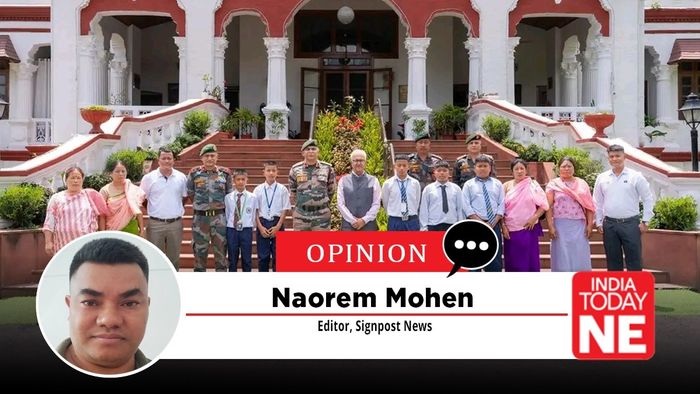
Governor of Manipur Ajay Kumar Bhalla interacted with the students and their guardians at Lok Bhavan, Imphal, on June 22, 2026. The interaction was attended by Major General Gaurav Sharma, SC, SM, IGAR (South), Brigadier Pratyush Kumar, Commander of 9 Sector Assam Rifles, and senior military officials.
The Governor encouraged the students to make full use of the opportunity, learn sincerely, and develop their talents. He also appreciated the efforts of Assam Rifles in supporting and nurturing internally displaced students.
This may appear, on the surface, to be a small welfare initiative involving only five students. In the context of Manipur’s continuing social rupture, it is far more important than the number suggests.
Education is one of the first casualties of prolonged conflict.
When families are uprooted, children lose not only homes and neighbourhoods but also classrooms, friends, routines and confidence. Relief camps provide physical shelter, but they cannot easily replace the stability of a school environment.
A displaced child carries the memory of fear and uncertainty into every aspect of life. For such children, uninterrupted education is not a luxury. It is a form of rehabilitation.
Assam Rifles’ decision to sponsor these students therefore has a deeper meaning. It recognizes that peace cannot be built only through deployment, patrols and security management.
Peace also requires institutions to protect childhood, restore dignity, and prevent a generation from being permanently shaped by violence. By taking responsibility for the education of displaced students, Assam Rifles has acted not merely as a security force but as an institution engaged in social repair.
Peace cannot be built only through deployment, patrols and security management. It also requires institutions to protect childhood and restore dignity.
This is important because the role of Assam Rifles in Manipur has often been misunderstood, misrepresented, and judged through the narrow lens of competing ethnic anxieties. In a deeply polarised environment, every institution operating on the ground is vulnerable to suspicion.
Neutral action is often interpreted as bias by one side or the other. Restraint is mistaken for weakness. Humanitarian outreach is sometimes dismissed as public relations. Security enforcement is read through community identity rather than institutional duty.
Such perceptions have unfairly clouded the work being done by Assam Rifles in difficult conditions. The force operates in areas where mistrust is high, movement is sensitive, and every action is subject to instant public interpretation. It has to maintain order, prevent escalation, assist civilians, coordinate with civil administration, and respond to humanitarian needs. These are not easy responsibilities in a society where the emotional temperature remains high.
The educational sponsorship of displaced students gives the public an opportunity to look more carefully at the wider work of Assam Rifles on the ground. It is not only standing between hostile positions. It is also helping vulnerable families recover a sense of normal life. It is not only managing immediate security concerns. It is also investing in the long-term stability of Manipur by supporting children whose education might otherwise have been interrupted.
This distinction matters. A society emerging from conflict cannot afford to view every institution through suspicion alone. Accountability is necessary. Public scrutiny is necessary. But criticism must be guided by facts and fairness. To portray Assam Rifles as a biased force without acknowledging its continuing humanitarian and stabilising work does not serve the cause of peace. It only deepens mistrust and weakens the institutional bridges that Manipur urgently needs.
The students selected under this initiative come from relief camps in Imphal. Their backgrounds reflect the human cost of the crisis. They are not political symbols. They are children whose lives have been disrupted by circumstances beyond their control. When Assam Rifles facilitates their journey to Dehradun for education, it sends a message that the state and its institutions have not abandoned them.
The presence of the Governor at Lok Bhavan also gives the initiative institutional weight. His interaction with the students and guardians was not simply ceremonial. It placed the welfare of displaced children within the larger responsibility of governance. It also showed that security agencies, civil authorities and educational institutions can work together in practical ways when the focus remains on people rather than rhetoric.
Manipur needs more such interventions. Relief and rehabilitation cannot be confined to food, shelter and temporary assistance. The deeper challenge is to prevent displacement from becoming permanent social exclusion. Children in relief camps must not be allowed to fall behind in education. Young people must not be left vulnerable to bitterness, idleness or loss of direction. Families must see pathways back to dignity.
Assam Rifles’ initiative is a reminder that peacebuilding is a patient process. It is built through trust, one family at a time. It is built when institutions show consistency. It is built when children from disturbed areas are given access to schools, hostels, books and mentors. It is built when communities begin to see that national institutions are not enemies but partners in recovery.
The phrase “national integration” is often used in official language, but its real test lies in lived experience. For a displaced student from Moreh or Churachandpur to study in Dehradun, interact with students from other regions, and grow in a secure educational environment is a meaningful act of integration. It widens the child’s world beyond conflict. It also helps the rest of India understand that Manipur’s children deserve opportunity, compassion and respect.
There is also a larger lesson for civil society and public commentators. In times of conflict, narratives can harden quickly. A force, a community, or an institution can be labelled and judged without careful attention to ground realities. Such labelling is dangerous. It prevents honest assessment. It discourages constructive work. It also punishes those who are quietly trying to reduce suffering.
Assam Rifles, like any institution operating in a sensitive region, must remain open to public scrutiny. But scrutiny must be balanced by recognition where recognition is due. The sponsorship of five displaced students may not end the conflict. It may not resolve political grievances. It may not immediately heal social divisions. But it represents the kind of humane, practical and confidence building effort that Manipur badly needs.
Peace in Manipur will not come from security action alone. Nor will it come from speeches alone. It will require a combination of justice, dialogue, restraint, rehabilitation, institutional fairness and social trust. In that wider process, Assam Rifles has an important role to play. Its silent work on the ground, especially in support of displaced families and children, deserves to be seen with honesty.
The true value of this initiative will be measured not only in examination results or school certificates. It will be measured in whether these children regain confidence, whether their guardians feel reassured, and whether society learns to support acts of recovery across community lines.
Manipur has suffered enough from division. Every institution that helps restore education, dignity and hope must be encouraged. This time, the Assam Rifles’ sponsorship of displaced students is one such effort. It shows that even in a wounded society, peace can begin with a classroom.
(The views expressed in this article are those of the author and do not necessarily reflect the views of India Today NE or its affiliates.)