Assam’s Rubber Economy Needs to Move Up the Value Chain
For decades, Assam’s plantation economy has been identified almost exclusively with tea. That is changing. Natural rubber is emerging as a serious second pillar, and the numbers suggest that it should no longer be treated as a peripheral crop.
- Aug 08, 2026,
- Updated Aug 08, 2026, 4:32 PM IST
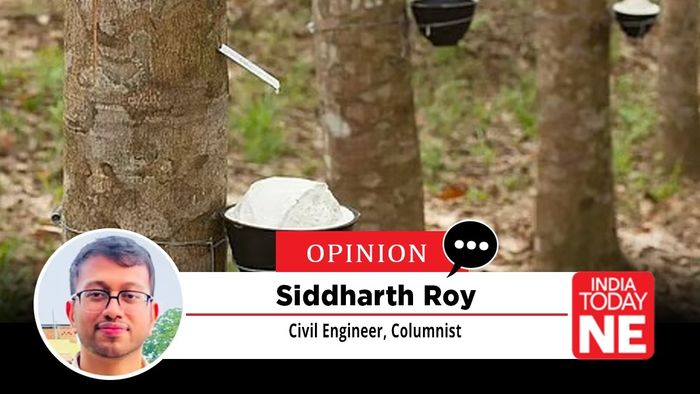
For decades, Assam’s plantation economy has been identified almost exclusively with tea. That is changing. Natural rubber is emerging as a serious second pillar, and the numbers suggest that it should no longer be treated as a peripheral crop. In June 2026, the Rubber Board said Assam had become India’s third-largest natural rubber producer, after Kerala and Tripura, with nearly 50,000 hectares under rubber. The State’s Economic Survey records 94,500 hectares under rubber and production of 47,500 tonnes in 2024-25, with employment estimated at 3.02 lakh people. The difference between these figures reflects statistical definitions, but the direction is unmistakable: rubber is becoming important to Assam’s rural economy.
This growth has not happened overnight. Assam has promoted rubber on hill slopes for decades, particularly where conventional agriculture is difficult. The Assam Plantation Crops Development Corporation, established in 1974, promotes cash crops on such land. Rubber has consequently become important in districts including Karbi Anglong, Dima Hasao, Goalpara and parts of the Barak Valley. For communities seeking alternatives to shifting cultivation, a perennial plantation can offer a predictable income once trees mature.
The recent acceleration is striking. Assam’s rubber area rose from 58,897 hectares in 2020-21 to 94,500 hectares in 2024-25, according to the Economic Survey. Production increased from 34,348 tonnes to 47,500 tonnes, while employment rose from 1.77 lakh to 3.02 lakh. They indicate a plantation economy capable of supporting rural employment and diversifying farm incomes.
The wider Indian market makes Assam’s expansion strategically important. India produced 8.75 lakh tonnes of natural rubber in 2024-25 but consumed 14.10 lakh tonnes, leaving a gap of 5.51 lakh tonnes met through imports. In 2023-24, consumption was 14.16 lakh tonnes against production of 8.57 lakh tonnes. The automobile-tyre industry accounted for 67.3% of domestic consumption in 2023-24.
Assam can therefore contribute to reducing India’s dependence on imported natural rubber. But increasing acreage is not enough. The real opportunity lies in productivity and value addition.
The State’s 2024-25 figures reveal a productivity challenge. Of 94,500 hectares under rubber, only 37,900 hectares were recorded as tapping area, producing 47,500 tonnes. Much of the plantation base is therefore immature or not yet tapped. This creates a pipeline for future output, provided growers receive technical support and disease management. Rubber trees take years before commercial tapping begins; policy must therefore be predictable rather than driven by annual targets.
The INROAD project, supported by the Rubber Board and the Automotive Tyre Manufacturers’ Association, envisages rubber development over two lakh hectares across the Northeast and West Bengal. By the 2025 planting season, planting had been completed on 1,79,376 hectares, benefiting 2,07,248 growers. Assam’s participation should now be accompanied by stronger local processing.
This is where Assam’s biggest opportunity may lie. Selling raw latex or sheets leaves much of the value elsewhere. The State should encourage factories producing gloves, footwear, hoses, belts, medical products and other rubber goods. Industrial clusters near producing districts, linked to Guwahati, could create jobs beyond plantations. Assam’s position as the gateway to the Northeast can connect producers with regional markets and potentially external markets.
Research is equally important. In June 2026, the Centre highlighted the planting in Assam of the world’s first genetically modified rubber plant developed specifically for the region. Such trials require rigorous ecological assessment before wider adoption. Productivity gains are welcome, but they should not come at the expense of biodiversity or soil health.
Rubber can strengthen environmental resilience when planted appropriately on degraded or suitable slopes. Assam’s Soil Conservation Department promotes rubber and other plantation crops for soil conservation and sustainable land use. Yet expansion should never mean clearing natural forests or replacing ecologically valuable landscapes with monocultures. Land suitability mapping and biodiversity safeguards must precede expansion.
The biggest risk is market volatility. Rubber prices can fluctuate sharply because of global supply, weather and automobile demand. Small growers cannot absorb these shocks easily. Assam needs stronger producer societies, transparent price information, affordable credit, crop insurance and processing facilities that reduce distress sales. The Centre has raised rubber-sector assistance to ₹708.69 crore for 2024-25 and 2025-26; Assam must ensure access for growers effectively.
The rubber story should not be framed as a replacement for tea. It is a diversification strategy. A resilient Assam economy cannot depend excessively on one plantation crop, particularly when climate change is altering rainfall patterns and raising production risks.
Rubber has earned a place in Assam’s economic conversation. The next step is to ensure that its growth benefits growers rather than merely expanding plantations. If Assam combines scientific cultivation, fair markets, local processing and environmental safeguards, rubber could evolve from a promising cash crop into a durable rural industry. The objective should not be simply more rubber trees, but more income, more jobs and more value retained within Assam.