Before Manipur Votes, Its Assembly Candidates Should Learn From MUSU Election
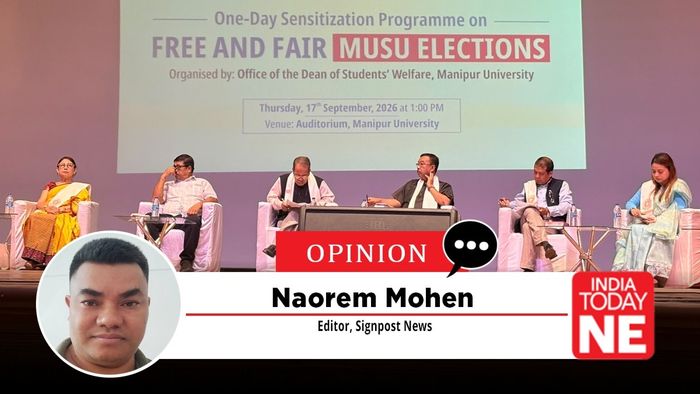
A one-day sensitisation programme held at Manipur University on September 17 was organised for candidates and voters preparing for the Manipur University Students’ Union election.
- Sep 17, 2026,
- Updated Sep 17, 2026, 7:46 PM IST
A one-day sensitisation programme held at Manipur University on September 17 was organised for candidates and voters preparing for the Manipur University Students’ Union election. But much of what was discussed inside the University Auditorium deserves a wider audience. Those preparing to contest the next Manipur Assembly election should listen carefully too.
The programme spoke of free choice, equal rules, realistic promises, clean campaigns, the character of candidates and respect for electoral outcomes. It warned against money power, muscle power, personal attacks and external political interference. These may have been presented as principles for a university election, but they address some of the deepest weaknesses of electoral politics in Manipur.
If student candidates are expected to follow these standards while seeking office in a university, surely those asking to represent the people in the Manipur Legislative Assembly must be held to an even higher standard.
Prof. Khelena Gurumayum, Head of the Department of Political Science, described the MUSU election as a “laboratory of democracy.” It is an appropriate description. A university election teaches students how to contest, campaign, debate, persuade voters and accept the verdict. It can prepare young people for participation in the larger democratic process.
But a laboratory is also where principles are tested. If the ideas discussed at Manipur University are important enough to shape future leaders, they must also be used to examine those already seeking political power.
The invited experts at the the one-day sensitization programme on Free and Fair MUSU Elections were senior advocate Khaidem Mani Singh, former Chairperson of the Manipur State Human Rights Commission; social scientist Dr. Dhanabir Laishram; Prof. M.C. Arunkumar, Dean of the School of Human and Environmental Sciences, Manipur University; Dr. Yumnam Premananda Singh, Head of the Department of Law, Manipur University; and Prof. Khelena Gurumayum, Head of the Department of Political Science, Manipur University.
The presidium members included Prof. Premlata Maisnam, Dean, School of Education; Prof. Kananbala Sarangthem, Dean, School of Agricultural Sciences; Prof. Toijam Tampha Devi, Dean, School of Humanities; Prof. R.K. Lonibala, Dean, School of Mathematical and Physical Sciences; Prof. N. Basanta Singh, Dean, School of Engineering; Prof. N. Rajen Singh, Proctor; Prof. Laishram Rajendrakumar Singh, Finance Officer; and Prof. Ch. Ibohal Singh, Dean of Students Welfare.The programme concluded following an interactive session involving the invited experts, presidium members and participating students. Dr. Huidrom Suraj Singh proposed the vote of thanks.
Let Ideas Be Stronger Than Money
One of the most meaningful appeals made during the programme was that ideas should be stronger than money and arguments stronger than abuse.
Manipur needs to carry that message into the coming Assembly election.
Election campaigns in the State too often become competitions in expenditure, mobilisation and personal influence. A candidate’s financial capacity can appear more visible than his or her understanding of the constituency. Short-term inducements can overshadow questions about roads, schools, healthcare, employment, public safety and the performance of government institutions.
Money may create crowds and campaign spectacles, but it cannot repair a failed public institution. It cannot substitute for legislative ability, administrative knowledge or the courage to speak for Manipur before the highest authorities in the country.
Senior advocate Khaidem Mani Singh cautioned students against money power, muscle power and indirect political interference. Assembly candidates should face the same scrutiny. Voters have the right to ask where campaign resources come from, what interests stand behind a candidate and whether the person will remain accountable to the constituency after the election.
A free election is not one in which voters are formally allowed to enter a polling booth while being influenced by money, fear or organised pressure outside it. The secrecy of the ballot must be protected not merely by election officials but by a political culture that respects the independence of every voter.
A Legitimate Mandate Comes With Responsibility
Delivering the welcome and keynote address, Prof. Ch. Ibohal Singh, Dean of Students’ Welfare, placed the election in the larger context of democratic practice and electoral reform. The revival of MUSU, he argued, made it necessary for the University community to think seriously about conducting the election peacefully, transparently and systematically.
His observation applies equally to Manipur’s larger electoral process. Conducting an election is not simply a matter of announcing dates, filing nominations, campaigning and counting votes. The legitimacy of the institution that emerges depends on the credibility of the entire process.
Prof. Ibohal reminded the gathering that a legitimately elected students’ union should represent students and contribute to the academic and institutional development of the University. Since Manipur University has a wider responsibility in shaping the future of the State, its students’ union must also become a responsible stakeholder in that process.
The same must be said of the Manipur Legislative Assembly. Winning an election gives a candidate the legal authority to enter the House, but legitimacy must be sustained through conduct. An elected representative must speak for the constituency, participate seriously in legislative proceedings, remain accessible to the people and place public interest above personal and party convenience.
An Assembly seat cannot be treated merely as a political reward. It carries responsibility for the future of Manipur.
Prof. Ibohal also appealed to MUSU candidates and their supporters to avoid personal attacks, intimidation and unnecessary expenditure. Referring to unauthorised campaign materials displayed at different places on the campus, he said those responsible had been asked to remove them within 48 hours and help maintain the cleanliness of the University.
It is a small but meaningful principle: the right to campaign does not include the right to disregard common rules or damage a shared public space. Assembly candidates, who seek far greater authority, should be expected to demonstrate at least the same degree of discipline.
Examine the Candidate, Not Merely the Party Symbol
Dr. Yumnam Premananda Singh, Head of the Department of Law, said the antecedents, academic attendance and disciplinary records of MUSU candidates should be properly examined.
An Assembly candidate may not have an attendance register like a university student, but every former legislator and political leader has a public record.
How often did the representative attend the Assembly? How many questions were raised? What issues concerning the constituency were placed before the House? Did the representative remain accessible during a crisis? Did the person speak when the people needed a voice, or only appear when another election approached?
Voters should also examine the conduct of first-time candidates. What public work have they undertaken before seeking office? Do they understand the constituency beyond its electoral arithmetic? Can they explain their position on unemployment, education, healthcare, displacement, drug abuse, environmental degradation and the continuing crisis in Manipur?
A party ticket should not become a shield against scrutiny. Nor should community identity alone be treated as proof of leadership. The Assembly requires representatives who understand the Constitution, the law, governance and the history and aspirations of the people they seek to represent.
Dr. Dhanabir Laishram urged student voters to assess candidates on the basis of honesty, character, knowledge of issues and the history of the land, administrative ability and familiarity with the Constitution and the law. Could Manipur’s voters ask for a better set of qualifications from their Assembly candidates?
An Opponent Is Not an Enemy
Prof. Khelena reminded MUSU candidates that an electoral opponent is not an enemy. This is a lesson Manipur’s political class urgently needs.
Political disagreement in the State frequently becomes personal hostility. Criticism is treated as betrayal. Supporters of rival parties attack one another’s character instead of debating policies. At times, political competition contributes to divisions within localities, organisations and communities that continue long after the votes have been counted.
An election should offer competing ideas about governance. It should not produce permanent enemies.
Manipur has already suffered enough from mistrust and social fragmentation. Candidates who seek public office must not deepen those wounds merely to gain a temporary electoral advantage. They should be able to challenge one another firmly while recognising that all of them will have to work within the same constitutional system after the result.
The ability to disagree without hatred is not weakness. It is a democratic strength that Manipur badly needs.
Promises Must Be Realistic
Students contesting the MUSU election were urged to explain what they stood for and to make realistic commitments on students’ welfare, mental well-being, gender equality and campus development.
Assembly candidates should be required to do the same. Every election brings promises. Some disappear immediately after polling day. Others concern matters outside the authority of an MLA. Candidates speak of employment, development and peace without explaining what they will do, which government agency is responsible, how much funding will be required or how progress will be measured.
A manifesto should not be a collection of attractive sentences. It should be a public commitment against which the elected representative can later be assessed.
Each Assembly candidate should place before the voters a constituency-specific programme. The document should identify the most urgent local problems, propose achievable measures and state what can reasonably be completed during one term. Such commitments should remain publicly available so that voters and the media can conduct a performance audit before the next election.
Winning Is Not the Only Test of Leadership
The Manipur University discussion also emphasised accepting electoral defeat gracefully. That, too, is a test of leadership.
Democracy cannot survive if every victory is celebrated as absolute ownership of power and every defeat is explained through conspiracy or hostility. Candidates have the right to seek legal remedies when there is credible evidence of wrongdoing, but they also have a responsibility to respect a legitimate verdict.
A winner must remember that an MLA represents the entire constituency, including those who voted for another candidate. The opposition, meanwhile, should continue to raise public issues instead of disappearing until the next election.
Manipur needs representatives who can win without arrogance and lose without abandoning the people.
The Election Authority Must Also Be Impartial
Free and fair elections are not created by candidates and voters alone. Prof. Khelena correctly underlined that the election authority must remain impartial and that the whole community must protect the democratic character of the institution.
The same principle applies to the Assembly election. Election officials, security agencies, political parties, civil society organisations and the media all have responsibilities. Rules must be applied equally. Complaints must be examined fairly. Voters must be protected from intimidation, misinformation and coercion.
The media must scrutinise every serious candidate, not merely amplify the loudest campaign. It should compare promises, examine previous performance and question unexplained claims. Journalism during an election must help voters make informed choices rather than become an extension of campaign machinery.
Participation Must Strengthen the Institution
Prof. Premlata Maisnam stressed the importance of conducting the MUSU election in a disciplined, transparent and responsible manner. She also underlined that meaningful student participation should advance democratic values, academic development and a constructive environment within the University. That is another principle worth carrying beyond the campus.
Participation in an election should strengthen the institution being contested. It should not reduce that institution to an arena for personal ambition, factional rivalry or the influence of forces operating from outside it.
The test of a students’ union is not how loudly it can assert power after an election, but whether it can improve the University and protect the legitimate interests of students. In the same way, the test of political leadership is not the size of a victory procession but the ability to strengthen the Assembly, improve governance and produce measurable benefits for the people.
Manipur’s elected institutions will not regain public confidence merely because elections are held at regular intervals. Confidence will return when representatives demonstrate that electoral participation can produce constructive governance.
Manipur Needs a Higher Electoral Standard
A students’ union election may appear small beside an Assembly election, but the democratic principles governing both are not fundamentally different. Every voter must be able to choose without fear. Every candidate must compete under the same rules. Money and intimidation must not determine the result. Campaigns must be based on ideas, programmes and public character.
The students preparing to contest the MUSU election have been told to maintain discipline, avoid personal attacks, respect the campus and place the welfare of the University above narrow interests.
When Manipur’s Assembly candidates begin asking for our votes, we must ask whether they are prepared to follow the same rules.
Will they campaign without dividing communities? Will they make promises they can explain and fulfil? Will they disclose their record and accept public scrutiny? Will they place Manipur above personal power and party convenience? Will they respect their opponents and accept the people’s verdict?
These should not be difficult questions. Yet the answers will tell us who is genuinely prepared to represent Manipur.
The MUSU election has been described as the first school and laboratory of democracy. Perhaps some of Manipur’s established politicians and aspiring legislators need to return to that classroom.
(The views expressed in this article are those of the author and do not necessarily reflect the views of India Today NE or its affiliates)