Before Saving Manipur, Save Your Party First
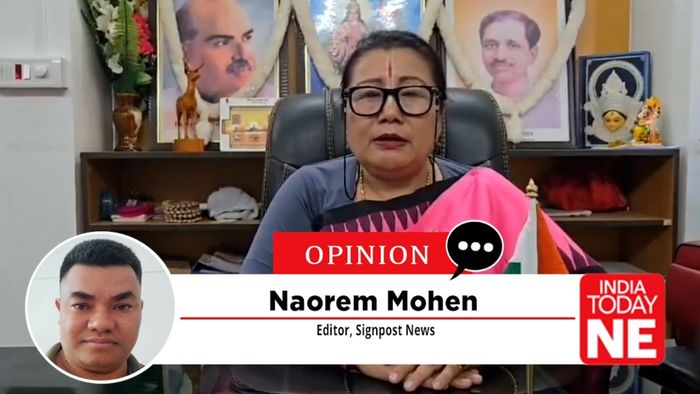
Adhikarimayum Sharda Devi’s recent appearance at the listening session for the 130th episode of Prime Minister Narendra Modi’s Mann Ki Baat, where she reiterated the claim that "only BJP can save Manipur" has gained significant traction online, though much of it has been in the form of sharp trolling and ridicule on social media.
- Jan 28, 2026,
- Updated Jan 28, 2026, 12:14 PM IST
Adhikarimayum Sharda Devi’s recent appearance at the listening session for the 130th episode of Prime Minister Narendra Modi’s Mann Ki Baat, where she reiterated the claim that "only BJP can save Manipur" has gained significant traction online, though much of it has been in the form of sharp trolling and ridicule on social media.
Her repeated assertions framing the BJP as the state’s sole savior now feel increasingly out of touch with the harsh ground realities of ongoing ethnic violence, internal party fractures, electoral setbacks, and governance failures under her leadership since 2021.
Far from inspiring confidence, her statement has amplified public skepticism and mockery, highlighting the widening gap between party rhetoric and state's persistent crisis.
The irony is stark. A party that has governed the state (until President's Rule) and holds power at the Centre throughout the crisis is positioned as the sole savior, yet under her watch, the state BJP has struggled with internal fractures, electoral wipeouts, and a failure to stem ethnic polarization.
Her most recent statement on the violence further exposes this disconnect. "The conflict is now bringing into religion which led to geo politics, that is the reason Central government finds it difficult to end the conflict. India remains mute knowing everything as taking action will impact on Vikshit Bharat campaign."
By invoking religion, geopolitics, and the supposed constraints of the national "Viksit Bharat" (Developed India) vision, she shifts responsibility outward, implying that decisive intervention is deliberately withheld to protect a flagship national narrative.
This framing portrays her own party's central leadership as hamstrung by image concerns rather than capable of bold action. It conveniently deflects from the BJP's governance record in Manipur since 2017 and the state unit's organizational lapses under her stewardship.
Such deflections ring particularly hollow given her pattern of silence on pressing, party-specific issues. She has offered no public advocacy or concrete steps to ensure free movement for Meiteis along vital national highways, routes repeatedly disrupted by blockades, severely impacting supplies, livelihoods, and daily life amid the ethnic tensions
A Sharda Devi's tenure as BJP Manipur President is marked by two records. She is the longest-serving state president and led the party while it ruled the state. Yet these distinctions mask a stark truth, she ranks among the weakest leaders in the history of the Manipur BJP.
Under her watch, the state unit has suffered unchecked rebellions, a humiliating 2024 Lok Sabha wipeout, deepening ethnic divisions, and total failure to enforce discipline or unity.
The fitting label for her record is clear. The President who couldn't discipline her own house—longest in office, but presiding over the party’s most fractured and ineffective phase, where factionalism and personal ambition eclipsed organizational strength and crisis leadership.
However, her leadership deserves initial acknowledgment for the formidable scale of responsibility she carries. She presides over a national party whose foundational philosophy of "Nation first, party next, self last" has, in practice in Manipur, often appeared to be mere lip service rather than a guiding principle observed in action.
She is now dealing with one of the country's most fractious and self-centered political arenas—where ambition runs high, almost every leader views themselves as Chief Ministerial material, and personal or factional interests frequently take precedence over collective discipline and state welfare.
Sharda Devi's continued participation in central initiatives, such as the Har Ghar Tiranga campaign, VB-G RAM G awareness drives, Atal Smriti Varsh 2025 programs including workshops and commemorative events honoring Bharat Ratna Atal Bihari Vajpayee's legacy, and hosting the listening session of Prime Minister Narendra Modi's Mann Ki Baat demonstrates an effort to keep the party machinery engaged and aligned with the national vision.
Her steadfast commitment to central BJP and national initiatives stands out as a consistent thread throughout the nearly three years of ethnic violence in Manipur. Notably, she has never missed participating in or organizing listening sessions for Prime Minister Narendra Modi's Mann Ki Baat episodes during this turbulent period, ensuring that the program reaches grassroots workers and party supporters even amid crisis.
This unwavering engagement with Mann Ki Baat, including the recent 130th episode hosted alongside Bishnupur district MLAs and karyakartas at MLA K. Govindas Singh's residence remains perhaps her singular, tangible achievement as state president, one that party supporters can take genuine pride in as a symbol of loyalty to the national leadership and an effort to sustain ideological connect when everything else seemed fractured.
When journalists questioned her about the Kuki Inpi Manipur (KIM) statement warning or cautioning Kuki BJP MLAs against participating in government formation processes (tied to demands for separate administration), she remained completely mum, providing no clarification, rebuttal, or party line.
This avoidance avoids confronting direct challenges to BJP unity from ethnic affiliates.Equally troubling is the lack of urgency in rebuilding grassroots strength in alienated hill districts.
Churachandpur, a key Kuki and Zo area, stands as a glaring example. In one Assembly Constituency during the 2024 Lok Sabha elections, the BJP secured a mere 38 votes, an indicator of near-total rejection. Yet there is no visible campaign from her to re-engage local karyakartas, address grievances, or rebuild cadre in Churachandpur, Kangpokpi, Tengnoupal, or Pherzawl.
This failure to coordinate across districts contributed directly to the NDA's humiliating defeat in Outer Manipur, where ethnic divides shattered the party's hill base.
Sharda Devi's leadership during this multi-year turmoil, from the May 2023 eruption of ethnic violence through the 2024 Lok Sabha rout, Chief Minister N. Biren Singh's resignation in early 2025, the imposition of President's Rule in February 2025, and ongoing struggles to restore an elected government has been characterized by muted, reactive responses rather than proactive discipline.
Meetings with Union Home Minister Amit Shah to discuss "permanent solutions," repeated Delhi visits, meeting every tom dick and harry in Delhi and denials of internal rifts have yielded little visible reconciliation or enforcement of party unity.
Not once has she issued a strong public condemnation or disciplinary outreach against rebel BJP MLAs defying central leadership. No explanatory calls or accountability measures have targeted Kuki MLAs who have spoken of separation, issued provocative statements, or appeared to undermine party efforts.
There has been no firm defense or action when elements within or associated with the party seemed to criticize or erode confidence in Prime Minister Modi and Home Minister Amit Shah. This passivity has permitted divisions to deepen, transforming the state unit into a fragmented organization incapable of unified action.
The 2024 Lok Sabha results delivered the clearest rebuke, where both Inner and Outer Manipur seats lost to Congress, reversing prior strengths. President's Rule followed internal dissidence, ally withdrawals, and an inability to convene the assembly or form a government, exposing profound organizational failure for a party that commanded a majority after the 2022 polls.
Her unusually prolonged tenure raises pointed questions. Does the high command prioritize ethnic balancing or symbolic representation over electoral competence and discipline? Or does inertia prevail in a state too divided for swift change?
Whatever the rationale, prolonged weak leadership has coincided with Manipur's deepest wounds, hundreds killed, tens of thousands displaced, homes and sacred sites destroyed, economies crippled, and inter-community trust shattered.
On what foundation does Sharda Devi base the claim that only the BJP can save Manipur? Is there an unannounced plan to reverse the damage accumulated under her oversight since May 2023, the bloodshed, the polarization, the communal scars?
The party she leads has wielded power at both levels throughout. However, her statements increasingly blame external factors (religion, geopolitics, campaign optics) rather than confront internal shortcomings or demand bold internal reforms.
Before the BJP can credibly position itself as Manipur's savior, the outgoing President A Sharda Devi must first rescue and rebuild her own party.
This demands real action, like enforcing discipline by publicly addressing rebels and saboteurs within ranks; engaging alienated hill districts with genuine outreach instead of neglect; advocating forcefully for free movement on highways and practical peace measures; responding decisively to threats like those from Kuki Inpi Manipur; and demonstrating ground-level strengthening rather than perpetual silence or deflection.
People need accountability and results, not excuses framed around national campaigns or abstract geopolitics. The public ridicule her statements attract is not baseless cynicism. Rather, it reflects deep frustration with a leadership that appears perpetually out of step with the crisis it helped preside over.
Until she shows the resolve to unify, discipline, and revitalize the BJP from within, any assertion of the party's singular ability to save Manipur will remain not just unpersuasive, but profoundly ironic.