Beyond an MoU: Manipur University’s Opportunity to Become India’s Academic Gateway to Southeast Asia
For years, Manipur has been described as India’s gateway to Southeast Asia. The description is geographically persuasive. It has also become politically familiar. Whenever the Act East Policy is discussed, Manipur and the wider Northeast appear naturally on the map connecting India with Myanmar and beyond.
- Sep 09, 2026,
- Updated Sep 09, 2026, 10:56 AM IST
For years, Manipur has been described as India’s gateway to Southeast Asia. The description is geographically persuasive. It has also become politically familiar. Whenever the Act East Policy is discussed, Manipur and the wider Northeast appear naturally on the map connecting India with Myanmar and beyond.
But a gateway need not be built only with roads. It can also be built inside a university.
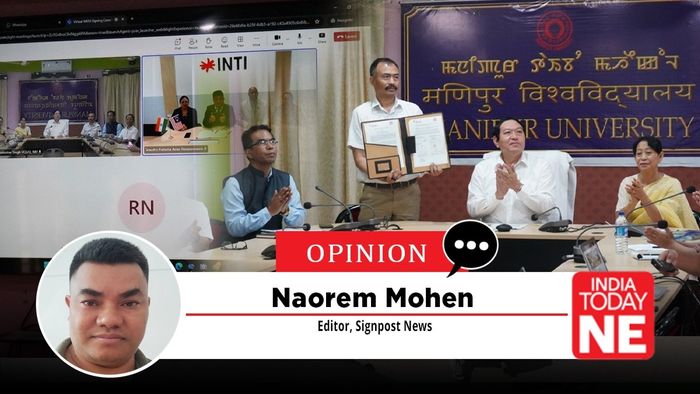
The Memorandum of Understanding signed between Manipur University and INTI International University, Malaysia, on September 3 therefore deserves to be looked at beyond the ceremony in which it was signed. The agreement envisages joint research, student and faculty exchanges, internships and collaborative academic programmes.
Each of these may appear routine in the language of an MoU. Together, however, they open a larger possibility.
For Manipur University, the partnership can become part of an attempt to place its students and researchers within a wider international academic network. For Manipur, it offers another way of imagining its relationship with Southeast Asia — not merely as a transit territory between India and its eastern neighbours, but as a place from where knowledge, research and young people can travel. That distinction matters.
The partnership also reflects the collective effort that went into turning an academic connection into an institutional agreement. Registrar Prof. M. Premjit Singh signed the MoU for Manipur University and Prof. Dr. Goh Khang Wen, Pro-Vice Chancellor for Global Engagement, signed for INTI, with Manipur University Vice-Chancellor Prof. R.K. Hemakumar Singh, Dean of Social Sciences Prof. Memcha Loitongbam and INTI's Prof. Dr. Asokan Vasudevan signing as witnesses.
The MoU signing event also involved Prof. Angom Dilip Kumar Singh, Prof. Mayanglambam Lilee Devi and Dr. Sakila Nongmeikapam from Manipur University, and Dr. Tafara Mudzengi, Dr. Thingnam Anne and Tanushri Natasha Anne Paramesvaran from INTI. Their involvement is worth recognising because an international partnership is rarely the work of a signature alone; it takes people on both sides to turn an academic conversation into an opportunity for students, researchers and their institutions.
India's Act East Policy has long placed ASEAN at the centre of the country's engagement with its extended eastern neighbourhood. Connectivity in this context cannot be understood only in terms of highways, trade routes and border infrastructure. Economic, cultural and people-to-people connections matter too.
Education belongs naturally within that idea. A Manipuri student spending a semester in Malaysia is also a form of connectivity. A research scholar from Manipur working with a Malaysian academic is connectivity. So is a jointly published paper, a collaborative research project or an internship that gives a young person from the Northeast exposure outside the academic environment in which he or she has grown up.
These movements may look small beside an international highway. Their consequences need not be.
India's higher-education ambitions increasingly emphasise research, innovation, multidisciplinary learning and greater international engagement. That gives institutions such as Manipur University an opportunity to translate large national aspirations into something a student in Canchipur can actually experience.
The university's role in this process deserves attention. As Manipur's central university, its responsibility goes beyond awarding degrees. It produces teachers, researchers, administrators, scientists, professionals and future academic leadership. In a state where opportunities for international academic exposure remain limited, the university can become one of the institutions through which young people enter wider networks of knowledge and opportunity.
This is where the Manipur University–INTI agreement becomes interesting.
The greater opportunity may lie with research. For a research scholar, publishing a paper is important. But contemporary research increasingly grows through networks — through people working across institutions, disciplines and sometimes countries.
Imagine, therefore, a research scholar at Manipur University no longer having to think of an international publication simply as an individual paper to be sent to a journal somewhere outside India.
The scholar could instead work with a researcher at INTI on a common question. They could exchange data and academic perspectives. Faculty members could develop joint projects. Scholars could co-author papers. Research groups could work across institutions rather than within the walls of a single department.
One paper could lead to another. One collaboration could introduce a young scholar to another researcher, another institution and perhaps another research project. That is how an academic network begins to grow.
The value of the MoU should therefore not be measured simply by how many activities are organised under it. A more meaningful measure would be how many academic relationships it eventually creates.
If a Manipur University scholar is able to produce internationally co-authored work because of this partnership, the benefit does not end with one publication. The scholar gains exposure to another research culture, another academic network and another way of approaching a problem.
The university gains too. And over time, so does the region. There is another reason why international collaboration matters to universities in this part of India.
The Northeast has generated enormous academic interest. Its ethnic diversity, languages, biodiversity, borderlands, migration, economy, environment, culture and political history have been studied from universities far beyond the region.
There is nothing unusual about that. Knowledge should travel. But universities within the Northeast should increasingly become producers and partners in that knowledge, not merely locations from which other institutions collect it.
Manipur University is particularly well placed for such a role. Its location provides access to questions that are simultaneously local and international — border economies, cultural connections with Southeast Asia, environmental change, indigenous knowledge, language, technology, public health, migration and regional development, among many others.
International collaboration can allow researchers sitting in Manipur to bring their own knowledge of the region into a wider conversation. That changes the relationship.
Instead of Manipur merely being researched, scholars from Manipur become equal participants in producing the research. That is a far more important form of academic internationalisation.
There is also a larger national context. India's ambition of becoming a developed country by 2047 cannot be realised only through the growth of its metropolitan centres. The strength of Viksit Bharat will ultimately depend on whether regions historically distant from India's main centres of opportunity can build institutions capable of producing knowledge, skills and innovation of their own.
The Northeast therefore cannot remain on the margins of India's knowledge economy. This gives Manipur University a responsibility at three levels.
It must serve Manipur by producing skilled young people and research relevant to the state. It can serve the Northeast by becoming a stronger regional centre of knowledge and innovation. And because of where Manipur is located, it can contribute to India's engagement with Southeast Asia. These are not separate ambitions.
Research on border trade can contribute to the understanding of Act East. Collaboration on biodiversity, climate, public health or agriculture can connect local problems with challenges shared across Southeast Asia. International exposure can help a student from Manipur acquire skills and networks that may later contribute to entrepreneurship, research or employment at home.
In that sense, a successful university partnership can connect three ideas that are often discussed separately: education in Manipur, India's Act East Policy and Viksit Bharat.
The connection between them is human capital. Roads can connect markets. Universities connect minds. India needs both.
Manipur University has another opportunity before it. Manipur has long aspired to become an educational destination for the wider region. International partnerships can strengthen that aspiration, provided they become part of a larger and sustained academic ecosystem.
A university connected to institutions in Malaysia and eventually elsewhere in Southeast Asia becomes attractive in a different way.
Students coming to Manipur would not simply be entering a university located in India's Northeast. They would be entering an institution with academic pathways extending beyond India's borders.
For students already studying here, the meaning is even more immediate.
A student exchange can introduce them to another society and academic system. An internship can give classroom learning a professional dimension. Faculty exchange can bring new ideas into departments without students having to leave the campus. Joint programmes can expose them to teaching and expertise unavailable within one institution alone.
These opportunities matter particularly for young people studying far from India's major metropolitan academic centres. Internationalisation can reduce the intellectual distance created by geography.
Manipur does not have to become Delhi, Bengaluru or Mumbai to become academically connected to the world. It can do so from Imphal.
Perhaps India's eastern engagement also needs an educational vocabulary. We began with Look East. It evolved into Act East. For universities in the Northeast, there is room now to Learn East.
Before we can fully benefit from the economies of Southeast Asia, we must understand them. Before young people from Manipur can participate in opportunities there, they need exposure to its universities, industries, technologies and societies.
Malaysia is a logical place to deepen that engagement. India and Malaysia elevated their bilateral relationship to a Comprehensive Strategic Partnership in 2024. Malaysia is an important member of ASEAN, while ASEAN remains central to India's Act East engagement.
For Manipur, Southeast Asia is also not an abstract distant region. Geography, history and cultural interactions have long placed the Northeast close to the worlds lying east of India's conventional political and economic centres.
That proximity has frequently been discussed in terms of trade and connectivity. Universities can add another dimension: knowledge.
A researcher does not require a cargo corridor to connect two societies. Sometimes a shared research question is enough.
Every MoU begins with optimism. Its real life begins afterwards. The promise of the Manipur University–INTI partnership will eventually be visible not in the document itself but in the opportunities that emerge from it.
A student going to Malaysia. An INTI academic teaching or working with students in Manipur. A research scholar finding a collaborator. Two researchers publishing together.
An internship opening for a student who otherwise might never have received international exposure. A joint project growing into a longer institutional relationship. None of these requires dramatic announcements. They require continuity.
And there is one more test. Internationalisation should not become an opportunity only for students who can afford it. If exchanges and internships grow from these partnerships, scholarships and institutional support will matter. A talented student from an ordinary family should have the same chance to participate as anyone else.
That is when internationalisation acquires a public purpose. Perhaps that should be the larger ambition behind Manipur University's international engagements. One partnership need not remain one partnership. Successful collaboration with INTI can create confidence for relationships with other universities in Malaysia and elsewhere in Southeast Asia.
Gradually, individual agreements can become a network. A network can become an academic ecosystem.
And an academic ecosystem can begin to change how a university, and eventually a region, is seen.
Manipur's geographical position cannot be changed. For generations, distance from India's principal centres of power and opportunity has often been treated as a disadvantage.
But geography can be read in another direction. Look west from Manipur and Delhi is far away. Look east, and another world begins much closer.
That is why the Manipur University–INTI partnership carries a possibility larger than an MoU. If it produces genuine student mobility, collaborative research, internationally co-authored scholarship and lasting institutional relationships, it can contribute simultaneously to Manipur's educational development, India's Act East Policy and the larger ambition of Viksit Bharat.
For years, we have said that Manipur is India's gateway to Southeast Asia. Perhaps one day, when we use that phrase, we will not only be talking about a road passing through Manipur. We may also be talking about a university.