Beyond Craftsmanship: Can Manipur’s Artisans Become Successful Entrepreneurs?
Manipur University’s six-day entrepreneurship programme for 20 artisans offers an opportunity to bridge traditional craftsmanship, modern technology and wider markets. But its real success will depend on what happens after the training ends.
- Nov 02, 2026,
- Updated Nov 02, 2026, 4:42 PM IST
Manipur has never been short of skilled artisans. From intricate handloom designs to bamboo, cane and other indigenous handicrafts, generations of craftspeople have preserved traditions that reflect the cultural identity and creativity of the State. What many of these artisans lack is not talent or determination, but the business knowledge, financial support, technological exposure and market connections needed to turn their skills into sustainable enterprises.
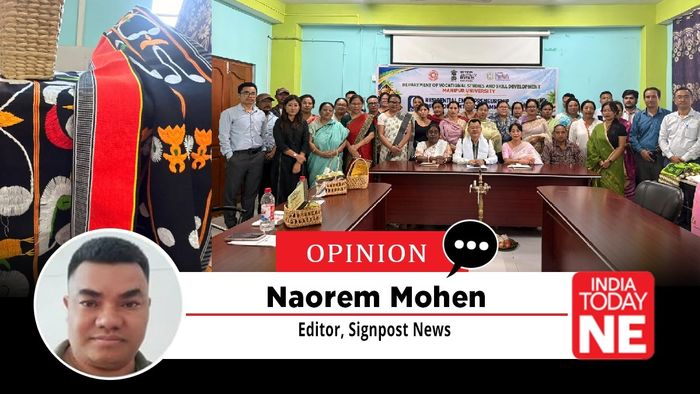
This is where the Six-Day Residential Entrepreneurship Development Programme (EDP), inaugurated at Manipur University on November 2, assumes significance. Twenty registered artisans representing six Handicrafts Producer Companies are participating in the programme, organised by the Department of Vocational Studies and Skill Development (DVSSD) with support from the Ministry of Textiles through the Office of the Development Commissioner (Handicrafts). The training, which continues until November 7, seeks to equip these artisans with knowledge of enterprise management, financial literacy, digital marketing, taxation, banking and access to national and international markets.
Twenty participants may appear a modest number when compared with the thousands of artisans working across Manipur. The participating artisans represent six Handicrafts Producer Companies—Heeri Konba Handloom & Handicraft, Loijing Loya Handicraft, Gyanis Handicraft, Kauna Eastern Company Limited, Aahena and Citizen Welfare Handicraft Producer Companies. Yet the value of such a programme should not be measured by the number of people occupying training seats.
These participants belong to organised producer companies, and the knowledge they acquire has the potential to reach other members of their organisations. If each participant returns with a better understanding of pricing, marketing, financial planning and business expansion, the benefits could extend well beyond the immediate group. That possibility, however, depends on whether the training translates into actual changes in how their enterprises function.
For a traditional artisan, the journey from producing a beautiful handicraft to selling it profitably is often more complicated than outsiders imagine. A craftsperson may spend several days making a product without knowing how to calculate its full production cost, including raw materials, labour, transportation and other expenses. Even when the product reaches a market, intermediaries may capture a substantial portion of its selling price. The artisan who contributes the skill and time may receive considerably less than the final value of the product.
Entrepreneurship education can help address this imbalance. Understanding how to price products, maintain accounts, obtain institutional credit, package goods and approach customers directly can improve an artisan's position in the marketplace. Knowledge of digital payment systems and online selling platforms can further reduce dependence on traditional intermediaries. The EDP's inclusion of practical subjects such as product photography, digital marketing, GST, export management and e-commerce is therefore relevant to the actual difficulties faced by handicraft producers.
During the inaugural programme, Vice-Chancellor Prof. R.K. Hemakumar Singh made an important observation when he encouraged artisans to look beyond local markets and explore opportunities elsewhere in India and abroad. The suggestion deserves attention because Manipur's handicrafts possess cultural distinctiveness that can appeal to consumers outside the State. But cultural uniqueness alone cannot guarantee commercial success. Products must meet customer expectations in quality, consistency, pricing, presentation and timely delivery. An artisan who understands these requirements is better positioned to compete without abandoning the identity of the craft.
The Vice-Chancellor also urged participants to treat the programme as an opportunity for practical learning rather than merely attending lectures. His advice that they should maintain records, ask questions and share their knowledge with fellow artisans points towards an important responsibility. The 20 trainees should not become the only beneficiaries of the programme. They should be able to carry useful knowledge back to their producer companies, where it can influence decisions on production, marketing and financial management.
A particularly encouraging aspect of the initiative is the University's offer to extend technical and incubation support beyond the six-day training period. Dr. Nambram Amulkumar, Head of DVSSD, informed participants about facilities available in the Department, including CNC machines and other equipment that could support product development. He encouraged artisans to approach the University whenever they required technical assistance.
This offer could become one of the most valuable outcomes of the programme. Traditional artisans often work with limited resources and may not have access to modern equipment, design expertise or facilities for experimenting with new products. A university can help bridge this gap by providing technical advice, opportunities for innovation and access to appropriate institutional resources. Such cooperation need not replace traditional methods. Rather, it can help artisans improve production efficiency and product presentation while retaining the distinctive qualities that make their craftsmanship valuable.
There is also a wider responsibility for higher education institutions in a State like Manipur. Universities should not remain isolated centres of classroom learning and academic research when communities around them face serious economic challenges. Their knowledge, laboratories and technical facilities can contribute to local development when made accessible through well-designed programmes. In this respect, the interaction between Manipur University and practising artisans offers an example of how academic institutions can become more directly relevant to the livelihoods of ordinary people.
Another significant development during the inaugural function was the proposal to explore a specialised academic programme in traditional arts and crafts at Manipur University. Smt. Pampa Karmakar, Assistant Director (Handicrafts), Handicrafts Service Centre, Porompat, indicated that the Ministry of Textiles was examining opportunities for closer cooperation with universities in linking traditional craftsmanship with formal vocational education and entrepreneurship.
The proposal is still at an exploratory stage. Questions concerning academic provisions, infrastructure, laboratories, classrooms and institutional arrangements will have to be examined before any course can be introduced. A national-level consultation scheduled for November 19 and 20 could provide an opportunity for the University to present its suggestions to Ministry officials. Nevertheless, the idea deserves serious consideration because it recognises traditional craftsmanship as an area worthy of structured academic engagement.
For generations, much of Manipur's indigenous craft knowledge has passed directly from elders to younger members of families and communities. This system has preserved valuable skills, but it has also left many traditions dependent on individual practitioners. Formal academic engagement could create opportunities for documentation, research, design development and specialised training. Experienced artisans could contribute their practical knowledge while faculty members provide academic and technical expertise. Such cooperation would help ensure that traditional skills are not merely displayed during cultural occasions but remain relevant as sources of employment and economic activity.
However, the success of a specialised crafts programme would depend on its design. It should not become another course that produces certificates without creating practical opportunities. Artisans and producer companies must have a meaningful voice in developing the curriculum. Students should learn not only the history and techniques of traditional crafts but also product development, enterprise management, market research and the commercial realities of the handicraft sector.
The six producer companies represented in the present EDP offer a starting point for this relationship. Their members can identify the problems they encounter in obtaining raw materials, accessing finance, managing production and finding customers. University faculty and resource persons can then help examine practical solutions. This exchange of knowledge is important because an academic understanding of entrepreneurship becomes more useful when tested against the everyday experiences of people running small enterprises.
There is also a need to recognise the economic situation in which Manipur's artisans are working. Years of instability and disruption have affected livelihoods, transportation, business confidence and market connections across the State. For small producers, uncertainty in the movement of goods and access to customers can be especially damaging. Strengthening indigenous enterprises is therefore not simply a matter of promoting traditional culture. It is also part of rebuilding economic confidence and encouraging self-reliance at the community level.
The training's emphasis on online platforms such as India Handmade and the Government e-Marketplace (GeM) is timely. Digital commerce offers possibilities for artisans to introduce their products to customers who may never visit Manipur. But learning to open an online account is only the beginning. Producers must also understand photographs, descriptions, pricing, packaging, inventory, delivery charges, customer service and the responsibilities involved in fulfilling orders. These are practical skills that determine whether an online business can survive beyond its initial enthusiasm.
The Ministry of Textiles and Manipur University can strengthen the programme's impact by establishing a mechanism to assess what participants achieve after completing their training. It would be useful to know how many of the 20 artisans adopt improved accounting practices, begin selling through digital platforms, develop new products, obtain financial assistance or expand their customer base over the following months. Such follow-up would provide a more meaningful measure of success than the number of lectures delivered or certificates distributed.
The second Entrepreneurship Development Programme, scheduled for November 16 to 21, offers another opportunity to build on the experience of the first batch. Lessons learned from the initial training could help resource persons respond more effectively to the requirements of participating artisans. Over time, a sustained partnership between the University, the Handicrafts Service Centre and producer companies could create a practical support network for local enterprises.
Ultimately, the purpose of entrepreneurship development should be to help artisans receive better returns for their labour, exercise greater control over their businesses and create opportunities for others. The preservation of traditional crafts cannot depend on cultural pride alone. Young people will be more willing to learn and continue these skills when they see that craftsmanship can provide a respectable and dependable livelihood.
The 20 artisans attending the residential programme at Manipur University represent more than six producer companies. They represent an opportunity to demonstrate that indigenous knowledge and modern entrepreneurship can work together. The University has offered its academic expertise and technical facilities, while the Ministry of Textiles has opened the possibility of further institutional cooperation. The artisans themselves bring generations of practical knowledge and creativity.
What matters now is how effectively these resources are brought together. If the participants return to their enterprises with better business practices, improved market access and continued technical support, the programme will have achieved something of lasting value. If the proposed academic collaboration also takes shape, it could provide a stronger institutional foundation for Manipur's craft sector.
For Manipur, the important question is not whether its artisans possess the skills to make valuable products. They have demonstrated those skills for generations. The question is whether our institutions can help them earn a better living from what they already know how to create.