Brotherhood, Biometrics, Borders and Contradictions: Why Is Mizoram Suddenly Worried?
The continuous influx of displaced people from Myanmar has become an increasing burden for small Northeastern states such as Mizoram and Manipur. Speaking on the sidelines of the North Eastern Council (NEC) Annual General Meeting in Shillong on June 4, Mizoram Chief Minister Lalduhoma voiced a concern that many in the state have quietly shared for years.
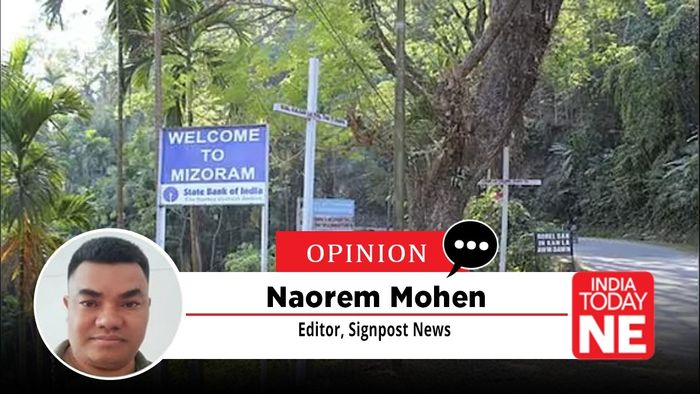
- Jun 07, 2026,
- Updated Jun 07, 2026, 4:49 PM IST
The continuous influx of displaced people from Myanmar has become an increasing burden for small Northeastern states such as Mizoram and Manipur. Speaking on the sidelines of the North Eastern Council (NEC) Annual General Meeting in Shillong on June 4, Mizoram Chief Minister Lalduhoma voiced a concern that many in the state have quietly shared for years.
Referring to the continuing conflict and instability across the border, he noted that Mizoram is already hosting a large number of people fleeing violence and may have to accommodate even more in the future.
“Due to the geopolitical condition there, we are getting many displaced people nowadays. It is likely that we will get more people seeking safety. This has become a burden for us,” he said.
The scale of the challenge is substantial. According to official figures, Mizoram is currently sheltering nearly 29,000 refugees from Myanmar across its eleven districts. The overall number of displaced persons is even higher when refugees from Bangladesh and internally displaced persons from neighbouring Manipur are included. Altogether, more than 38,000 displaced people are presently being accommodated in the state.
For a sparsely populated hill state with limited resources and infrastructure, such numbers inevitably raise difficult questions about governance, public services and long-term sustainability.
What makes Lalduhoma's remarks particularly noteworthy is that they appear to contrast with the position Mizoram has consistently taken since the military coup and civil conflict erupted in Myanmar. For years, the state projected itself as a humanitarian sanctuary for those fleeing violence. Political leaders frequently emphasized the shared ethnic, cultural and historical bonds linking the Chin, Kuki and Zo peoples across the Indo-Myanmar border.
The people arriving from Myanmar were not portrayed as outsiders but as members of an extended family separated by modern political boundaries. The dominant narrative was one of kinship, solidarity and moral responsibility.
Yet the Chief Minister's latest remarks suggest that humanitarian sentiment and administrative reality are not always easy to reconcile.
No government, however sympathetic, can absorb large numbers of displaced people indefinitely without facing practical consequences. Schools, hospitals, housing, food supplies and welfare systems come under pressure. What begins as a humanitarian response gradually evolves into a long-term governance challenge.
There is also a security dimension. Mizoram sits along a sensitive international frontier adjacent to the Golden Triangle, one of the world's most notorious narcotics-producing regions. Law-enforcement agencies have repeatedly intercepted drugs, contraband and trafficking networks operating across the Indo-Myanmar border.
While the overwhelming majority of refugees are genuine victims of conflict, governments cannot ignore the possibility that criminal elements may exploit large-scale population movements and porous borders.
Perhaps this explains why Mizoram has undertaken extensive biometric registration of displaced persons. The exercise is not merely humanitarian; it is administrative. It reflects a recognition that compassion must be accompanied by documentation, monitoring and accountability. A government may extend refuge, but it also has a responsibility to know who has entered, how many have arrived and how long they remain.
The biometric exercise may have revealed a reality that political rhetoric often obscures: numbers matter. It is one thing to speak of ethnic brotherhood in principle. It is another to manage the long-term consequences of accommodating tens of thousands of people within a small state.
This brings us to a larger contradiction.
For years, Mizoram has opposed the Union Government's proposal to fence the Indo-Myanmar border and has criticised the decision to end the Free Movement Regime (FMR).
Political leaders argued that fencing would divide families and communities that have historically lived on both sides of the border. The Free Movement Regime, they maintained, recognised the unique realities of tribes whose social and cultural lives predate modern international boundaries.
The underlying message was clear: ethnic ties mattered more than physical barriers. Yet if unrestricted cross-border movement is essential for preserving ethnic unity, why has the growing influx become a matter of concern? If borders are secondary to kinship, why is the state investing heavily in biometric registration, enumeration and monitoring of those crossing them?
These questions do not invalidate Mizoram's humanitarian position. Rather, they expose the tension between two competing realities.
The first is the emotional and cultural reality of a trans-border Chin-Kuki-Zo identity. The second is the administrative reality that governments are ultimately responsible for managing populations, resources, security and public order within defined territorial boundaries.
CM Lalduhoma's remarks may therefore signify something larger than concern over refugee numbers. They may represent an acknowledgement that even the strongest bonds of ethnicity and kinship cannot eliminate the practical challenges created by prolonged displacement, demographic pressure and uncertain migration flows.
Borders may appear artificial from the perspective of shared ancestry, but they become very real when governments must provide housing, healthcare, education, security and welfare.
That is the contradiction now confronting Mizoram. A state that has long championed ethnic brotherhood across borders is simultaneously discovering the limits of its administrative capacity. A government that opposed border restrictions is now worried about the consequences of continued arrivals. And a society that welcomed its ethnic kin is increasingly forced to confront questions of regulation, documentation and sustainability.
Brotherhood may open the door. Governance, however, determines how long it can remain open.