Can AI change Manipur tourism? Start with the traveller’s questions
Manipur’s tourism hackathon offers an opening. Its value will depend on whether the ideas make travel easier, information more reliable and local livelihoods stronger.
- Sep 24, 2026,
- Updated Sep 24, 2026, 2:15 PM IST
Before a visitor books a journey, there are basic questions. How do I get there? Where can I stay? What can I see? Whom do I contact if plans change? For Manipur, another question cannot be avoided: can I travel safely?
An artificial intelligence tool may answer all these questions in seconds. What matters is whether the traveller can trust those answers.
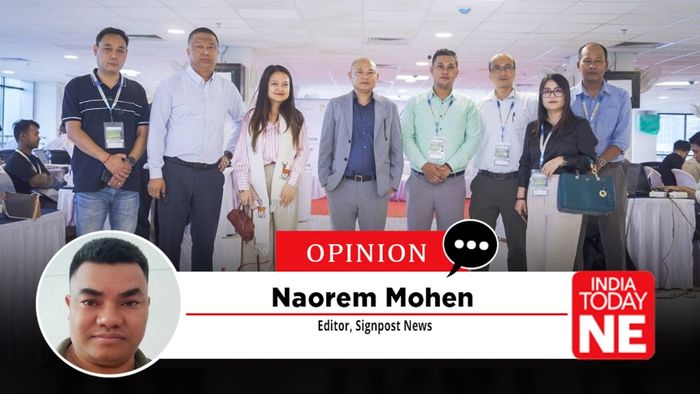
That should be the starting point for the conversation emerging from the Re-Imagining Manipur: Hackathon 2026. At its valedictory session in Imphal on September 23, officials discussed the potential of AI and digital technology to develop tourism in the state. According to the published account of the programme, 61 teams participated, including seven from outside Manipur who joined online, with around 150 participants overall.
Somorjit Salam, Secretary, Information Technology, and Khumanthem Diana Devi, Director, Tourism, were also present. The participation gives the government something to work with. The task now is to give these ideas a life beyond the competition.
At the event, Tourism Secretary N. Kheda Varta Singh spoke about the digital journey through which visitors discover Manipur, access information, experience its culture and engage with local communities. That is a useful way to frame the issue.
Tourism begins long before arrival. A traveller may form an impression of a place through a search result, a video, a hotel listing or an account shared by another visitor. An official digital service has to earn its place in that process by being useful and dependable.
For Manipur, a sensible beginning would be a service that answers ordinary questions accurately: accommodation contacts, transport options, opening hours, local guides and relevant travel advisories. It should show when information was last updated and direct users to an accountable source.
AI could help organise this information and make it available in different languages. But it cannot compensate for records that are incomplete or out of date. An incorrect description of a monument is embarrassing. Incorrect guidance about a journey can have more serious consequences.
Any proposed tourism assistant should therefore be allowed to say it does not know. Where information cannot be confirmed, it should refer the traveller to a person or an official service. Confident language must never be mistaken for verified knowledge.
In a state living with conflict, tourism policy cannot avoid the conditions in which travel takes place. A visitor needs confidence that a journey can be completed. A host needs confidence that accepting a booking will not expose a guest to an unforeseen difficulty. Residents need the freedom and security to move, work and maintain the services on which tourism depends.
Technology can communicate reliable information about those conditions. Establishing the conditions remains the responsibility of the government.
There is still reason to support young people working on tourism ideas during a difficult period. They should have opportunities to build skills, start businesses and imagine a future in Manipur. That work can proceed alongside an honest acknowledgement of the state’s circumstances.
The difficulty begins when promotion promises more than the experience on the ground can support. For a place seeking to build trust, accuracy is itself a form of hospitality.
The next question is who a digital tourism initiative is intended to serve. A homestay owner may need help keeping a listing current. A guide may need a way to receive enquiries directly. An artisan may want visitors to find a workshop, understand the work involved and purchase a product at a fair price. These are concrete problems against which a proposal can be assessed.
A service should also be usable by people who lack the time, equipment or confidence to navigate a complicated platform. If maintaining a listing requires constant outside assistance, the technology may create another dependency for the small business it was meant to help.
Local participation matters just as much when it comes to cultural content. Manipur’s traditions, sacred places and community histories require careful representation. AI-generated descriptions should be reviewed by people with relevant knowledge. Communities should have a say in how their practices are presented and what visitors are encouraged to do.
Some places welcome sightseeing. Others require restraint, permission or an understanding of religious observance. A useful tourism service would help visitors recognise those distinctions.
Information Technology Director G. Robert Sharma described the event as a platform for innovative ideas and solutions. The government now has an opportunity to show what that platform produces.
A small number of promising proposals could be tested with actual users: travellers, guides, accommodation providers, artisans and transport operators. Their experience would reveal problems that a presentation cannot.
The departments should explain which ideas are taken forward, what support they receive and what the trials achieve. Did the service provide accurate answers? Could a local operator update information easily? Did an enquiry reach the intended business? Were errors corrected promptly?
These are modest measures, but they would tell the public more than claims about transformation.
For other states exploring AI in tourism, Manipur could offer a useful example of how technical ambition can be connected to local needs. But that example will have to be built through patient work: maintaining information, listening to users and making someone responsible when a service fails.
The 61 teams have brought their ideas to the table. The next step belongs to the institutions that invited them. A traveller finding a dependable answer, or a local guide receiving a booking through a service that works, would be a meaningful beginning.