Can Manipur Turn Its Indigenous Fruits Into a Start-Up Economy
Can Manipur bottle its biodiversity? A new study on roselle, pineapple and wild olive wines shows how science, start-ups and food processing support can turn local fruits into market-ready products.
- Jul 11, 2026,
- Updated Jul 11, 2026, 12:17 PM IST
Can Manipur bottle its biodiversity? A new study on roselle, pineapple and wild olive wines shows how science, start-ups and food processing support can turn local fruits into market-ready products.
Manipur has never lacked biodiversity. Its hills, valley, wetlands and home gardens carry a quiet wealth of fruits, herbs, edible plants and fermented food traditions. What the state has often lacked is not natural abundance, but the scientific, institutional and market system required to convert that abundance into reliable value.
This is why a study on roselle, pineapple and wild olive wines shows why Manipur must move from laboratory protocols to start-up incubation, market access and food processing support
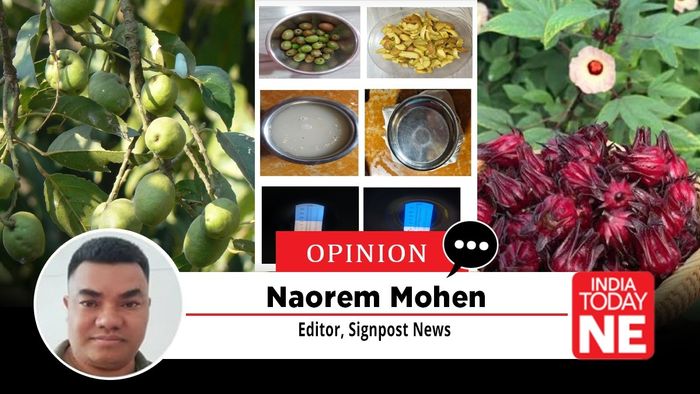
The research developed standardised protocols for preparing wines from roselle (Hibiscus sabdariffa), pineapple (Ananas comosus) and wild olive (Elaeocarpus floribundus), while also assessing their total phenolic content and alcohol content.
At one level, this is a food science study. At another level, it asks a larger question: can Manipur move from celebrating indigenous resources to studying, standardising, branding and responsibly marketing them?
The authors, Leishangthem Geetarani Chanu, Ng. Ajitkumar Singh, Laishram Lenin Singh, Thoudam Basanta Singh, Saikhom Debina Chanu, Ningthoujam Reemi Devi and Senjam Jinus S., worked with three locally relevant fruit sources.
Roselle brings colour and biochemical interest. Pineapple already has agricultural recognition in the region. Wild olive represents the many underused fruits of Manipur that remain closer to household knowledge than to formal product development.
The study used Saccharomyces cerevisiae under controlled fermentation conditions. Diammonium phosphate was added as a yeast nutrient. Total soluble solids were adjusted and monitored through °Brix readings. Total phenolic content was estimated through the Folin–Ciocalteu method, while alcohol content was assessed using a density measurement method after distillation.
These details may sound technical, but they matter. They move the discussion away from vague claims and into measurable science. Local products cannot build serious markets on sentiment alone. They need repeatable methods, reliable composition, safety checks, labelling discipline and batch consistency.
The study recorded total phenolic content values of 0.80 mg gallic acid equivalent per mL sample for roselle wine, 0.64 mg GAE per mL for olive wine and 0.56 mg GAE per mL for pineapple wine. Roselle wine therefore showed the highest phenolic content among the three samples.
This is not merely a biochemical finding. It is a market signal. If properly studied further, roselle can become more than a seasonal or household resource. It can become part of a product line built around colour, flavour, local identity and measurable quality. Pineapple can support farmer-linked processing. Wild olive can open a new category of indigenous fruit-based products.
The alcohol analysis was equally practical. The researchers distilled the wine samples, measured the density of a 1 mL distillate and compared the values with an ethanol density reference table. As ethanol concentration increases, density decreases. This gave the researchers a simple method for estimating alcohol content.
Such practical methods matter in places like Manipur. Not every college, start-up or local research facility can depend on expensive instruments. A reliable and accessible protocol can help widen participation in food science, fermentation research and small enterprise development.
The larger significance is clear. Manipur is part of the Indo-Burmese biodiversity hotspot, but biodiversity by itself does not create livelihoods. It must be studied, protected, processed, packaged and marketed through institutions. A fruit in the field has one value. A fruit processed with scientific discipline, tested for quality and linked to responsible enterprise has another.
Other Northeastern states have already begun to show what this direction can mean. Arunachal Pradesh has gained visibility through kiwi wine from Ziro, with Naara Aaba presenting itself as a fruit wine brand based on handpicked kiwi from the region.
Arunachal has also taken such products to wider trade platforms, including showcases of kiwi, mandarin oranges and fruit wines for ASEAN-linked market opportunities.
Nagaland, too, is building food processing infrastructure, with the state inaugurating a food processing incubation centre at Toluvi, Dimapur, in June 2026.
The lesson for Manipur is direct. Fruit wine and related fermented products should not be treated only as academic experiments or cultural curiosities. They can become start-up opportunities, provided the state creates the right support system.
That support must begin with the Ministry of Food Processing Industries and its allied schemes. The Ministry’s PMFME framework includes support for individual micro food processing units, FPOs, self-help groups, producer cooperatives, common infrastructure, branding, marketing, capacity building and training. These are exactly the areas where Manipur’s fruit-based entrepreneurs need help.
The state should identify roselle, pineapple, wild olive, passion fruit, gooseberry, banana, tree tomato and other local fruits for structured value addition. Colleges and universities can develop protocols. Food technology departments can test stability and quality. Incubation centres can help convert formulations into products. Farmer producer organisations can ensure raw material supply. The government can help with licensing, safety standards, cold chain, packaging, branding and access to markets.
This is where Manipur must be ambitious but careful. Fruit wine development should not become uncontrolled alcohol production. Regulation must be clear. Public health concerns must be respected. Labelling must be accurate. Production must comply with applicable laws. But responsible regulation should not become administrative discouragement.
The start-up potential is real. A young entrepreneur in Manipur should be able to source roselle from local growers, work with a university laboratory, test fermentation quality, access a small incubation facility, receive training on food safety, obtain legal clearances, develop packaging and sell a controlled product to a defined market. This is how science becomes livelihood.
Such enterprises can also reduce post-harvest losses. Pineapple, for instance, is highly perishable. If farmers cannot access timely markets, value addition becomes essential. Fermented products, preserves, concentrates, vinegar, dried fruit and fruit wines can all form part of a wider processing chain. Wine is only one example. The larger issue is fruit preservation, product diversification and market discipline.
The Northeast cannot depend only on raw agricultural sales. Transport difficulties, small holdings, seasonal production and weak market networks often reduce farmer income. Processing gives local produce a longer life and a better price. It also creates jobs in sorting, grading, fermentation, bottling, packaging, testing, design, logistics and sales.
This study offers a useful starting point because it is modest and disciplined. It does not exaggerate. It does not make sweeping claims. It provides procedures, measurements and a basis for future work. That is how serious value addition begins.
The next step should be deeper research. Future studies can examine shelf life, microbial stability, sensory quality, sugar reduction, organic acid composition, ethanol yield, consumer acceptability and regulatory compliance. Metabolomic profiling can help identify the chemical composition of these fruit wines more precisely.
The state's future cannot rest only on biodiversity. It must rest on what the state does with that biodiversity. Roselle, pineapple and wild olive wines may appear small in the larger development debate. But they point to a practical lesson.
The journey from biodiversity to value begins with measurement. It grows through standardisation. It succeeds only when institutions, start-ups and markets work together.