Can Peace Be Negotiated Behind Closed Doors in Manipur?
If a meeting did take place, it may prove less important than the questions it has triggered. In a state searching for peace, the real test is not who sits at the table, but who has the authority to speak, who is left outside the room, and whether the process can earn the trust of a deeply divided Manipur.
- Jun 19, 2026,
- Updated Jun 19, 2026, 11:15 AM IST
In a conflict as painful and prolonged as Manipur's, the question is not whether dialogue should take place. Dialogue is indispensable. No society fractured by violence, displacement, fear, and political distrust can return to stability through silence. The real question is whether peace negotiations can be conducted behind closed doors, and if so, under what conditions.
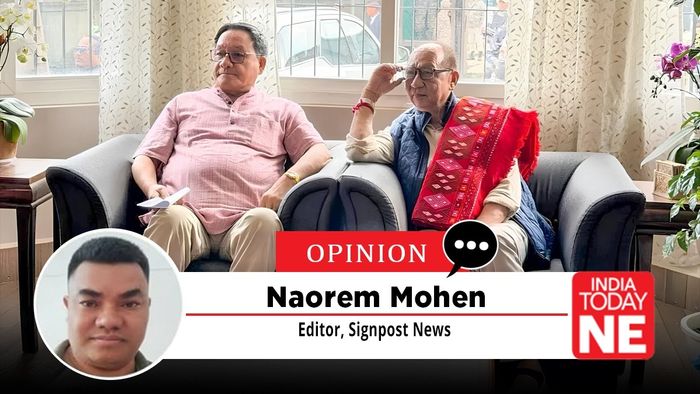
That question has become unavoidable following reports that Saitu MLA Haokholet Kipgen and certain Kuki civil society representatives met Chief Minister Yumnam Khemchand Singh to explore possible avenues for addressing the crisis that erupted on May 3, 2023.
The reported meeting allegedly involved individuals associated with Kuki Inpi Manipur (KIM) and other Kuki civil society organisations. No official statement was issued. No agenda was disclosed. No list of participants was released. No outcome was communicated.
In ordinary circumstances, such silence might have attracted little attention. Manipur, however, is not living through ordinary circumstances.
Every political move is now viewed through the prism of conflict. Communities remain deeply divided. Trust is fragile. Allegations of violence, institutional bias, selective governance, and complicity continue to shape public perception. In such an environment, secrecy rarely remains neutral. It quickly becomes a source of suspicion.
The situation became more complicated when Kuki Inpi Manipur issued a clarification on June 18, 2026, stating that it had no knowledge of any meeting between its representatives, KSO members, and the Chief Minister. KIM further asserted that any engagement with the government must follow established procedures, including consultation with its Executive Committee and the consent of the people. It warned that appropriate action would be taken against anyone who participated without authorisation.
The clarification shifted the debate. The issue was no longer limited to whether a meeting occurred. It became a question of mandate, representation, and legitimacy.
Who speaks for a community? Who authorises a delegation? Can individuals claim to represent an organisation without formal approval? Can the government treat informal interlocutors as representatives of a larger constituency?
These are not procedural questions. In a conflict situation, they are fundamental. Adding another layer to the controversy, Thadou Inpi Manipur questioned the wisdom of engaging with KIM and KSO representatives at a time when public anger remains intense over recent incidents of violence. TIM argued that such interactions could be perceived as attempts at political damage control while serious allegations concerning the killings of Naga civilians, Thadou pastors, and other acts of brutality linked to Kuki militant networks remain unresolved.
This raises a difficult but unavoidable question: can a peace process gain public confidence when accountability for violence remains uncertain?
At the same time, the very existence of communication channels should not be dismissed. After more than three years of mistrust, displacement, segregation, and political bitterness, any sincere effort to reopen dialogue deserves cautious encouragement.
Peace cannot begin unless people are willing to speak, listen, and search for common ground. If the reported engagement was intended to reduce hostility, restore communication, and prepare the ground for broader consultations, it should be viewed as a constructive step. Manipur needs more bridges, not fewer.
What matters is the manner in which such engagement is conducted. Private dialogue is not inherently problematic. In many conflicts, preliminary conversations occur away from public scrutiny. Informal discussions can reduce tensions, identify common concerns, and create conditions for formal negotiations. Governments frequently use discreet channels before launching structured peace initiatives.
The problem arises when private dialogue lacks clarity, mandate, and accountability. There is a clear distinction between confidential dialogue and secretive dealing.
Confidential dialogue can be an essential component of peace-building. Secretive dealing breeds mistrust. Confidential dialogue protects a process. Secretive dealing protects participants from scrutiny. Confidential dialogue eventually leads to transparency. Secretive dealing produces rumours, denials, and competing narratives. Manipur requires the former, not the latter.
If the Chief Minister has opened communication channels with Kuki MLAs or civil society leaders, there is nothing improper about that. Engaging political representatives is part of governance. Speaking with communities affected by conflict is necessary. Reaching out to influential actors may also be unavoidable.
What the public deserves, however, is clarity about the nature and purpose of such engagement. The government is not required to disclose every detail of sensitive discussions. It does have a responsibility to explain whether the interaction was exploratory, consultative, political, administrative, or part of a larger peace initiative. It should also clarify the capacity in which participants attended.
Without such clarification, speculation inevitably fills the vacuum. That is precisely what has happened. KIM's denial has created confusion. TIM's objections have intensified scrutiny. Public attention has shifted away from peace and toward questions of credibility. The government's silence has not protected the process. It has weakened confidence in it.
The Chief Minister's Office must recognise that communication itself has become a matter of governance. Silence is no longer neutral. It is interpreted, contested, and weaponised by competing narratives. A government that permits ambiguity to grow cannot later complain about the spread of rumours.
A durable peace process must also avoid the danger of selective engagement. If the government speaks to one organisation and presents it as the voice of an entire community, it risks alienating others. If it engages only the most influential or coercive actors, it rewards power rather than representation. If it excludes dissenting voices, it creates fresh grievances before resolving existing ones.
Inclusivity is not a procedural formality. It is a prerequisite for legitimacy. The same principle applies to accountability. Dialogue cannot become an escape route from justice. Allegations of serious crimes must be investigated independently. Armed groups accused of violence must face the law. Allegations involving public officials or political actors must be examined without fear or favour.
Peace cannot be built by suspending justice. At the same time, justice must not become collective punishment. Entire communities cannot be held responsible for crimes allegedly committed by individuals or armed groups. Manipur has already witnessed the destructive consequences of collective blame. The state's responsibility is to identify perpetrators, not stigmatise populations.
This balance is difficult, but it is essential. The government must pursue dialogue and accountability simultaneously. It must engage communities without shielding criminals. It must promote reconciliation without rewarding violence. It must reject both revenge and appeasement. Above all, it must demonstrate that the rule of law applies equally to all.
The controversy surrounding the reported meeting has exposed a deeper problem: the absence of a publicly trusted peace framework.
At present, Manipur appears to be relying on fragments of engagement, informal contacts, closed-door discussions, public denials, competing statements, and political messaging. This cannot become the foundation of a sustainable peace process.
The government should begin by clarifying whether the reported meeting took place. If it did, it should explain its broad purpose without compromising sensitive details. It should also make clear that dialogue will not interfere with ongoing investigations into acts of violence.
More importantly, the Chief Minister should move beyond fragmented consultations and initiate a broader peace process involving representative organisations from all affected communities. This should include Meitei civil society bodies such as COCOMI, UCM and AMUCO, Naga organisations including UNC and JTC, Thadou Inpi, Meitei Pangal organisations, Kuki bodies such as KIM, Zomi organisations, elected representatives, and other relevant institutional stakeholders.
No one should expect a single meeting to resolve years of violence, displacement, mistrust, and competing political aspirations. What such a process can do is establish a minimum framework for dialogue, accountability, humanitarian concerns, safe movement, rehabilitation, and the gradual restoration of public trust.
Manipur's peace process must be inclusive because the suffering has not been confined to any one community. The Chief Minister now has an opportunity to demonstrate that dialogue is not appeasement, justice is not revenge, and consultation is not weakness.
If peace is to command legitimacy, it must be visible, credible, and inclusive. A common platform bringing together Meitei, Naga, Thadou, Meitei Pangal, Kuki, Zomi, and other civil society representatives may not provide all the answers. It can, however, become the necessary first step toward restoring the idea of Manipur as a shared political home.