Catholic School Canchipur’s First Alumni Meet: A Call to Unite and Give Back to Society
More than three decades after its first batch passed out in 1992, Catholic School Canchipur's maiden alumni gathering was more than a celebration of old friendships. It was a reminder that education carries a lifelong responsibility to one's alma mater, fellow students and society, particularly in a Manipur struggling to recover from years of conflict.
- Nov 09, 2026,
- Updated Nov 09, 2026, 10:30 AM IST
A school reunion should never end with photographs, embraces, laughter and promises to meet again. There is certainly nothing wrong with celebrating old friendships or remembering the days when life was simpler and our greatest worries were examinations, unfinished homework or the teacher waiting outside the classroom. Those memories are precious because they remind us of a time when we were still discovering ourselves.
But when former students return to the institution that helped shape their lives, particularly after more than three decades, there is also an opportunity to ask a larger question. What have we done with the education we received, and what can we now give back to the school and society that made our achievements possible?
In a state like Manipur, where prolonged violence has affected families, livelihoods, education and social relationships, that question has acquired an urgency that goes far beyond the happiness of a reunion.
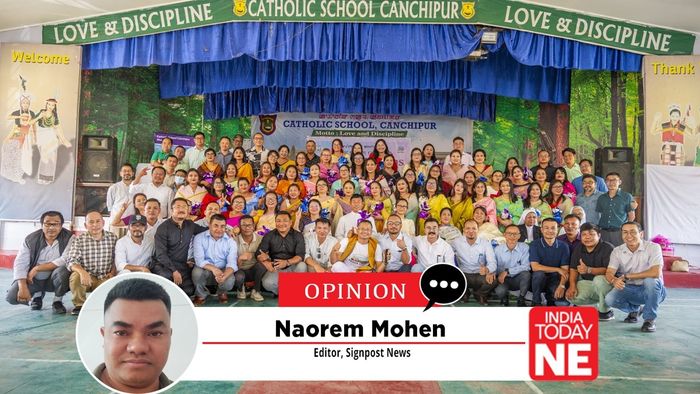
It was against this background that Catholic School Canchipur organised its first-ever Alumni Meet-cum-Ningol Chakouba celebration on November 8, 2026. The occasion was historic for an institution whose first batch of students passed out in 1992, yet whose alumni had never before come together in such a gathering.
Thirty-four years after that first batch completed its schooling, former students from different generations returned to the campus, some after decades of separation, bringing with them memories of childhood, stories of personal struggles and achievements, and the shared affection that comes from belonging to the same institution.
The gathering naturally carried an atmosphere of celebration, but the messages delivered during the programme gave it a significance that deserves attention beyond the school community. It was not merely an occasion to remember the past. It offered an opportunity for former students to unite, strengthen their relationship with their alma mater and consider how their collective experience and professional accomplishments could become useful to society.
Over the years, Catholic School Canchipur has produced former students who have established themselves in almost every major profession. Its alumni serve in the Indian armed forces, medicine, engineering, information technology, hospitality, journalism and media, business and entrepreneurship, and education. Some have returned to their own school as teachers, continuing the work of those who once guided them through their formative years.
Their achievements demonstrate how an institution that began with limited facilities can contribute to shaping generations of capable individuals. Yet an impressive list of professions, however encouraging, tells only one part of the story. The more important question is whether this accumulated knowledge, experience and social standing can now be brought together for a common purpose. If those who once shared classrooms can unite across batches, professions and generations, their combined strength can do far more than organise occasional celebrations. It can help improve educational opportunities, support former classmates in difficulty and contribute to the larger society from which they emerged.
Father Immanuel, Principal of Catholic School Canchipur, captured the emotional significance of the occasion through a simple observation that many former students would immediately recognise. He reminded them of the days when they first entered the school gates as children, some crying because they did not want to leave their homes or remain inside the unfamiliar campus. Those same children had now returned as adults, many with families and professional responsibilities of their own.
Seeing the transformed school and meeting people who had once been part of their everyday lives could again bring tears to their eyes, but this time they would be tears of joy, gratitude and affection. It was a touching reflection because the passage of time changes almost everything around us while leaving certain childhood memories remarkably intact. The classrooms may look different, the playground may have changed and the teachers who once guided us may no longer be present, but the feeling of belonging to a place where we spent our formative years often remains stronger than we realise.
Father Immanuel's address, however, went beyond these sentimental memories. Recalling the school's early years, when the institution stood amid paddy fields with modest classrooms and facilities, he spoke of the love and discipline through which teachers had helped shape their students. He also drew attention to people whose contributions are rarely acknowledged when educational institutions celebrate their achievements. Who cleaned the classrooms and washrooms? Who maintained the campus and performed the ordinary but essential work that allowed children to study in a safe and comfortable environment?
These questions may appear simple, but they remind us that no institution is built solely by its most visible personalities. Behind every successful school stands the collective effort of teachers, administrators, support staff, parents and many others whose contributions seldom find a place in commemorative speeches. Remembering them is not merely an act of courtesy. It is an acknowledgement that the achievements of an institution are shared, and that gratitude becomes meaningful only when it includes those who contributed without expecting public recognition.
Among those who spoke at the gathering was Thounaojam Brinda, a former Manipur Police Service officer and a member of Catholic School Canchipur's 1994 batch. Her reflections offered another perspective on the school's journey and the values that remain long after formal education has ended. Brinda recalled studying there with her cousins during the institution's early years, when the facilities were extremely modest and classrooms were sheltered by tin roofs. Returning after more than thirty years, she was struck by how much the school had developed from those beginnings. The transformation was particularly emotional for someone who had personally experienced its earliest conditions. Yet her emphasis was not simply on the improvement of buildings or physical facilities.
What mattered most to her was the education, affection and compassion that teachers had imparted to their students, and how those lessons had continued to influence their lives as adults. She acknowledged that whatever she and her fellow alumni had become was connected in important ways to the values they had learned within those classrooms.
Brinda's message carried a responsibility that deserves serious reflection. Education should not be treated merely as a means of acquiring qualifications, securing employment or achieving professional recognition. Those achievements are important, and every educational institution has reason to celebrate the success of its former students. But the real worth of education becomes visible when an individual uses the knowledge, experience and opportunities gained over the years to improve the lives of others. Brinda emphasised the responsibility of former students, now mature adults, to give back to society and the state. It is a powerful thought because it challenges the increasingly narrow understanding of success that dominates modern life.
We often measure achievement by professional position, income, social status or the ability to secure a comfortable life for ourselves and our families. Yet the values that schools attempt to impart—compassion, discipline, integrity, kindness and responsibility—cannot be measured through examination results or salary figures. They become meaningful only through the way we live and the contribution we make to people beyond our immediate families.
There was another important message in Father Immanuel's address, one that may ultimately prove more valuable than any formal resolution adopted at an alumni gathering. He reminded former students of classmates who might be facing illness, financial difficulties or other personal hardships. Reunions naturally bring attention to people who have done well in life. We meet former classmates who have become successful professionals, established businesses, travelled abroad or achieved positions of distinction. Their success brings happiness and pride because we remember them as the children who once sat beside us, shared their lunch or played with us during school breaks.
But adulthood does not treat everyone equally. Somewhere among those former classmates may be a person struggling to afford medical treatment, someone who has lost employment or a family quietly facing a crisis that is difficult to discuss. Such individuals may not appear in reunion photographs or social media celebrations, but they remain part of the same school community and deserve the same affection and consideration.
Father Immanuel encouraged alumni to reach out to such people, reminding them that even a visit, a conversation or a modest collective contribution could make a meaningful difference. No individual or association can solve every problem, and no school community can be expected to carry the burdens of society as a whole. But that limitation should not discourage people from doing what lies within their capacity.
A few classmates coming together to support someone undergoing medical treatment may provide relief that no single person could offer alone. A former student who has lost employment might find guidance or an opportunity through someone from an earlier batch. A struggling family may gain encouragement simply from knowing that old friends have not forgotten them. These are small acts when viewed individually, but together they create the kind of human relationships that make communities resilient.
An alumni network should therefore be judged not merely by the number of members registered, the attendance at reunions or the professional distinctions of its members, but also by its willingness to stand beside those who have fallen upon difficult times.
The same principle should guide the relationship between alumni and their alma mater. Catholic School Canchipur's former students now possess a wealth of professional knowledge and experience that could be shared with younger generations. Doctors can guide students interested in medical careers, engineers and information technology professionals can introduce them to new opportunities, entrepreneurs can explain the challenges of building businesses, and teachers, journalists, members of the armed forces and professionals from other fields can help students make informed choices about their futures.
Such interactions would provide lessons that extend beyond textbooks and examinations. Alumni could also contribute towards scholarships for deserving students from economically disadvantaged families, improvements to educational facilities, mentorship programmes, career counselling and assistance to children whose education is affected by difficult family circumstances.
These initiatives need not depend entirely on large financial contributions. The willingness to share knowledge, time, contacts and experience can sometimes be more valuable than money, particularly for young people who possess talent and determination but lack guidance or opportunities.
This is where the first alumni gathering can become the foundation of something more enduring. An institution that has educated students since before its first batch passed out in 1992 possesses a network of individuals connected by shared memories and a sense of belonging. If that network remains active and inclusive, it can become a meaningful resource for the school and the wider community.
The immediate task need not be an ambitious undertaking. Maintaining contact across batches, identifying alumni who require assistance, creating opportunities for professional mentoring and supporting students from disadvantaged backgrounds would provide a practical beginning. Over time, such efforts could develop into a sustainable culture of giving back, where former students view their connection with the school not as something that ended when they received their certificates, but as a relationship that continues throughout their lives.
The importance of such collective responsibility becomes even clearer when viewed against the circumstances confronting Manipur. Since May 2023, prolonged ethnic violence has caused immense suffering, displaced families from their homes, disrupted education and livelihoods, and damaged relationships between communities. Even those who have not directly experienced displacement or violence have lived with the uncertainty and social consequences of the crisis. Children have grown up amid anxiety, parents have worried about their futures, and many families have struggled to maintain ordinary routines that people elsewhere may take for granted.
The responsibility for restoring security, ensuring justice, rehabilitating displaced families and creating conditions for lasting peace rests primarily with the government and the institutions entrusted with those duties. Citizens and voluntary organisations cannot substitute for the state. Yet it would also be a mistake to believe that society has no responsibility until every political problem is resolved. There are many constructive things that individuals and organised groups can do to support people in need, strengthen educational opportunities and restore a measure of confidence in everyday life.
Manipur has never lacked talent. Its people have distinguished themselves in the armed forces, education, medicine, science, sports, administration, media, business and numerous other fields, both within India and abroad. What the state urgently needs is a stronger culture of bringing these abilities together for common social purposes.
Too often, professional achievement remains an individual accomplishment celebrated within families or institutions, while the wider community continues to struggle with problems that might be eased through collective effort. A doctor cannot independently reform the healthcare system, an entrepreneur cannot resolve unemployment across the state, and a teacher cannot repair every disruption caused by years of conflict.
But when people with different abilities organise themselves around realistic objectives, they can help particular families, schools, neighbourhoods and groups of vulnerable citizens. An effective alumni association is one possible platform through which such cooperation can begin, because its members already possess a relationship that existed before their professional lives took them in different directions.
There is also something important about the fact that Catholic School Canchipur's gathering was organised alongside Ningol Chakouba, a festival deeply associated with affection, family relationships and the renewal of bonds between siblings. At its heart, the festival reminds us that relationships must be nurtured through care and consideration rather than reduced to material exchanges. The same understanding can enrich an alumni community.
Meeting once after thirty years may bring enormous happiness, but the deeper value of that meeting lies in whether people continue to care for one another when the celebration is over. Friendship should not become a memory preserved only in old photographs, just as gratitude towards a school should not be confined to ceremonial speeches. Both acquire meaning through continued relationships, shared responsibilities and a willingness to respond when others need support.
In today's Manipur, the spirit of coming together deserves particular encouragement. The state has experienced deep divisions, and rebuilding trust will require patience, honesty, justice and sustained efforts from all sections of society. Educational institutions cannot resolve political disputes or replace the responsibilities of government, but they can continue to nurture the values that make peaceful coexistence possible.
Schools teach children to share classrooms, participate in common activities, respect teachers, cooperate with classmates and recognise that individual achievement need not come at the expense of others. These ordinary experiences form an important part of social education. When former students carry those lessons into adulthood, they help preserve the human connections upon which a healthy society depends. The collective responsibility of an alumni association therefore extends beyond its own members, even if its first efforts are necessarily modest and focused.
Catholic School Canchipur's November 8 reunion deserves to be remembered as a historic milestone for the institution. It brought together former students for the first time since the earliest batch passed out thirty-four years ago and allowed generations of alumni to renew relationships that had been interrupted by time, distance and the demands of adult life.
The joy of returning to familiar surroundings, meeting childhood friends and witnessing the school's development was reason enough to celebrate. But the messages delivered by Father Immanuel and Brinda Thounaojam and other alumni offered the gathering a purpose that could outlast the event itself. One reminded alumni to remember the people who contributed to their education and to care for classmates facing hardship. The other emphasised that the values received from school should inspire mature adults to give back to society and the state. Together, their reflections provided a direction for what the alumni community might become.
The true success of the first alumni meet will therefore not be determined by how many photographs were taken, how impressive the programme appeared or how emotional the reunion felt. Those memories will remain precious, but they cannot be the final measure of its significance. The more meaningful test will come in the months and years ahead, when former students have returned to their professions, families and everyday responsibilities.
Will the connections renewed on November 8 continue to grow? Will alumni come together to support the school and its students? Will they remember classmates who could not attend because life has been less generous to them? And will they use their collective professional strength to make even a modest contribution towards addressing the difficulties confronting Manipur?
These questions are not intended to place unreasonable burdens upon former students. They are reminders of the possibilities created when people who share a common educational foundation recognise that their association can serve a purpose beyond themselves. A reunion becomes meaningful when nostalgia develops into friendship renewed, friendship develops into cooperation, and cooperation eventually becomes a source of support for others.
Catholic School Canchipur has already given its alumni something valuable: the education, discipline, affection and memories that helped shape their lives. After more than three decades, its former students now have an opportunity to return that gift in ways that can benefit both the institution and the society around it.
The finest tribute we can pay to the school that made us who we are is not simply to return and remember our childhood, but to unite and carry forward the values we learned there. When those values find expression in helping a classmate, guiding a student, strengthening an institution or supporting a family in difficulty, education fulfils a purpose far greater than personal success.
For Catholic School Canchipur, the first alumni meet should be a beginning rather than an occasion that will be remembered only until the next celebration. And for Manipur, where rebuilding lives and relationships remains an urgent responsibility, the message is equally relevant.
We may not all possess the power to change the condition of the state, but each of us can contribute something towards making it better. The school that once brought children together in a classroom has now brought its former students together again as adults. What they choose to do with that renewed connection will determine the lasting value of their reunion.