Darika Silsakoo: Saving a Bridge Is Saving a Memory
In Assam, history is often encountered not inside museums but beside rivers, roads and paddy fields. The Darika Silsakoo at Simaluguri in Sivasagar is one such monument. Its recent damage from floods and the decision to restore it using traditional techniques should prompt a larger question: are we preserving Assam’s heritage merely as old structures, or are we preserving the knowledge and memory embedded in them?
- Aug 24, 2026,
- Updated Aug 24, 2026, 3:39 PM IST
In Assam, history is often encountered not inside museums but beside rivers, roads and paddy fields. The Darika Silsakoo at Simaluguri in Sivasagar is one such monument. Its recent damage from floods and the decision to restore it using traditional techniques should prompt a larger question: are we preserving Assam’s heritage merely as old structures, or are we preserving the knowledge and memory embedded in them?
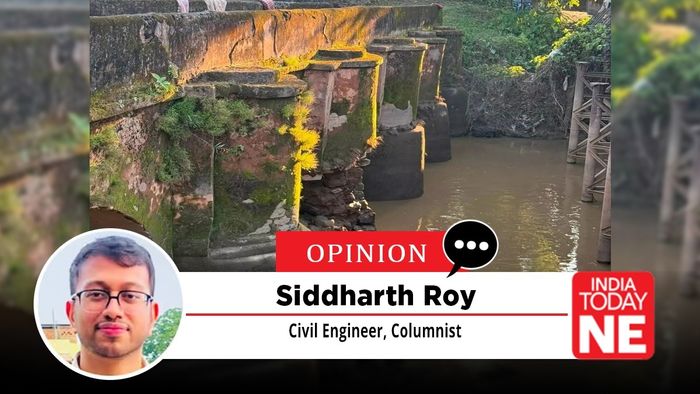
The Darika Silsakoo is an extraordinary reminder of Ahom engineering. Built during the reign of Swargadeo Pratap Singha, who ruled from 1603 to 1641, the bridge spans the Darika river. Assam’s Directorate of Archaeology records that it stands on four pillars founded on dressed stone blocks and contains five arches made from thin lakori bricks bonded with lime-surkhi mortar. The bridge is about 109 feet long, 12 feet wide and 18 feet high.
Its importance therefore goes beyond antiquity. It represents a period when engineering responded to the landscape rather than attempting to overpower it. The Ahoms developed sophisticated systems of roads, embankments, bridges, tanks and waterways suited to the Brahmaputra valley’s difficult hydrology. Modern research into Ahom architecture has identified Darika Silar Saku among a wider group of stone bridges that demonstrate the dynasty’s remarkable construction capabilities.
That makes the present damage especially significant. Recent flooding has affected the historic structure, and archaeologists are now preparing to undertake conservation using traditional stone masonry and a centuries-old mortar recipe rather than replacing the damaged portions with modern materials.
This is the correct philosophy of conservation.
A heritage bridge should not be treated like an ordinary public asset that can simply be demolished and reconstructed. Its materials, proportions, construction techniques and relationship with the surrounding landscape constitute part of its historical meaning. Replacing an old structure wholesale with concrete may preserve a bridge-shaped object while destroying the very evidence that makes it historically valuable.
Darika Silsakoo also offers an important lesson for contemporary Assam. The state has repeatedly experienced the destructive power of water. Floods and erosion are generally discussed as modern disasters, but the Ahom builders understood that living with water required engineering adapted to local conditions. Their structures survived for centuries because they were conceived within the geography of Assam.
Conservation, therefore, should not mean freezing monuments in time while allowing their surroundings to deteriorate. The Darika river, drainage patterns, vegetation and access routes around the bridge form part of its heritage landscape. Poorly planned construction, altered water flows or neglect can eventually threaten a restored monument just as seriously as a flood.
There is also an educational opportunity. Assam’s schoolchildren should know that the Ahom period was not only an era of political resistance and military achievement. It was also an era of engineering innovation. Bridges such as Darika Silsakoo demonstrate how architecture, material science and an understanding of local terrain came together long before modern engineering institutions existed.
The restoration should consequently become a model rather than an isolated project. Assam has numerous historic bridges, embankments, tanks, monuments and archaeological sites that require systematic documentation. Each should have a conservation plan based on structural condition, flood vulnerability, surrounding land use and historical significance.
Tourism can be another beneficiary, but commercialisation must follow conservation, not precede it. Carefully developed heritage circuits linking Simaluguri with Sivasagar’s larger Ahom landscape could generate livelihoods while creating public interest in preservation. A monument survives best when local communities see its value.
Darika Silsakoo has already endured centuries of political change, floods and environmental transformation. Its survival is a quiet testimony to the ingenuity of those who built it.
The task before Assam today is not simply to repair an old bridge. It is to ensure that the knowledge represented by that bridge does not disappear.
If the stones of Darika Silsakoo can survive four centuries, our institutions should be capable of ensuring that its story survives much longer.