Disqualifying Manipuri Pageant Contestants for Speaking Their Mother Tongue Is Not Professionalism
The recent incident at the I-Glam Manipur 2026 beauty contest, where young contestants were interrupted, publicly humiliated, and sidelined simply for speaking in Manipuri language during the question-and-answer rounds, has rightly sparked outrage across the state.
- Apr 01, 2026,
- Updated Apr 01, 2026, 3:18 PM IST
The recent incident at the I-Glam Manipur 2026 beauty contest, where young contestants were interrupted, publicly humiliated, and sidelined simply for speaking in Manipuri language during the question-and-answer rounds, has rightly sparked outrage across the state.
What was billed as the first-ever I-Glam Miss & Mr. Teen Manipur and Miss & Mr. Junior Manipur Beauty Contest, a platform meant for grooming, confidence-building, and celebrating local talent, instead became a site of linguistic discrimination and emotional distress for several participants.
Language is not merely a tool for communication. It is the vessel of identity, culture, emotion, and lived experience. For contestants from Manipur, expressing themselves in their mother tongue on home soil should have been a natural right, not a punishable offence.
Interrupting girls mid-sentence, dismissing their responses, or flatly telling them to “go inside” and calling the next contestant because they chose Manipuri over English sends a damaging message: your culture is secondary, your voice is inadequate unless it conforms to someone else’s standard. This is not empowerment. This is erasure disguised as grooming.
Beauty pageants worldwide have long navigated the question of language without turning it into a barrier. No major international contest — Miss Universe, Miss World, or Miss Earth — insists on flawless English fluency as a precondition for participation or victory.
Organizers routinely provide interpreters precisely because contestants represent diverse linguistic realities. The emphasis remains on poise, intelligence, confidence, advocacy skills, and the ability to connect with an audience, not on delivering accent-free, error-free English.
A powerful reminder came from Janine Tugonon, first runner-up at Miss Universe 2012 from the Philippines. When asked whether English should be mandatory for a Miss Universe because she represents the world, Tugonon replied with conviction: “For me, being Miss Universe is not just about knowing how to speak a specific language. It’s about being able to influence and inspire other people. So whatever language you have, as long as your heart is to serve and you have a strong mind to show to people, then you can be Miss Universe.”
Her words resonated globally because they cut to the heart of what pageants should celebrate, substance over syntax. History offers more evidence. Dayana Mendoza (Venezuela, Miss Universe 2008) used a translator to understand the question in Spanish but answered in English, imperfect yet authentic, and still won the crown.
Her compatriot Irene Esser attempted something similar in 2012 but faltered; the difference lay in delivery and clarity, not in the mere act of using a native language.
In national pageants too, such as Miss Universe Vietnam 2022, organizers wisely allowed finalists to speak in Vietnamese or English, recognizing that forcing a second language can add unnecessary pressure without enhancing true merit.
In India’s diverse cultures, where the Constitution recognizes 22 scheduled languages including Manipuri, such sensitivity becomes even more essential.
A state-level event held in Imphal, featuring around 100 contestants from the region, should naturally prioritize local expression. Instead, reports suggest some judges (including those perceived as non-local) applied informal expectations of English dominance, turning a celebratory platform into an intimidating one.
What makes the I-Glam incident particularly troubling is the age profile of the participants. The contest featured two clear categories: Juniors (ages 3 to 12 years) and Teens (ages 14 to 17 years). Many contestants, especially in the junior segment, are still developing their confidence and linguistic comfort.
For young children and early teenagers, the stage itself is daunting enough, facing bright lights, an audience, and public judgment. Adding public interruption, dismissal, or outright humiliation for speaking their mother tongue can leave lasting psychological scars.
As far as the I-Glam contest is concerned, there is no official rule mandating English as the sole medium for question-and-answer rounds. No prospectus, entry guidelines, or public announcement from the organizers required contestants to speak only in English.
The event positioned itself as a grooming and personality development platform for Manipuri youth, aimed at building self-belief and preparing them for future opportunities while celebrating local talent.
In such a context, penalizing or embarrassing participants for using Manipuri was neither justified by rules nor aligned with the spirit of a home-state pageant.
The Judges and Organisers should not humiliate the contestants. If they do not speak English fluently or comfortably, let them speak in their mother tongue and listen to them with respect. Reject them during shortlisting or final judging if they do not meet your benchmarks in overall performance, confidence, or other criteria — but do so privately and professionally.
Flatly showing them the door and calling the next contestant in the middle of a live segment is beyond imagination and unacceptable.
Personality development is not measured by the way one speaks English; it is reflected in self-assurance, clarity of thought, emotional intelligence, and the courage to stand on stage. Public shaming achieves the opposite of grooming, it breeds insecurity, especially among impressionable young minds.
If such humiliation affects these minors, some as young as three to twelve years old, who will ultimately be responsible? The judges who wielded the microphone with arrogance? The organisers who failed to brief the panel on cultural sensitivity? Or the broader system that normalizes linguistic elitism in platforms meant for empowerment?
The emotional well-being of children and teenagers must take precedence over any subjective notion of “global readiness.”
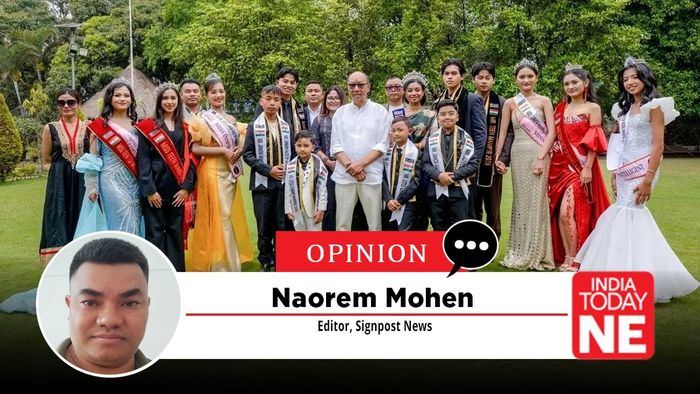
Meanwhile, Chief Minister Yumnam Khemchand met the title winners and organisers shortly after the grand finale at the Secretariat. In his public statement, he praised the event for celebrating talent and opening career pathways, extending best wishes to the winners for carrying “the pride of Manipur.”
While positive encouragement for youth achievement is welcome, the meeting highlighted a glaring gap. There was no public acknowledgment or condemnation of the reported linguistic discrimination and humiliation that marred the contest for several participants.
A leader committed to preserving Manipuri culture and identity should have used the occasion to send a clearer message, that the state’s official language and the dignity of its young citizens deserve respect on every platform, including beauty pageants.
True support would include urging organisers to adopt more inclusive practices in future editions.
Manipur, like other Northeast states, has long navigated complex questions of identity, representation, and belonging within the larger Indian narrative. Language sits at the core of that identity. The Meitei language is not just a medium; it is a carrier of history, folklore, poetry, and resilience.
Treating it as inferior on a Manipuri stage reinforces harmful hierarchies — where English (or sometimes Hindi) is positioned as superior and “modern,” while indigenous languages are dismissed as provincial or inadequate.This mindset echoes broader patterns of linguistic chauvinism seen across India, where non-dominant language speakers often face subtle exclusion in education, media, employment, and public life.
Beauty pageants, which claim to empower young women and men, have a responsibility to counter such exclusion rather than perpetuate it. By allowing contestants to speak in the language they are most comfortable with, organisers could have showcased authentic voices discussing issues close to their hearts — whether related to Manipur’s unique challenges, women’s rights, education, or cultural preservation.
Few may argue that English training prepares contestants for national or international stages. There is some merit in offering optional English grooming as part of personality development. However, this preparation should never come at the cost of public humiliation or forced conformity, especially for minors.
Many successful international delegates receive targeted language coaching only after selection. Translators and bilingual support exist for a reason — to ensure ideas, not accents, are judged.
Bilingualism or multilingualism should be viewed as an asset. Contestants from Colombia, Ukraine, or the Philippines often begin in English and transition proudly to their native languages, displaying both global competence and cultural pride. Manipuri girls deserved the same opportunity.
The I-Glam Manipur 2026 controversy should serve as a wake-up call rather than a defensive moment for organisers. Future editions must include clear, transparent guidelines that respect linguistic diversity. Judges, whether local or from outside the state, should receive briefing on cultural sensitivity.
Personality development in a beauty and grooming contest should focus on building inner confidence, articulate thinking, empathy, and stage presence, qualities that transcend any single language. A contestant speaking passionately in Manipuri about her vision or experiences can inspire far more deeply than a rehearsed but hollow English script.
As Janine Tugonon reminded the world over a decade ago, the essence of a titleholder lies not in mastering a specific language but in possessing a heart to serve and a mind to inspire. The young contestants at I-Glam who dared to speak their mother tongue embodied authenticity and courage. They should have received encouragement, not interruption or dismissal.
Organisers, judges, and all stakeholders in Manipur’s emerging pageant ecosystem must internalise this: respect for the mother tongue is respect for the child. Grooming should uplift, never break. Only then can such contests genuinely crown representatives who carry the pride of Manipur with uncompromised grace, confidence, and cultural rootedness.