Divine Panthou’s Sunday Teaching: Human Nobility Lies in Protecting Life
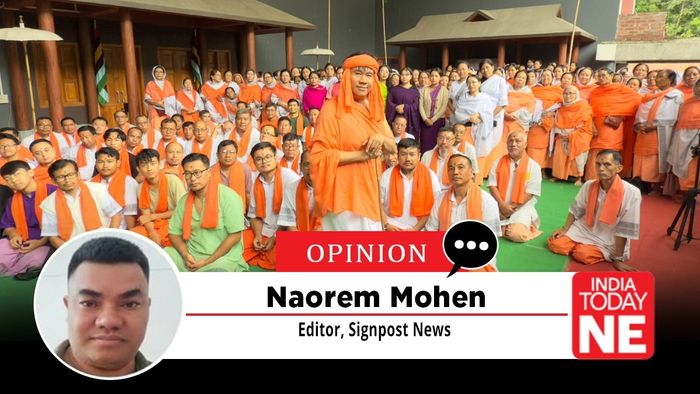
Divine Panthou’s latest Sunday teaching linked faith with non-violence, mutual help and care for nature. It cast human nobility as a duty to protect life, rebuild trust and safeguard Manipur’s shared earth.
- Sep 20, 2026,
- Updated Sep 20, 2026, 1:30 PM IST
A week after Divine Panthou urged people to practise their own religion without belittling another, his latest Sunday teaching carried the discussion further. This time, he connected religious faith with humanity, mutual help and our responsibility towards the natural world.
At the heart of the teaching were three simple lines:
“Meena mee hatkanu,
Meena mee tengbangminashi,
Thawai panba pumnamaki athoibadi meeni.”
In English, it means:
“Let no human kill another human.
Let people help one another.
Of all living beings, human beings are the noblest.”
These lines contain the central idea of Divine Panthou’s teaching. Human beings cannot claim to be the noblest among living creatures merely because they possess intelligence, power or the ability to dominate others. Nobility must be earned through conduct. It must be visible in our refusal to take life, our willingness to help one another and our care for the wider world that sustains every living being.
The teaching was rooted in Meitei laining, but the questions it raised were universal. What is the value of religion if it cannot stop one human being from killing another? What is the purpose of prayer if it does not move us to help someone in distress? And can human beings call themselves the noblest of living creatures while destroying the earth on which all life depends?
Human beings have built places of worship, composed sacred texts and developed elaborate religious traditions. Yet people continue to kill in the name of identity, territory, community and belief. We speak of civilisation while slowly becoming accustomed to the suffering around us. We recognise the divine in temples and sacred places but sometimes fail to recognise the humanity of the person standing across a social or political divide.
“Let no human kill another human” is therefore more than a plea against physical violence. It challenges every attempt to divide human life into categories: lives that deserve protection and lives that can be sacrificed.
Religion loses its moral purpose when it teaches people to recognise God but fails to teach them to recognise another human being.
For Manipur, this message cannot remain an abstract spiritual thought. Our society has endured killings, displacement, separation and a steady hardening of community boundaries. Families have lost loved ones. Thousands have been forced to live away from their homes. Suspicion has entered everyday relationships, and language itself has sometimes become a weapon.
In such a situation, Divine Panthou’s words demand more than passive agreement. They ask every community to reject the belief that its own suffering justifies the suffering of another.
No lasting peace can be built upon selective grief. If we mourn only for those who share our identity while remaining indifferent to the pain of others, we may demonstrate loyalty to a group, but we have not yet reached the humanity that religion is meant to awaken.
The second line, “Let people help one another”, takes the teaching from restraint to responsibility. It is not enough that we do not harm others. Human beings must also stand beside one another.
A hungry person needs food. A displaced family needs shelter. A frightened child needs security. A person carrying grief needs someone willing to listen. A wounded society needs people courageous enough to rebuild trust across the boundaries created by conflict.
Mutual help is perhaps the most practical expression of faith. It does not always require a large institution, a public ceremony or an announcement. It can begin with sharing food, protecting a neighbour, caring for an elderly person, listening to someone in pain or refusing to spread a rumour that could endanger another person.
Religion becomes meaningful when its teachings enter these ordinary choices.
The third line, “Of all living beings, human beings are the noblest”, may appear to place humanity above the rest of creation. But Divine Panthou’s message should not be understood as permission to dominate or destroy other forms of life. If anything, it places a heavier responsibility upon us. Nobility is not a privilege. It is a duty.
If human beings possess reason, moral understanding and creative ability, they also carry a greater obligation to protect the vulnerable. A human being cannot claim superiority while poisoning rivers, cutting down forests without restraint, destroying wetlands or treating animals and other forms of life merely as objects of consumption and profit.
Intelligence without compassion may make us powerful. It does not make us noble.
This is where Divine Panthou’s teaching connects religion and humanity with the environment. The earth is not separate from spiritual life. Hills, forests, rivers, wetlands, animals and human settlements form one living system. Damage inflicted upon one part eventually reaches the others.
Manipur’s indigenous traditions have long recognised this relationship. Sacred groves, forest deities, water bodies and ancestral landscapes are not simply cultural symbols. They carry an older understanding that human existence depends upon a world larger than human desire.
Nature was not regarded merely as property waiting to be exploited. It was approached with gratitude, restraint and reverence.
That wisdom is particularly relevant today. Loktak Lake, Manipur’s rivers, Koubru, Thangjing and surrounding hills, wetlands and forests are under visible pressure. They cannot be protected through ceremonial concern alone. Environmental responsibility must enter public policy, development planning and personal conduct.
The same person who prays for the welfare of future generations cannot remain indifferent while their natural inheritance is destroyed. We cannot seek divine protection for our homes while polluting the water, cutting the forests and damaging the land that make those homes habitable.
Religion, science and law each have a role. Science can explain what is happening to the environment. Law can regulate harmful activities and punish violations. Religion can shape the conscience that determines how people behave even when no authority is watching.
Law may prevent someone from cutting a protected tree. Faith can teach why the tree should not be viewed merely as timber. Regulation may prohibit the pollution of a river. Moral understanding can prevent a person from treating the river as a convenient dumping ground in the first place.
Divine Panthou’s teaching thus brings together three inseparable responsibilities. Religion must awaken humanity. Humanity must lead people to help one another. Human nobility must be demonstrated through compassion towards other living beings and responsibility towards the earth.
Remove one of these elements, and the others become incomplete. Religion without humanity can become rigid and divisive. Humanity without concern for nature forgets that no society can survive after destroying its ecological foundations. Environmental concern without changes in everyday human conduct risks becoming a slogan repeated only on special occasions.
The teaching also deserves to be documented carefully. Oral spiritual discourses often contain reflections on society, ethics and ecology that disappear after a gathering ends. Recording, translating and compiling them would allow younger generations to understand Meitei laining not merely as a collection of rituals but as a living moral tradition.
Documentation alone, however, is not enough. The real test begins outside the place of worship.
It begins when we encounter someone from another community. It begins when a neighbour needs help, when public anger demands another victim or when personal profit comes at the cost of a forest, river or wetland. It begins whenever we must choose between convenience and responsibility.
If human beings are truly the noblest among living creatures, that nobility must be visible in the way we protect life.
Manipur desperately needs this moral reminder: let no human kill another human, let people help one another, and let human beings prove their nobility by protecting every form of life and the shared earth upon which all of us depend.
(The views expressed in this article are those of the author and do not necessarily reflect the views of India Today NE or its affiliates)