Divine Panthou’s Sunday teaching: What is a livelihood worth if it costs a life?
The care with which Meitei families prepare a meal offers a standard for anyone who makes or sells food and drink. The person who will consume it is someone’s family, too.
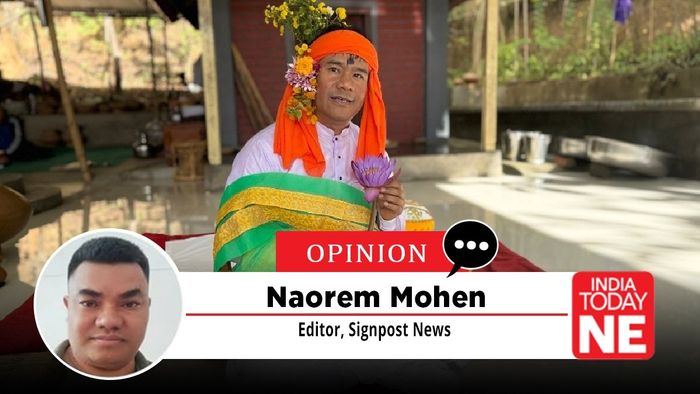
- Nov 22, 2026,
- Updated Nov 22, 2026, 2:11 PM IST
In his Sunday teaching, Divine Panthou asked a question that anyone who makes or sells liquor should have to sit with. If the person who drinks it dies, who will be left to buy it? The question sounds at first like one about trade.
His concern, however, was with the person whose life is in the hands of a maker or a seller who may never know their name. Money can change hands in a moment. A family can spend the rest of its life living with what happened in that moment.
Divine Panthou began with the body and the soul. Our time in this world is brief, he said, and what we have been given is too precious to replace with money. That includes the body we live in and the human form through which we do our work.
We are the ones who will teach what we know of religion, write down what we have learned and remember the names of the land, the trees, the flowers, the animals and the fish around us. Someone has to carry that knowledge forward. When a life is cut short, a family loses a person, and the world may also lose things that person alone knew how to do or tell.
From there, Divine Panthou took his listeners into a Meitei kitchen. He recalled how the person who cooks bathes before preparing the meal, how the hearth is cleaned and how the pots and utensils are washed. Rice and greens are rinsed before they go into the pot. He spoke of the care taken with foods as familiar as hawaijar and Utong Nga.
These were ordinary details, the sort of work a child might watch every day without thinking much about it. Yet the child is learning something about responsibility. Whoever prepares the food takes care with things that the people who sit down to eat will never see.
What happens to that sense of responsibility when food travels beyond the kitchen? A person opening a packet or buying a drink often has little way of knowing how it was prepared or what went into it. Divine Panthou widened his warning to packaged food and unfamiliar things we eat and drink.
For those who produce and sell them, that lack of knowledge on the buyer’s side creates a duty. If I would take care over a meal I serve my own family, I owe the same care to a stranger who pays me for food. The stranger’s money does nothing to lessen my responsibility for what I hand over.
He also distinguished between preparations made for religious observances and liquor made for commerce. He spoke of the care with which food is cooked and offered to a deity and asked for comparable care where customary practice calls for preparing liquor.
His personal counsel was to abstain from drinking. His appeal to anyone who makes or sells liquor concerned the person on the receiving end. When a drink takes a life, an inquiry may eventually establish what was added to it. That finding may help prevent another death. For the family already grieving, it comes too late.
There is a responsibility here for public authorities as well. Families can decide what they prepare in their own kitchens, but they cannot inspect the places where everything they buy is made. Producers and sellers must answer for what they put into circulation, and the authorities charged with oversight have a duty to act before a dangerous product reaches a household. An investigation after a death can establish who failed in that duty. The harder work is making sure someone takes responsibility while there is still time.
Divine Panthou spoke of the unseen deity and of human beings as the visible form of the divine. That thought ran through the whole teaching, from the daily work of washing a pot to the decision a seller makes when a customer is standing in front of him.
In the kitchen, the people we cook for are usually people we know. The measure of our care is whether it extends to someone whose face we may never see.