Don’t Let the Ghost of Churachandpur Haunt Litan in Manipur
The swift and visible response by Manipur’s newly installed government to the arson and clashes in Litan Sareikhong, Ukhrul district, in the on February 9, 2026 stands as both a hopeful signal and a painful reminder.
- Feb 09, 2026,
- Updated Feb 09, 2026, 7:30 PM IST
The swift and visible response by Manipur’s newly installed government to the arson and clashes in Litan Sareikhong, Ukhrul district, in the on February 9, 2026 stands as both a hopeful signal and a painful reminder.
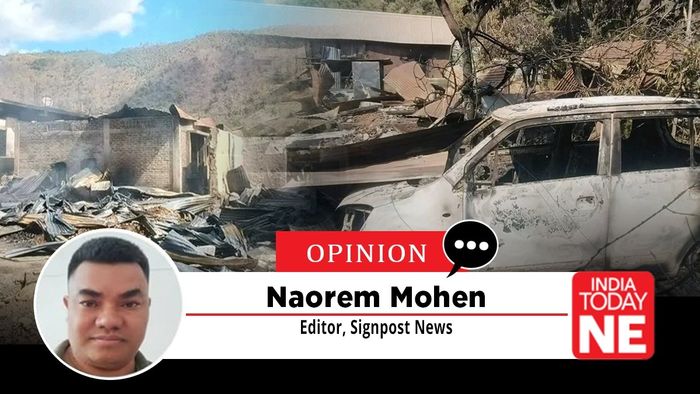
On the night of February 7 and 8, what began as a drunken brawl, leaving a Tangkhul man named Sterling seriously injured, rapidly escalated into targeted arson. Miscreants set fire to houses late Sunday night into Monday morning, followed by gunshots, reportedly from automatic rifles, echoed through the village.
When peace was expecting in the State, panic spread along the Imphal–Ukhrul highway. Families fled in trucks, private vehicles, and on foot, clutching mattresses, utensils, and whatever belongings they could carry.
Initial police assessments reported 25 houses and four government quarters burnt, the majority belonging to the Tangkhul community (21 houses) with a smaller number belonging to Kukis (4 houses).
Minister Govindas Konthoujam informed the media, describing the ground situation as “very tense.” Another 7 more houses were burnt in broad daylight on Monday despite heavy security presence.
Curfew was promptly imposed under Section 163 of the Bharatiya Nagarik Suraksha Sanhita; joint forces, iincluding CRPF, BSF, Assam Rifles, state police, additional CAPF units, the 8 Bihar Regiment, and the 4th Mahar Regiment were deployed in strength. A senior Manipur Police team led by an Inspector General (Law and Order) reviewed the scene on the ground.
This level of immediacy, curfew enforcement, rapid reinforcement, helicopter services arranged between Imphal and Ukhrul to maintain connectivity, and high-level political engagement prevented the violence from metastasizing into the kind of statewide ethnic conflagration that began on May 3, 2023, in Churachandpur.
That earlier outbreak started with a Tribal Solidarity Peace Rally. However, within hours it devolved into targeted ethnic attacks by Kuki militants and mobs. Meitei houses and businesses burnt in Churachandpur to drive the minority community out, which spread to Kuki properties attacked in the Imphal Valley in retaliation.
The absence of decisive, impartial containment in those first critical days created an ethnic fault lines to harden into near-permanent divides—security zones, relief camps, and mutual suspicion that have persisted for nearly three years, claiming over 300 lives and displacing more than 70,000 people.
Litan’s fault lines are different. This is an inter-tribal clash between Tangkhul, the dominant Naga tribe in Ukhrul and Kukis, rooted in localized land ownership disputes, historical claims, and territorial assertions.
The burning of Tangkhul houses carries an unmistakable message of exclusion. “Leave this land.” Yet unlike the 2023 valley–hills, Meitei–Kuki polarization, community leaders moved toward dialogue relatively quickly.Deputy Chief Minister Losii Dikho (Naga), Ukhrul MLA Ram Muivah, and Saikul MLA Kimneo Hangsing (Kuki) visited the affected areas and convened an emergency joint meeting at Litan Police Station. Participants included Tangkhul Naga Long (TNL) President Sword Vashum, the Litan Kuki Chief, and representatives from Tangkhul Shanao Long, Katho Katamnao Long, Kuki Students’ Organisation, and other civil society bodies.
The talks were repeatedly described as “productive,” “positive,” and “fruitful.” Both sides formally expressed commitment to peace and harmony. The government pledged every possible assistance to restore normalcy.These engagements, together with the fast imposition of curfew, security surge, and facilitation of helicopter services, deserve appreciation.
They demonstrate that when political will exists, escalation can be checked before it consumes entire districts. Earlier, the precedent of Mongkot Chepu (June 26, 2025) reinforces the point. An attack on a Ukhrul-bound passenger winger near the Kuki village led to brutal assault on the driver and passengers and destruction of the vehicle.
Tangkhul organizations issued ultimatums. Then, the Kuki village chiefs of the Litan area responded by condemning the act, naming the accused, and agreeing to stringent conditions, like no future repetition without severe consequences and no room for compromise; respect for Tangkhul customs and traditions as landowners; submission of household and village census details to the Tangkhul Naga Long within 48 hours; payment of ₹5 lakh compensation within three days.
That agreement, though fragile, averted immediate further violence then.Yet Litan’s ground reality tempers any premature celebration. While leaders spoke of fruitful dialogue, no binding roadmap emerged to address the core issue like unresolved land ownership and historical rights. Firing and burning of houses still continue while the talk was going on, indicating some fringe groups don't want peace in Litan or anywhere in Manipur.
TNL President Sword Vashum cut through the diplomatic language with stark clarity. “We want peace, but not at the cost of denying the rightful landowner. If the legitimate owner is disregarded, how can a lasting solution ever be achieved?”
Without courage to confront and resolve that fundamental dispute, through transparent, neutral mediation and legal mechanisms, any truce remains paper-thin. Charred house frames stand as mute testimony; families continue to flee ancestral land; once-busy roads lie deserted; fear lingers thick despite the heavy security blanket.
Adding to the chorus of appeals for calm, former Chief Minister N. Biren Singh weighed in on Monday via a Facebook post. Expressing deep concern over the sudden flare-up, he urged members of the Tangkhul and Kuki communities in Litan to restrain themselves from provocation.
He emphasized that, after collective hard work to restore a measure of peace and normalcy across the state, achieved through shared sacrifice and restraint any escalation now risks undoing that fragile progress.
“I urge both communities to exercise patience, avoid provocation, and stand together to protect the peace we have rebuilt,” he stated, framing the incident as originating from an altercation where some individuals from the Kuki community allegedly brutally beat a Tangkhul man on Saturday night.
Biren’s appeal, coming from a figure whose tenure was marked by allegations of intense polarization and criticism over handling the broader ethnic crisis, carries symbolic weight in this moment. It exposes a rare cross-community call for unity amid fresh tensions, even as underlying grievances persist.
Chief Minister Yumnam Khemchand Singh who assumed the office on February 4, 2026, was selected by the central leadership in large part for his perceived ability to engage across ethnic lines. His December 2025 visit to Kuki internally displaced persons (IDP) relief camps in Litan Sareikhong and Chassad, becoming the first Meitei MLA to make such an outreach, often accompanied by Tangkhul friends carried symbolic weight in a deeply fractured state.
In a touching moment at Imphal Airport, CM Khemchand Singh personally saw off Paite MLA Vungzagin Valte, who was airlifted to New Delhi for advanced medical treatment. Amid the ongoing efforts to heal Manipur's divisions, Khemchand recounted their brief but meaningful exchange before Valte's departure. The ailing MLA, a Paite representative injured in the 2023 ethnic violence, expressed his congratulations on Khemchand's recent assumption of office and reaffirmed his belief in the Chief Minister's leadership to restore peace.
Valte also pledged his support in bridging communities, conveying deep hope and trust that CM Khemchand could guide the state toward reconciliation and lasting harmony. This gesture of solidarity, with the CM wishing him a speedy recovery and urging his return, symbolized a shared commitment to unity across divides.
He has already visited injured persons from Litan at RIMS Hospital, urged restraint and dialogue, and publicly assured safety and medical care for Kuki community members visiting Imphal.
Every act of arson or assault, regardless of the community responsible, must be condemned without equivocation.
With only a limited window before the next electoral cycle, the new government faces harsh social truths. Yet public trust in Khemchand offers a narrow opening, if used wisely.
To prevent the ghost of Churachandpur from haunting Litan and beyond, the administration must move decisively on several fronts:
(i) Facilitate sustained, neutral-mediated negotiations specifically on land ownership, historical claims, and forest rights.
(ii) Accelerate credible IDP resettlement packages with genuine security guarantees and confidence-building measures.
(iii) Bridge hill–valley development disparities through transparent, equitable investment in infrastructure, education, health, and livelihoods and
(iv) Pursue disarmament of non-state armed groups and accountability for Kuki militant atrocities and violence.
Manipur can begin to heal.But if dialogue remains performative, if land disputes are left to fester, if security deployments substitute for political solutions, the ghost will return, first to Litan, then to other fault lines across the hills and valley.
Manipur has already paid too high a price in lives, trust, and futures. The world watches not merely for stability in India’s Northeast, but for whether a diverse democracy can still muster the will to confront its own divisions.
For the sake of Tangkhul, Kuki, Meitei, and every Manipuri family still living in fear or exile, don’t let Churachandpur’s ghost haunt Litan. Bury it—with justice, transparency, and unflinching courage on the roots.