Even birds from the valley will not be allowed to fly in Kuki airspace soon
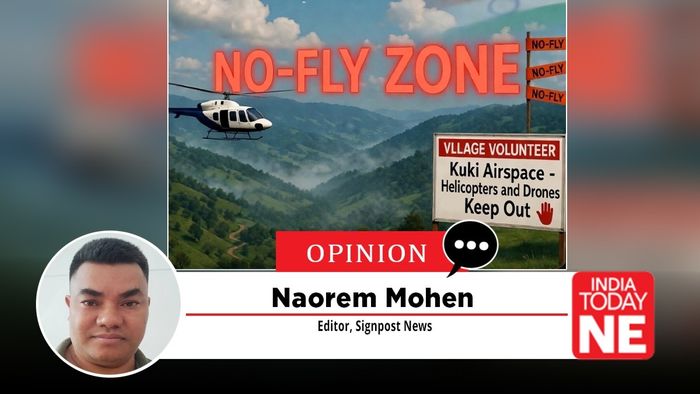
The press statement issued by Village Volunteer Ukhrul Gamkai on 19 May 2026, openly warning that passenger helicopters and drones will be shot down if they fly over Kuki villages in Ukhrul, is not empty rhetoric. This threat cannot be taken lightly.
- May 20, 2026,
- Updated May 20, 2026, 4:49 PM IST
The press statement issued by Village Volunteer Ukhrul Gamkai on 19 May 2026, openly warning that passenger helicopters and drones will be shot down if they fly over Kuki villages in Ukhrul, is not empty rhetoric. This threat cannot be taken lightly.
In a state already scarred by years of violence, such declarations carry real and deadly weight. We have seen how advanced weapons have been used against civilians before.
In 2024, RPG-type projectiles fired from a distance of around 20 km struck areas in Moirang, killing and injuring civilians. More recently, on 7 April 2026, the tragic Tronglaobi incident in Bishnupur district shocked everyone.
A powerful rocket type projectile hit a civilian home in the middle of the night, instantly killing two innocent children, while their mother was critically injured. The family was sleeping. These are painful reminders of how quickly “warnings” or “self-defence” claims can turn into loss of innocent lives.
The latest sarcastic remark from outlawed Kuki organization doing the rounds captures the deepening frustration and disbelief among the people of Manipur. After nearly three years of turmoil since May 2023, what began as National Highway blockades has now extended to claims over the skies.
On 19 May 2026, the so-called Kuki Village Volunteer Ukhrul Gamkai issued a formal press statement threatening to shoot down passenger helicopters and drones flying over Kuki villages in the Ukhrul area.
They specifically directed the Ukhrul-Imphal chopper service to avoid “their” airspace and restrict itself to Tangkhul Naga villages, describing low-altitude flights as “provocative.”
Drones spotted over Mongkot Chepu areas were also targeted with warnings of being shot down, holding originating villages responsible.This statement is not a minor local grievance. It is a mockery of Indian sovereignty, the rule of law, and basic common sense.
A group of armed civilians, operating under the label of “Village Volunteers,” has taken it upon themselves to regulate national airspace with the stroke of a letterhead. The document, complete with a date, reference number, and motto, reads like an official government notice, except it carries threats of violence against civilian infrastructure.
What is particularly alarming is how this warning by Kuki village volunteers now echoes the language and tactics of international militant and militia groups. In conflict zones around the world, outlawed armed factions have issued similar public threats to shoot down aircraft, declared “no-fly zones” over territories they control, and warned civilian or military flights to stay away or face destruction.
For instance, in November 2019, forces aligned with Khalifa Haftar’s Libyan National Army (LNA) declared a no-fly zone over Tripoli and explicitly threatened to shoot down any civilian or military aircraft attempting to use Mitiga airport.
Similarly, the Iraqi group Ashab al-Kahf has repeatedly issued public threats to shoot down US helicopters and manned aircraft. Such statements by non-state armed actors are globally viewed as serious security risks, often leading to international condemnation, flight restrictions, and heightened military responses.
Indian airspace is not a private domain. No village volunteer group, no ethnic outfit has the right to declare “no-fly zones” or issue shoot-down threats. Such actions challenge the authority of the DGCA, the Indian Air Force, and the Indian state itself.
In any functioning democracy, such a declaration would trigger immediate legal action. Here, it circulates freely on social media, adding to the cycle of provocation and counter-provocation.
The absurdity hits harder when viewed against the backdrop of repeated National Highway blockades. Since May 2023, certain Kuki groups have frequently imposed economic blockades on NH-2 and NH-37, the lifelines connecting the Imphal Valley to the hills and to the rest of India.
These blockades have caused shortages of essential goods, inflated prices, stranded thousands of vehicles, and inflicted immense hardship on ordinary families. Now, the same pattern of controlling movement has moved upward. Roads were first, and the sky is next.
One cannot help but wonder, as the sarcasm suggests, whether migratory birds or even clouds will soon require clearance from these self-appointed authorities.
This is not self-defence or community vigilance. It is an attempt to establish parallel governance in a sensitive border region. Indian airspace is not divisible by ethnicity or village jurisdiction.
Helicopters in Manipur are not tools of aggression — they provide critical connectivity in a terrain where roads are often disrupted by unrest, ambushes, or natural challenges. They serve medical evacuations, essential passenger travel, security operations, and administrative needs. Threatening them only endangers lives and deepens the isolation of communities already struggling after years of conflict.
The press statement mocks the very idea of one nation under one law. “Our territory, our airspace” has no constitutional validity. No village committee or militants can declare no-fly zones inside India. Yet this is the third year of such assertions. Earlier warnings targeted helicopter services to Moreh and other areas.
The pattern is very clear. They control movement, assert dominance, and challenge state authority. Meanwhile, drone sightings and low-flying choppers are framed as provocations, ignoring the practical necessities that make air travel indispensable in Manipur.
What makes this even more concerning is the utter silence from authorities. Manipur has seen President’s Rule imposed and later revoked earlier in February 2026, with efforts to restore elected governance.
Yet public threats like this one, openly challenging civilian aviation and national infrastructure, elicit little visible response. No immediate condemnation, no FIRs against those issuing the statement, no visible enforcement of airspace regulations. This silence is not neutral.
This silence only signals weakness and emboldens further mockery of the system. Ordinary citizens from all communities watch in dismay as armed “terrorist” continue to proliferate on every side. If the government fails to take firm and visible action against this open challenge by Kuki militants to shoot down civilian helicopters and drones, it will only worsen the fracture.
Such inaction is steadily turning Manipur into a patchwork of ethnic fiefdoms, where self-proclaimed guardians decide who can move by road or by air, and where national laws and sovereignty are openly disregarded.
Manipur is part of India, not a collection of independent territories. The Constitution guarantees equal rights and free movement across the country. When armed groups issue such statements with impunity, it erodes public faith in the authority. The silence from the government, whether at the state or central level, raises uncomfortable questions.
Is there fear of escalation? Political calculations? Intelligence gaps? Or simply fatigue after years of managing this hydra-headed crisis?
Whatever the reason, tolerance of such mockery weakens the state’s legitimacy. Firm, impartial action is urgently needed. Restoring the rule of law equally for every citizen is not optional — it is essential for healing. Without it, sarcasm about birds in the sky may soon turn into grim reality, where even basic freedoms are curtailed by fear and factionalism.
India cannot afford a state where ethnic militias dictate terms to the nation. The authorities must break this pattern decisively. The sooner normalcy returns, with roads open, skies safe, and governance impartial, the sooner Manipur can heal and its people from every community can look forward with hope.
(The views expressed in this article are those of the author and do not necessarily reflect the views of India Today NE or its affiliates.)