Ex-Deputy CM Joykumar launches NPP (Tera Lai) to reclaim Manipur’s political legacy
The National People's Party (Tera Lai) — NPP (TL) — was officially launched on February 1, 2026, in Manipur as a regional political party. Former Deputy Chief Minister Yumnam Joykumar Singh assumed the role of State President, vowing to serve the people without bias and positioning the party as an inclusive alternative focused on a united Manipur.
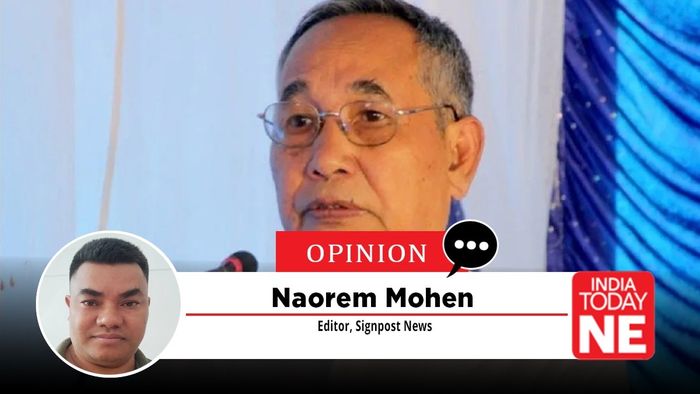
- Feb 01, 2026,
- Updated Feb 01, 2026, 9:33 PM IST
The National People's Party (Tera Lai) — NPP (TL) — was officially launched on February 1, 2026, in Manipur as a regional political party. Former Deputy Chief Minister Yumnam Joykumar Singh assumed the role of State President, vowing to serve the people without bias and positioning the party as an inclusive alternative focused on a united Manipur.
The party's formation stems from deep-rooted claims over the origins of the National People's Party (NPP), which has long been associated with Meghalaya and the Sangma family.
The trigger for the split came in late 2025. A documentary titled "Tera Lai: The Forgotten Heroes of Manipur, The Rise of NPP", released on November 15, 2025, spotlighted Nongthombam Ibomcha Singh (popularly known as Tera Laimu or Tera Lai) from Patsoi Assembly Constituency in Imphal West as the true founder of the NPP.
Just about two weeks later, on November 22, 2025, Yumnam Joykumar (state unit president and National Vice President) was replaced.
The suspicious timing of Yumnam Joykumar's replacement as NPP Manipur state president—just days after the November 15, 2025, release of the documentary Tera Lai: The Forgotten Hero of Manipur – The Rise of the National People’s Party—raises serious questions about why national leadership of NPP appear reluctant to give due recognition to Nongthombam Ibomcha, an important figure in establishing the NPP in Manipur.
This echoes the bitter 2020 internal crisis, when Thangminlien Kipgen (then claiming leadership of the Manipur unit) accused Conrad Sangma of orchestrating a "coup d’état" to rewrite party history by crediting his late father, Purno Agitok Sangma, as the founder, despite the party's origins in Manipur in 1989.
Kipgen has also alleged that Conrad Sangma was attempting to "own" the Manipur unit through expulsions and control, reacting to Sangma's September 13, 2020, statement affirming the 1989 founding by local leaders.
The party faced de-recognition by the Election Commission in 2012 for failing criteria but regained state party status in May 2017. Kipgen described PA Sangma's 2012 entry (as an NCP leader) and subsequent election as national president on September 15, 2012, as a takeover, not a founding act.
Such persistent tensions over crediting Manipur's indigenous founders versus the Sangma family's narrative suggest that discomfort with highlighting Tera Lai's legacy, especially via a recent documentary may be the change of guard within NPP and formation of a New Party to challenge the previous one.
Historical accounts confirm that the NPP was established on January 13, 1989, at a convention held at the Mandop of Kongrailatpam Brajamohon Dev Sharma in Naoremthong Uripok, Imphal. Attended by academicians, social workers, journalists, and others, the gathering elected Nongthombam Ibomcha Singh as the first President. It was registered with the Election Commission of India as a state party (Regd. No. 162/89 & 196/91) and viewed as a re-emergence of the earlier "Praja Shanti" party from 1948, with a broad national outlook initially.
In its early years, the original NPP contested Manipur assembly elections on a sporadic basis. In 1990, it secured one seat when V. Hangkhalian won from Churachandpur, and he went on to serve as a minister in an alliance government under the MPP-led ULF administration. The party followed up by winning two seats in the 1995 assembly polls.
After a period of limited activity, it made a stronger showing in 2007 by capturing three seats: V. Hangkhalian in Thanlon, Thangminlen Kipgen in Kangpokpi, and T. Hankhanpao in Singhat. However, the party achieved little to no success in several other elections — including 2000 and 2012 — and had become largely inactive by the mid-2000s.
In 2013, the late Purno Agitok Sangma, after parting ways with the Nationalist Congress Party, relaunched and expanded the NPP as a national entity from Meghalaya. He became its national president, shifting focus toward tribal and Northeast issues.
The party gained national recognition in 2019 under his son, Meghalaya CM Conrad Sangma. Official NPP narratives emphasize PA Sangma as founder, though Manipur sources and some party documents acknowledge Ibomcha's foundational role in 1989.
Tensions escalated in November 2025. On November 3, Conrad Sangma visited Manipur for an MLA's family event but said nothing about party matters. The next day (November 4), a Delhi meeting involving Northeast-based parties, chaired by Sangma, discussed merging into a new "North East People's Party," reportedly focused on tribal communities.
Manipur NPP representatives, including Joykumar, argued it should include all indigenous groups. Joykumar claims his removal as NPP Manipur state president — replaced by ex NPF MP Dr. Lorho S. Pfoze — and other changes (ex Congress Minister Irengbam Hemochandra Singh as National Vice President) stemmed from his advocacy for Manipur's integrity and opposition to separate administration demands during that meeting.
On November 22, 2025, Joykumar publicly stated his ouster was due to speaking out for Manipur's unity against divisive proposals. His ouster, coupled with the documentary highlighting Tera Laimu's legacy, led to the split.
However, currently NPP claims the loyalty of the four MLAs elected in 2022. Mayanglambam Rameshwar Singh (Kakching), Khuraijam Loken Singh (Wangoi), Noorul Hasan (Kshetrigao), and Janghemlung Panmei (Tamenglong). These MLAs were nurtured under Joykumar's leadership, raising questions about whether they will shift allegiance to their Mentor.
Today, NPP (TL) revives the "Tera Lai" identity to reclaim Manipur's foundational claim on the party, distancing itself from the Meghalaya-led national structure.Joykumar stressed that NPP (TL) is not Meitei-centric. It includes Naga representation, with ongoing talks involving winning Naga candidates. Doors remain open to Kuki leaders who support the idea of a united Manipur.
The new party aims to field candidates in the 2027 assembly elections, targeting a strong performance. While ambitious goals exist of winning more than 25 seats, securing around 10 seats would represent a significant achievement for the new party— especially given Joykumar's past contributions in building the original NPP's base in Manipur, including nurturing MLAs who won in 2017 and 2022.
The launch arrives amid widespread dissatisfaction with the BJP and Congress over Manipur's ethnic conflict, governance failures, and lack of local-centric solutions. By invoking Tera Laimu's legacy and Joykumar's grassroots experience, NPP (TL) seeks to fill the vacuum for a truly state-rooted, inclusive regional force ahead of 2027.
Whether NPP (Tera Lai) becomes a genuine bargaining force for Manipur's interests or fades as another election-season vehicle for sidelined politicians remains uncertain. Its key strength so far lies in reclaiming and publicizing the party's Manipur origins, long overshadowed by its Meghalaya-led national image. This could reshape political dynamics in a state hungry for local-led alternatives.