From Forced Oath to Liberation Dip: The 53rd Nongkhrang Ehanba and the Imperative of Sanamahi Revival
Held annually on the full moon of the Phairen month in the Meitei lunar calendar, Nongkhrang Ehanba is organized by the Lainingthou Sanamahi Thougal Kanglup and Sana Konung Uttra Sanglen.
- Feb 01, 2026,
- Updated Feb 01, 2026, 2:24 PM IST
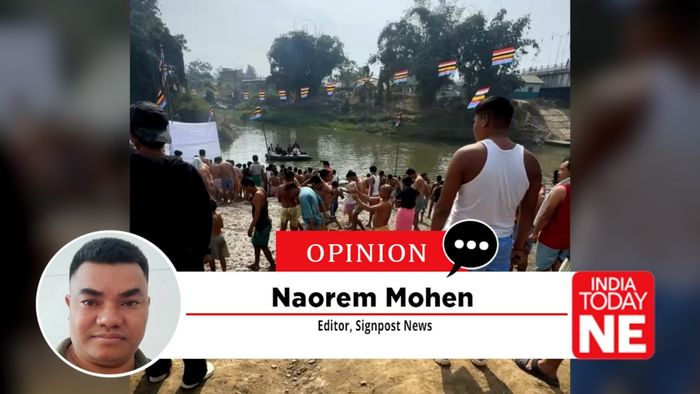
Today marks the 53rd Nongkhrang Ehanba, a ritual of profound transformation that shifts the narrative from historical subjugation to contemporary liberation. This ritual is observe at the sacred Lilong Irong River and stands as a living testament to the Meitei people's unyielding resolve to reclaim their indigenous spiritual heritage.
Held annually on the full moon of the Phairen month in the Meitei lunar calendar, Nongkhrang Ehanba is organized by the Lainingthou Sanamahi Thougal Kanglup and Sana Konung Uttra Sanglen.
Far from a mere ceremonial dip, it represents a deliberate reversal, a "liberation dip" that symbolically undoes the coerced oath of 1729 and purifies the collective Meitei bloodline from centuries of imposed religious allegiance.
The origins trace back to a dark chapter in 1729, when King Pamheiba, influenced by the Hindu preacher Santidas Mahanta from Sylhet, enforced mass conversion to the Guadiya Vaishnaviam faith. At the confluence of the Imphal and Iril rivers in the Lilong area, Meitei forefathers were compelled to hold a branch or leaf of the sacred Nongkhrang tree, revered in Meitei tradition for making oaths inviolable and binding fate to divine retribution, and immerse themselves in the waters.
This Nongkhrang Irupa (dipping in water) extracted a terrifying vow: "I will not abandon the religion; if I do, may I die vomiting blood." More severe vow were also heard during this forced conversions. A parallel ritual reportedly took place at midnight in Nungseng Ikon inside the Kangla, embedding the coercion deeper into sacred laiphamlen.
The Nongkhrang plant's cultural potency amplified the oath's gravity; any breach invited cosmic consequences. Yet, amid this forced submission, the Maichous—guardians of ancient Meitei knowledge—secretly vowed that the original Sanamahi faith would resurface after seven generations.
With an average generation span of 50–60 years from 1729, this prophetic period spans roughly 2079 CE to 2149 CE. The window opened in the late 20th century, aligning perfectly with the modern revival and lending a sense of historical inevitability to today's efforts.
The turning point arrived in 1974, when the ritual of Nongkhrang Ehanba ("cleaning the blood") was publicly revived under the leadership of the then titular King of Manipur, Pareihanba (Okendrajit Singh). This marked the first collective "liberation dip"—a ritual retraction of the 1729 oath, reaffirming loyalty to Sanamahi and cleansing the lineage of enforced conversion.
Since then, the ceremony has grown annually, drawing devotees to invoke unity, peace, and welfare by purging the legacy of coercion.
Sanamahism, the indigenous religion of the Meiteis is an animistic and polytheistic tradition centered on Lainingthou Sanamahi, the supreme household deity and guardian of humanity. It honors a rich pantheon like principal deities, ancestral spirits (Apokpa), regional protectors (Lam Lai or Umang Lai), and clan-specific entities. Rooted in harmony with nature, ancestors, and community, it features egalitarian worship, ritual purity, and vibrant festivals like Lai Haraoba, which reenact creation myths through dance, music, and offerings—free from the caste hierarchies introduced by later faiths.
The 1729 conversion systematically dismantled this framework. Hinduism dominated publicly, though syncretic practices persisted privately. However, revival movements emerged in the 1930s with pioneers like Naoria Phullo and organizations such as Apokpa Marup (1930) and Meitei Marup (1945), denouncing foreign imposition and restoring pre-Hindu traditions.
By the 1970s–1980s, activists reclaimed shrines, revived deities, and staged symbolic acts like the 1974 Nongkhrang Ehanba.Returning to Sanamahism is imperative for the Meitei people, not as nostalgia, but as a vital reclamation of cohesive identity fractured by external forces.
It also anchors Meitei existence in the soil of Manipur, offering an unbroken spiritual lineage that fosters pride in indigenous origins. Sanamahism can bridge divides by highlighting shared pre-colonial values like nature reverence, ancestor veneration, and communal harmony without divisive structures.
Sanamahism's animistic core resonates with tribal traditions honoring spirits, ancestors, and sacred groves. Reviving it as a unifying indigenous ethos can frame common struggles against cultural erasure, promoting solidarity over division.The ritual's promise, that retracting the oath cleanses the bloodline extends to societal healing, purging coercion to enable authentic indigenous standing.
This builds resilience against identity erosion, especially among youth disconnected from roots. Nongkhrang Ehanba educates and unites, repurposing unbreakable vows for liberation.
These efforts are nearing concrete fruition with the push for Sanamahi (Sanamahism) as a distinct religion code in India's upcoming national census. Rajya Sabha MP and titular Maharaja of Manipur Leishemba Sanajaoba raised this as a matter of urgent public importance in Parliament in December 2025, during the winter session.
He urged the central government to introduce a dedicated category, noting that Sanamahism's current grouping under "Others" or "Other Religions and Persuasions" misrepresents and undercounts adherents, erasing cultural identity.
This echoes the Manipur Legislative Assembly's unanimous resolution on August 5, 2022 (reaffirming earlier 2002–2003 calls), forwarded to the Registrar General and Census Commissioner. The Lainingthou Sanamahi Temple Board reinforced it with a September 17, 2025, memorandum. Official recognition would ensure accurate demographics, safeguard heritage, and validate the faith's legitimacy amid growing open adherents.
The Meitei stand out as one of the few larger indigenous groups in Manipur actively campaigning on this scale to revive their ancestral religion amid socio-political pressures. Smaller tribes like Kabui, Chothe, Maring, and others preserve their animistic traditions through community rituals and festivals, sharing threads with Sanamahism—nature spirits, ancestors, sacred sites.
The Meitei's visible revival inspires parallel efforts, fostering mutual recognition and broader indigenous solidarity rather than rivalry. Census inclusion would empower Meitei identity while advancing inclusive narratives for tribal faiths across.
As participants dip at Lilong Irong, holding Nongkhrang anew in affirmation, they proclaim Manipur's ancient faith vibrant and flowing. The shift from forced oath to liberation dip highlights Sanamahi revival's urgency for Meitei unity, sovereignty, and indigenous harmony, building peace on reclaimed heritage.
The river, once site of coercion, now carries prayers for enduring unity and welfare of the region.