Gaslighting of Assam Rifles and Central Paramilitary Forces by Feuding Kuki and Naga CSOs
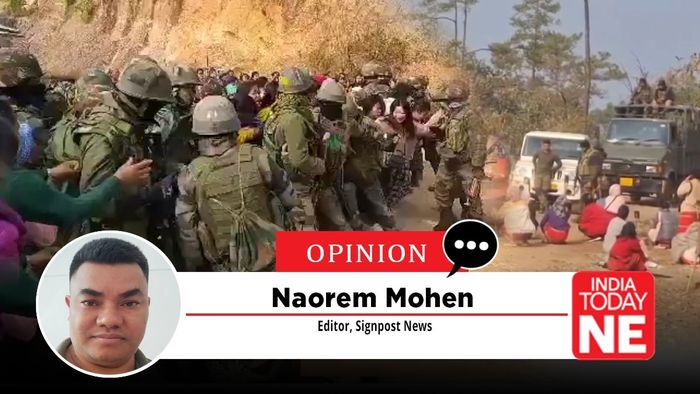
In the mist-shrouded hills of Manipur, where centuries-old ethnic boundaries intertwine with fresh wounds of suspicion and loss, the Assam Rifles and other central paramilitary forces find themselves caught in an unrelenting storm of accusation.
- Mar 24, 2026,
- Updated Mar 24, 2026, 8:00 PM IST
In the mist-shrouded hills of Manipur, where centuries-old ethnic boundaries intertwine with fresh wounds of suspicion and loss, the Assam Rifles and other central paramilitary forces find themselves caught in an unrelenting storm of accusation.
These neutral men and women, often operating from isolated camps under constant threat, shoulder the burdensome task of keeping fragile peace in one of India’s most complex conflict zones.
Their mandate is clear yet profoundly challenging. To maintain law and order, separate communities locked in bitter rivalry, dismantle illegal bunkers that turn villages into fortresses, patrol ambush-prone roads, respond to militant movements, and stop small incidents from exploding into wider tragedy.
However, instead of being seen as the thin line preventing total breakdown, they are repeatedly cast as biased actors, accused by one side of favoring the other, and vice versa.
This mutual, contradictory blame game amounts to a dangerous form of gaslighting. It distorts the forces’ role as neutral stabilizers, drains the morale of jawans performing thankless duty in hostile terrain, and conveniently shifts attention away from the deeper roots of violence: armed militants exploiting ethnic fault lines, unresolved land and resource disputes, and cycles of revenge that communities themselves have struggled to break.
The most recent illustration surfaced in the tense Kamjong district. On March 23, 2026, the Working Committee of the Tangkhul Naga Long (TNL) released a forceful press statement detailing what it described as unprovoked and heinous attacks by armed Kuki militants and miscreants on innocent Tangkhul Naga civilians.
According to the statement, beginning around 2:00 PM, Sikibung village came under siege from multiple directions. Sustained, indiscriminate firing created panic among women, children, and the elderly as bullets ripped through residential homes.
The assault reportedly eased only to resume the following morning, gravely injuring two civilians while sporadic gunfire continued.That same evening, around 8:15 PM, armed men believed to be from Chassad village opened fire with automatic weapons and single-barrel breech-loading guns toward the civilian areas of Kamjong headquarters.
The shooting occurred disturbingly close to the 11 Assam Rifles unit camp and the local police station, an act the TNL viewed as a brazen challenge to established authority. The intensity of the attack compelled more than 40 Tangkhul Naga families, including many women and children, to abandon their homes and seek refuge elsewhere.
These accounts paint a picture of genuine fear and suffering that no responsible voice can ignore. Civilians caught in the crossfire of ethnic tensions deserve protection, swift justice against attackers, and concrete steps to restore their sense of security.
The trauma of living under the shadow of gunfire is real and demands urgent attention from both state and central authorities.However, the TNL statement did not limit itself to condemning the perpetrators.
It directed sharp criticism at the Assam Rifles stationed at Kamjong headquarters and the wider framework of central security forces. The committee alleged “complete inaction and apparent leniency,” claiming the forces failed to intervene and safeguard innocent lives.
Most alarmingly, it asserted that Assam Rifles personnel had explicitly warned civilians that any retaliation by Tangkhul Naga volunteers against the Kuki militants would invite violent response from the security forces themselves. This warning, the TNL argued, proved beyond doubt that the Assam Rifles were “hand in glove with the Kuki militants.”
The statement went on to demand not only the booking of culprits but also a thorough probe into the security forces for alleged complicity, followed by prosecution under relevant sections of the BNS and suitable punishment. It also urged immediate and decisive intervention by authorities to halt the violence and prevent further escalation.
Such accusations are weighty. If proven, they would rightly invite accountability and reform. Yet, when placed against the broader, recurring pattern of Manipur’s ethnic crisis, they reveal a familiar and ultimately self-defeating script, one that undermines the very institutions working to contain the fire rather than fuel it.
Across flashpoints in recent months, both Kuki and Naga representative bodies have leveled parallel yet diametrically opposite charges against the Assam Rifles and paramilitary units.
Kuki organizations frequently accuse the forces of shielding Naga militants, ignoring abductions and killings of Kuki civilians, and failing to act decisively when Naga groups allegedly breach agreements.
In turn, Naga organizations, including the TNL and others, contend that the same forces display favoritism toward Kukis, tolerating Kuki bunkers while razing Naga ones, remaining passive during Kuki militant operations, and actively discouraging Naga self-defense measures.
Both these narratives cannot hold true simultaneously. This irreconcilable finger-pointing creates a classic gaslighting dynamic. The targeted institution is made to appear perpetually guilty, its every action or restraint twisted into evidence of bias.
The real instigators, militant outfits operating with varying degrees of restraint, historical territorial grievances, and deepening ethnic polarization, recede into the background as public anger is redirected toward the peacekeepers.
Moreover, operational realities on the ground tell a different story. The Assam Rifles, with its long institutional memory of Northeast counter-insurgency, functions in vast, rugged terrain with constrained resources. Dense forests, poor visibility, and the deliberate blending of militants with civilian spaces complicate rapid response.
When firing erupts near a camp or police station, as reportedly happened in Kamjong, the immediate priority is often containment, preventing a localized clash from spiraling into village-wide retaliation or drawing security personnel into ambushes.
Warnings against retaliation, where issued, are not signs of collusion but pragmatic de-escalation tools employed in conflict zones worldwide. Allowing armed volunteer groups to launch counter-attacks risks transforming a bad situation into a catastrophe, endangering more innocents on all sides and hardening positions for future talks.
In historically sensitive areas like Chassad and Kamjong, marked by land disputes that flared violently as far back as 2020, such restraint aims to preserve the narrow space for eventual coexistence.Time and again, the forces have demonstrated even-handedness under pressure.
In Waphong Inthan and similar Naga-dominated pockets earlier this month, they dismantled illegal bunkers and fortifications erected by villagers, actions that drew sharp condemnation from Naga bodies as harassment and selective targeting.
However, on the same days, Kuki voices highlighted the abduction and brutal killing of two Kuki youths in the Kamjong region, allegedly by suspected Naga militants, while accusing the forces of inaction or protection of the perpetrators.
The simultaneous release of detained 21 Tangkhul civilians through mediation further complicated the picture, with each community interpreting the same events through its own lens of grievance.
In the Litan-Sareikhong area, where clashes erupted earlier in February, Assam Rifles columns moved quickly alongside the Army and Rapid Action Force. They enforced curfews, conducted joint patrols in mixed villages, physically separated opposing groups, and helped facilitate humanitarian aid to displaced families in nearby subdivisions.
Therefore, accusations of bias flew from both directions, yet the intervention helped limit the immediate spread of violence amid sporadic firing near the foothills.
Similarly, in the recurring trouble spot of Chassad, the forces have repeatedly stepped in during nights of high tension. They have stopped mobs from advancing on villages, offered temporary shelter inside camps to frightened residents from both communities when arson threats loomed, and maintained a visible presence that prevented worse outcomes.
These are not the hallmarks of a partisan force aligned with one militant faction. They reflect the difficult, often invisible work of acting as a reluctant buffer in places where trust between communities has eroded dangerously.
The human toll of this persistent gaslighting extends far beyond bruised institutional pride. Our Jawans endure not only the physical hazards of ambushes, inclement weather, and isolation but also the psychological strain of operating under constant suspicion.
Every decision, to engage, to hold fire, to warn against escalation, or to facilitate a humanitarian release, becomes fodder for competing narratives that erode public confidence. Mediation efforts suffer when basic gestures of restraint are reframed as betrayal.
Most damagingly, the collective focus drifts away from holding militant elements accountable, addressing legitimate territorial and developmental concerns, and fostering the difficult conversations needed for long-term healing.
The current phase, overlapping with the larger Meitei-Kuki tensions since 2023, has added new layers of complexity and fresh displacements. In villages like Sikibung, Kamjong headquarters, Chassad, Litan, Shangkai, and Thawai, ordinary families, bothTangkhul farmers tending fields, Kuki mothers protecting children, elders recalling better times, live with the daily fear of sudden gunfire or forced evacuation.
When CSOs and Apex organizations channel significant energy into accusing central security forces of complicity rather than issuing joint calls for restraint and cooperation with authorities, the suffering of these civilians is prolonged.
Instead, the legitimate demands for stronger security deployment, flushing out violators of agreements, and fair investigation of incidents are valid and should be pursued through proper channels.
However, leaping from operational challenges or standard de-escalation warnings to sweeping claims of collusion risks undermining the very institutions that provide the breathing room necessary for any eventual dialogue.
Both Kuki and Naga CSOs, must acknowledge that the Assam Rifles and central paramilitary forces are not the creators of the crisis. They are present because internal mechanisms for peaceful resolution have, at critical moments, fallen short. Redirecting anger toward these forces only weakens the buffer that stands between manageable tension and outright disaster.
Ordinary villagers on both sides share the same fundamental aspirations, that is safety for their loved ones, the freedom to cultivate their lands without fear, access to education and healthcare, and a future unmarred by endless violence.
The gaslighting must stop immediately. The Assam Rifles and other paramilitary personnel deserve the space to perform their difficult mandate without being perpetually undermined or demoralized our jawans.