Himanta Biswa Sarma’s Manipur Message: Peace Needs Courage, Not Political Noise
What if Manipur's biggest challenge is not law and order, but the absence of leaders willing to rebuild trust? A remark by Assam Chief Minister Himanta Biswa Sarma has reignited debate over who can truly steer the conflict-torn state towards peace.
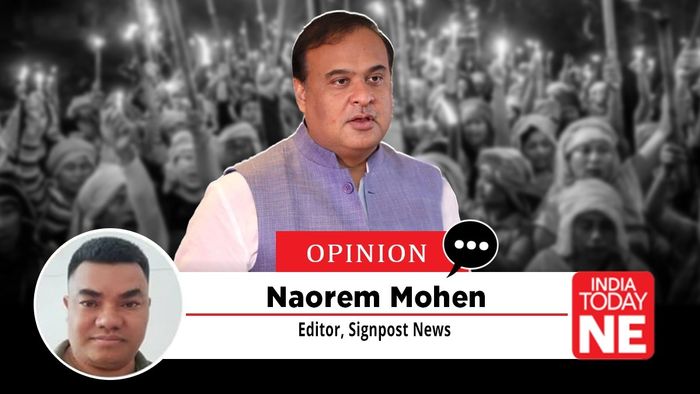
- Jul 05, 2026,
- Updated Jul 05, 2026, 1:35 PM IST
Assam Chief Minister Himanta Biswa Sarma’s remarks expose a hard truth: Manipur’s crisis cannot be resolved by force alone. It requires community dialogue, political clarity, and leaders willing to act with courage.
Speaking at an idea exchange on July 4, he said one cannot put a rifle to communities and ask them to resolve their issues by six o’clock the next evening. The State can maintain law and order, but a durable solution must come from the communities themselves.
This statement is important because it separates two issues that are often confused in public discussion. The first is the responsibility of the State to prevent violence, protect citizens, control armed groups, secure highways, and enforce the law. The second is the deeper social and political task of restoring trust among communities that no longer believe in each other’s intentions.
The first requires administrative authority. The second requires moral courage, political imagination, and sustained community dialogue. Manipur’s tragedy is that both have been weak at different moments.
Himanta Biswa Sarma’s recent remarks on Manipur deserve serious attention, not because they offer a complete solution, but because they cut through one of the most persistent misunderstandings about the crisis.
Manipur conflict is not merely a law and order problem. If it were only that, deployment of security forces, arrests, curfew, and administrative restrictions would have produced results long ago. The crisis has survived because it is rooted in accumulated distrust between communities, competing claims over land and identity, fears of demographic change, unresolved administrative grievances, armed mobilisation, and the failure of political leadership to create a credible forum for dialogue.
Right now, Manipur needs leaders who can combine firmness with empathy. It needs leaders who understand that security operations may stop immediate violence, but they cannot heal broken relationships. It needs leaders who know that community dialogue must be encouraged, but not allowed to drift endlessly without structure.
It needs leaders who can engage Delhi without surrendering local responsibility. It needs leaders who can speak the language of the Constitution and the language of community memory at the same time.
The larger question is not whether Manipur has leaders who can act like CM Himanta Biswa Sarma. The real question is whether Manipur has leaders prepared to think with depth, act with courage, and accept responsibility for history.
No outsider can love Manipur more than its own people. No Chief Minister from another state, no Delhi official, no security commander, and no commentator can build peace if Manipur’s own political and community leadership refuses to do the hard work.
External actors can facilitate. They can advise. They can maintain order. They can provide resources. But the moral centre of the solution must come from within.
CM Himanta’s statement is therefore both realistic and uncomfortable. It is realistic because no lasting settlement can be forced upon communities that refuse to speak to one another. It is uncomfortable because it exposes the absence of a clear political roadmap within Manipur itself.
The question then arises: do Manipur’s political leaders possess the knowledge, clarity, courage, and administrative depth required to move the state toward peace?
This is not a personal attack on any individual. It is a question of institutional performance. A political class must be judged not by speeches, symbolic visits, or press statements, but by its ability to read history, understand society, anticipate consequences, and act before a crisis becomes uncontrollable. By that measure, Manipur’s leadership across parties has failed to rise to the scale of the moment.
It requires political figures who can speak to Meiteis, Nagas, Zomis, Thadous, Kukis, Pangals, and smaller communities without being seen as captive to one group’s fear or another group’s ambition.
This is where the comparison with Himanta Biswa Sarma becomes politically relevant. One may agree or disagree with his politics. One may question several aspects of his public style. But few can deny that he understands the grammar of power in the Northeast.
Himanta is widely seen as a bold and decisive leader who understands the political temperament of the Northeast. His remarks, when he said that he does not think polarisation is needed in Assam and that he controlled the menace, carry relevance beyond Assam. They also speak directly to Manipur’s present crisis.
Manipur today needs leaders with similar clarity, courage, and administrative confidence, like Himanta Biswa Sarma.
A state as complex as Manipur cannot be governed through short-term calculations. It requires leaders who understand the hill-valley relationship, land laws, historical grievances, illegal immigration, border management, narcotics networks, proxy wars, insurgent legacies, and governance failure without losing sight of constitutional responsibility.
His approach may not be copied mechanically, because Assam and Manipur have different histories and social structures. But his larger message is important: difficult problems must be confronted with firmness, political intelligence, and a clear roadmap. That lesson perfectly suits Manipur’s search for peace and stability.
He knows that ethnic disputes cannot be settled only through files in Delhi. He understands that community leaders, church bodies, civil society organisations, student groups, village authorities, armed formations, and elected representatives all operate within a layered political society.
He also understands that the Centre can encourage, pressure, facilitate, and secure, but it cannot manufacture trust where communities themselves refuse to create space for negotiation. Manipur needs that level of clarity.
This clarity carries weight because Himanta Biswa Sarma has, in recent years, converted Assam into one of the most closely watched states in India, not merely in the Northeast. Under his leadership, Assam has pushed large infrastructure, aviation, railway, highway, industrial and semiconductor-linked initiatives, including recent efforts for a semiconductor ecosystem, railway expansion. At the same time, he has taken a firm political position on illegal immigration, demographic change, encroachment, and protection of indigenous land and cultural institutions, issues that remain among the most sensitive concerns across the Northeast.
This does not mean Assam’s model can be mechanically applied to Manipur. The two states have different histories, social compositions, and conflict structures. But it does mean that Himanta speaks from the experience of a leader who has treated security, development, identity, border management, and political messaging as connected questions. Manipur’s crisis also demands that kind of integrated understanding.
A credible roadmap for Manipur cannot be built on slogans or emotional declarations. It must begin with a sober recognition of reality: every major community in the state has a permanent stake in its future. The Meiteis will remain central to Manipur’s destiny. The Nagas will remain a decisive presence in any discussion on peace, territory, and governance. The Kukis, too, will remain a part of Manipur, like other ethnic communities.
Each community carries history, fear, memory, and political aspiration. A settlement that humiliates one side will fail. A settlement that rewards violence will fail. A settlement that ignores territorial anxieties will fail. A settlement that treats security as a substitute for political dialogue will also fail.
The first requirement is restoration of minimum trust. This does not mean immediate reconciliation. That would be unrealistic. It means creating conditions where communication becomes possible. At present, even dialogue is seen by many as surrender. This is dangerous. When communities stop speaking, armed actors, rumour networks, and hardline organisations fill the vacuum.
The second requirement is a structured inter-community dialogue process. Such a process cannot be reduced to occasional informal meetings. It needs recognised facilitators, clear agenda points, confidentiality where required, and public communication where necessary.
The dialogue must include Meitei, Kuki, and Naga representatives, but it must not be captured entirely by the loudest organisations. Women, displaced persons, traditional institutions, intellectuals, retired administrators, and local bodies must have space in the process.
The third requirement is a firm law and order framework. Dialogue cannot take place under intimidation. Armed checkpoints, illegal taxation, highway obstruction, extortion, village attacks, and targeted propaganda must be dealt with firmly. The State cannot ask communities to talk while allowing armed disorder to define everyday life. Peace requires both conversation and enforcement. One without the other is incomplete.
The fourth requirement is clarity from the Government of India. Delhi cannot remain a distant referee. It must clearly state the constitutional boundaries within which solutions will be explored. Ambiguity may appear useful in the short term, but in Manipur it has often encouraged maximalist expectations.
If demands are negotiable, say so. If certain demands are constitutionally unacceptable, say so. If administrative reform is possible, place it on the table. If security restructuring is required, explain the framework. Silence creates suspicion.
The fifth requirement is a serious review of Manipur’s administrative structure. Many disputes in the state are linked to governance failure. Development has not reached people equitably. District creation has often been seen through ethnic suspicion. Land administration remains deeply contested. Border management is weak. Unless governance becomes credible, every administrative decision will be interpreted as ethnic favour or punishment.
The sixth requirement is humanitarian justice. Internally displaced persons cannot remain indefinitely in camps. Their return, rehabilitation, compensation, security, education, and livelihood must be treated as central to any peace plan.
A child growing up in a relief camp today will carry the memory of abandonment tomorrow. A widow waiting for justice will not be moved by political speeches. A farmer who cannot return to his land will not believe in reconciliation. Peace must be visible in daily life.
The seventh requirement is political courage. This is the most difficult part. Leaders must be willing to tell their own communities uncomfortable truths. Meitei leaders must speak honestly to Meitei society. Naga leaders must speak honestly to Naga society. Kuki leaders must speak honestly to Kuki society.
Every community has suffered, but suffering cannot become a permanent licence for maximalism. Every community has grievances, but grievances cannot become a substitute for responsibility.
This is where Manipur’s political class has been weakest. Too many leaders speak only to their own audience. Too many calculate the electoral consequences before making moral choices. Too many wait for Delhi to take the burden. Too many prefer silence because clarity carries risk. But leadership without risk is only office-holding.
The Northeast has seen long conflicts before. Many were not resolved overnight. Some took years of negotiation, ceasefire, backchannel communication, and public patience. Hence, CM Himanta Biswa Sarma was right in saying that such disputes cannot be settled by threatening communities with a deadline.
But patience must not become passivity. Dialogue must not become an excuse for administrative paralysis. Law and order must not become a substitute for political settlement.
Manipur does not suffer from shortage of intelligence. It suffers from shortage of trust. It does not lack history. It lacks shared interpretation of that history. It does not lack political voices. It lacks leaders willing to move beyond their comfort zones.
The way forward is not mysterious. Secure the ground. Stop armed intimidation. Open structured dialogue. Protect displaced families. Clarify constitutional limits. Reform administration. Rebuild trust village by village, district by district, community by community.
This is not dramatic, but it is realistic.
The question is whether Manipur’s leaders have the courage to begin now!
(The views expressed in this article are those of the author and do not necessarily reflect the views of India Today NE or its affiliates.)