How Manipur University Stands Out in NEP 2020: 80 Percent ABC and 70 Percent FYUP Adoption
While most central universities in the region embraced core elements of the National Education Policy (NEP) 2020 only from 2022-23 or 2023-24, Manipur University under Vice-Chancellor Naorem Lokendra Singh took a bold and decisive lead right from the 2021-22 academic session.
- Apr 28, 2026,
- Updated Apr 28, 2026, 11:11 AM IST
While most central universities in the region embraced core elements of the National Education Policy (NEP) 2020 only from 2022-23 or 2023-24, Manipur University under Vice-Chancellor Naorem Lokendra Singh took a bold and decisive lead right from the 2021-22 academic session.
It has emerged as a clear leader in implementing the NEP 2020 among central universities in Northeast India, achieving approximately 80 percent enrolment in the Academic Bank of Credits and guiding nearly 70 percent of its affiliated government colleges into the Four-Year Undergraduate Programme well ahead of many peers.
While most institutions in the region began substantive rollout only from 2022-23 or later, Manipur University initiated bold reforms right from the 2021-22 academic session. This early and decisive action, combined with strong Academic Bank of Credits implementation, extensive affiliating outreach, and consistent engagement with stakeholders, has allowed MU to carve a distinct edge despite the shared regional challenges of ethnic unrest, infrastructural constraints, and faculty shortages.
The journey was encouraging, the struggles are real — prolonged ethnic tensions, infrastructural gaps, acute faculty shortages, and the immense task of transforming a deeply entrenched conventional education system in a sensitive border region. However, under the steady and visionary guidance of Prof. Naorem Lokendra Singh, who assumed charge as Vice Chancellor on 23 July 2021, the university has displayed exceptional resilience.
It has converted formidable obstacles into meaningful progress, steadily positioning itself as a regional frontrunner in NEP 2020 implementation. This journey reflects not just policy compliance but a genuine commitment to student welfare and academic excellence in one of India’s most challenging terrains.
The National Education Policy 2020, approved on 29 July 2020, marks India’s most comprehensive education reform in over three decades. It replaces the rigid structures of the 1986 policy with a flexible, multidisciplinary, and skill-oriented framework that emphasises holistic development, multiple entry and exit options, seamless student mobility, integration of Indian Knowledge Systems (IKS), and a strong focus on research and vocational education.
The policy’s ambitious target of raising the Gross Enrolment Ratio to 50 percent by 2035 carries particular significance for the Northeast, where issues of access, equity, and cultural relevance have long remained pressing concerns. Manipur University’s proactive response has demonstrated how these national goals can be translated into tangible local impact.
Almost immediately after taking office, Prof. Naorem Lokendra Singh steered the university toward NEP-aligned reforms starting in the 2021-22 session. The university registered with the Academic Bank of Credits platform in 2021 itself. The Academic Council formally adopted the ABC framework, making credits earned from that academic year onward depositable in the National Academic Depository.
Heads of Departments were directed to guide all students toward opening ABC accounts mandatorily, and this directive was systematically extended to affiliated colleges through a key Academic Council meeting held on 31 May 2022.
Today, these foundational steps have produced impressive outcomes. Around 7,000 students have actively registered on the ABC portal while data pertaining to over 70,000 students has been successfully uploaded. These numbers represent concrete advancement in enabling credit transfers, multiple exit options, and greater student mobility — elements that prove especially valuable in a state where students frequently face displacement and academic disruptions.
Simultaneously, the early rollout of the Four-Year Undergraduate Programme across various streams, supported by revised ordinances and publicly shared syllabi, has facilitated nearly 70 percent of government colleges under MU’s affiliating umbrella to transition smoothly. Managing 129 affiliated colleges adds significant administrative responsibility, yet Manipur University has shouldered this burden effectively.
The university has consistently demonstrated transparency and accountability in its implementation journey. In February 2023, Prof. Lokendra Singh presented a comprehensive review of Manipur University’s NEP progress at a UGC-chaired meeting of Central University Vice-Chancellors.
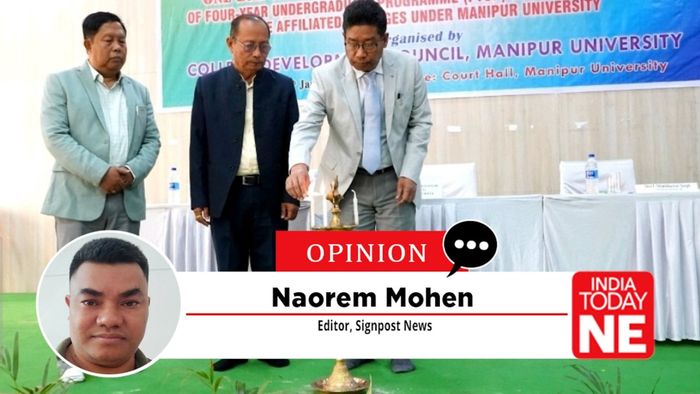
On 8 April 2025, the College Development Council organised a major interactive session involving college principals and UGC Secretary Prof. Manish R. Joshi. During this engagement, the Vice-Chancellor highlighted successes since 2021-22 while openly addressing practical challenges, particularly in the fourth-year Honours with Research programme, and appealed for collaborative solutions.
A dedicated one-day programme commemorating three years of NEP implementation showcased tangible achievements: a new five-year integrated Korean language course, vocational components in dance, music and physical education, a shift to practical learning, 71 value education courses, and 12 skill development courses. Regular workshops continue to build faculty capacity.
Moreover, equity and inclusion have been strengthened through synergy with the state government’s Chief Minister’s College Students Rehabilitation Scheme launched in 2023, which supports nearly 5,000 students annually and has driven a 15 percent rise in Scheduled Tribe enrolment and improved retention. Gender inclusion and multilingual support in Meitei and Naga dialects have further enhanced access.
In comparison with peer institutions, Manipur University’s early start gives it a distinct advantage. Most Northeast central universities began fuller implementation later, and Nagaland University introduced FYUP only in the 2026 session. MU stands out through higher ABC data uploads, extensive affiliating responsibilities, and transparent engagement.
A particularly noteworthy dimension of Manipur University’s NEP journey is its proactive and culturally attuned integration of Indian Knowledge Systems. Most Northeast universities have responded to NEP 2020’s IKS mandate through centres, electives, workshops, or research projects. However, many efforts remain at the awareness or research stage.
Manipur University distinguishes itself through consistent faculty capacity-building programmes, a dedicated Centre for Indian Knowledge Systems, and visible integration into value education and vocational streams — making IKS more accessible to undergraduate students and aligned with local Manipuri cultural expressions.
In a region as diverse as the Northeast, IKS cannot be a one-size-fits-all imposition from the mainland. MU’s emphasis on performing arts, indigenous practices, and bio-cultural knowledge makes it more resonant for local students. This culturally sensitive integration, combined with its early NEP adoption and strong ABC progress, enhances the holistic vision of NEP 2020. Challenges remain across the board — limited standardised curricula, faculty training gaps, and documentation of oral traditions. However, MU’s proactive steps in organising regular FDPs and establishing a centre show a clear commitment to overcoming them.
Watching these developments, one feels optimistic. Manipur University is not just ticking IKS boxes — it is meaningfully rooting education in our heritage while preparing students for the future. As NEP 2020 matures, MU’s model of blending IKS with vocational skills, research, and regional relevance can inspire other Northeast institutions. The youths of the state deserve an education that honours their roots while equipping them for tomorrow. Manipur University is showing the way forward with sincerity and vision.
This is progress worth celebrating and supporting. Our students now have access to a more flexible, skill-oriented, and inclusive education enriched with Indian Knowledge Systems (IKS) and robust Discipline-specific Vocational Skill Development components. The integration of IKS alongside practical vocational training in areas like traditional arts, music, dance, and local entrepreneurship has made learning culturally rooted yet globally relevant.
The progress is real, the direction is promising, and the potential is immense. It is prioritising full activation of ABC for actual credit transfers, strengthening the Honours with Research track, aligning skill courses with local needs in tourism, agriculture, handloom and entrepreneurship, scaling blended learning, and promoting greater regional collaboration by sharing its experiences with other Universities in the region.