IDPs deserve same grand ceremony as the Mayai Lambi repair, CM Khemchand should launch safe resettlement
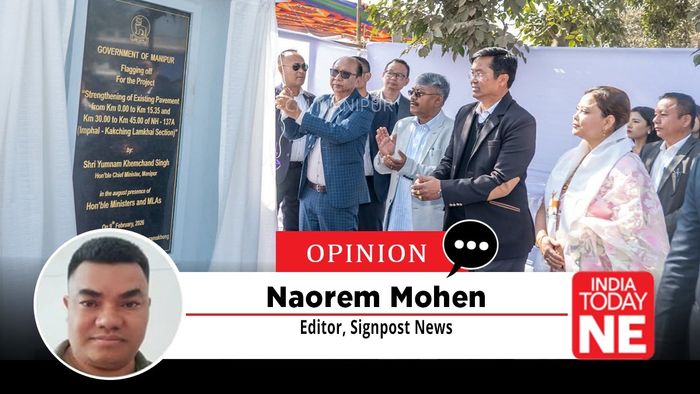
The flagging-off ceremony for the strengthening of Mayai Lambi (National Highway 137A, the crucial Imphal-to-Kakching Lamkhai section) on February 9, 2026, was not just an infrastructure launch, it was a powerful demonstration of what purposeful, visible governance can look like in Manipur today.
- Feb 11, 2026,
- Updated Feb 11, 2026, 8:45 AM IST
The flagging-off ceremony for the strengthening of Mayai Lambi (National Highway 137A, the crucial Imphal-to-Kakching Lamkhai section) on February 9, 2026, was not just an infrastructure launch, it was a powerful demonstration of what purposeful, visible governance can look like in Manipur today.
Chief Minister Yumnam Khemchand Singh stood at Langthabal Lep Makha Leikai in Imphal West, surrounded by MLAs from different constituencies, senior BJP leaders including ministers, MLAs, officials, contractors, party workers, and common citizens of Manipur.
What might have been a routine administrative function became a grand, open-air platform of accountability and collective resolve.The Rs 74 crore MoRTH-sanctioned project will strengthen approximately 30.35 km of existing pavement. With Rs 59 crore already released to a joint venture of five contractors, the formal deadline is 11 months plus three years of maintenance.
The contractors promised completion by late April. However, the Chief Minister pressed for March-end, offering future support as incentive, while firmly warning that payments would be withheld if quality suffered. He even instructed the Chief Engineer of the Public Works Department in public view to enforce strict standards.
In a state long accustomed to delayed projects, cost overruns, and questionable execution, this direct, ceremonial style felt like a welcome departure, transparent, urgent, and people-centered.
I truly appreciate this approach. By gathering MLAs, stakeholders, and the public, the CM transformed a technical road repair into a symbol of renewed commitment. It placed contractors under gentle but real pressure, gave officials clear marching orders, and reassured citizens that development would no longer be hidden behind closed doors.
Coming just days after the new government took charge on February 4 following the end of President's Rule, the event carried extra weight. In a society still healing from ethnic violence that took over 300 lives and displaced tens of thousands, repairing a vital artery like Mayai Lambi is not merely about asphalt, it is about restoring everyday trust and connectivity.
Yet this very success raises an obvious and pressing question. If such a high-profile, inclusive ceremony can drive accountability and momentum for road repair, why not apply the same model to the far more urgent humanitarian priority of resettling internally displaced persons (IDPs)?
Official figures from late January 2026 indicate that over 3,700 families, around 16,500 individuals have already been rehabilitated. The government aims to resettle roughly 40,000 IDPs (or up to 10,000 households, depending on the count) by March 2026.
These are not small numbers. They represent families who have endured nearly three years in relief camps, with relatives, or in temporary shelters, their homes burned, fields abandoned, children out of school, and futures suspended.Ground realities, however, tell a different story.
The Kangpokpi District Internally Displaced Welfare Committee (KDIDWC), in a strongly worded statement on February 2, described the March 31 deadline as “unrealistic and impractical.” They pointed out that many proposed return areas lack motorable roads, schools, hospitals, electricity, and water, which are basic prerequisites for safe, dignified living.
Without lifeline connectivity to critical locations like Kangchup, Phailengmol, Khamenlok, and Chingdai, families cannot return. The Rs 3 lakh housing assistance under PMAY-G (often called SPMAY-G locally) falls far short of what is needed to rebuild homes properly.
The committee has also called for immediate construction of priority roads, release of damage assessment forms, fair compensation for losses, transparent processes involving community leaders, and urgent educational support for thousands of displaced children.
The Meitei IDPs from Moreh, Churachandpur, and Kangpokpi were particularly hopeful of returning to their ancestral homes by the December 2025 deadline set by the previous PR administration to close all relief camps and complete phased resettlement.
That timeline, announced in mid-2025, raised expectations across affected communities, but it ultimately failed to materialize for many, especially those from these sensitive border and hill-valley fringe areas where insecurity and infrastructure gaps persist.
With no viable free and safe passage or rebuilt homes in sight by year's end, thousands felt betrayed, leading to intensified rallies, sit-in protests, demonstrations near Lok Bhavan, clashes during events like the Manipur Sangai Festival, and even month-long agitations by groups like COCOMI and various IDP committees.
Rallying and protesting became their only means to keep their voices heard and demand accountability from authorities. Now, with a new elected government and Chief Minister in place, there is fresh hope that he will listen attentively to these long-suffering families, address their legitimate grievances, and make their long-cherished wish of safe, dignified returns come true soon, perhaps through the very kind of bold, inclusive actions he has already shown he is capable of.
The demands of IDPs are not unreasonable, they are cries rooted in lived suffering. The Chief Minister Y Khemchand has also repeatedly affirmed that resettlement and restoration of peace remain the government's topmost priority. He even referenced safe travel assurances for the Kuki community during the Mayai Lambi event.
Yet announcements from the Chief Secretary or incremental updates in media lack the symbolic force, public visibility, and cross-community participation needed to turn words into widespread confidence.
Manipur's new beginning deserves more. It deserves a ceremony modeled on the Mayai Lambi launch, but this time centered on IDPs and their safe homecoming.
Picture this, Once Cabinet portfolios are allotted, the Chief Minister convenes a major public event at a carefully chosen central or neutral location, perhaps a site that carries symbolic weight for both hills and valley. On the dais and in the audience: MLAs representing both Kuki and Meitei communities, key ministers (Revenue, Relief & Disaster Management, PWD, Education, Health), district commissioners, IDP representatives from various places, community elders, civil society leaders, NGOs, and even prospective contractors for rebuilding works.
The Chief Minister could publicly flag off priority “lifeline road” projects to the most isolated return areas. He could announce enhanced housing support packages, commit to revised and realistic timelines, release damage assessment guidelines on the spot, and outline phased rehabilitation plans with clear incentives for swift, quality delivery.
Most importantly, IDP leaders and affected families would have the floor, speaking directly to decision-makers in front of cameras, MLAs, and the public. Such an event would not only kickstart tangible action; it would project unity across ethnic lines, affirm that humanitarian recovery is as non-negotiable as physical infrastructure, and generate the kind of public momentum and accountability that has proven effective for Mayai Lambi.
Deadlines are converging, major road repairs targeted for March 2026, large-scale IDP returns also pegged to the same month. Treating resettlement with the same ceremonial seriousness would send a profound message that internally displaced citizens are not mere numbers or administrative challenges.
Rather, they are people deserving dignity, safety, and a swift return to normal life.Of course, a single ceremony cannot erase deep-seated divisions, resolve all security concerns, or magically fill funding gaps.
But it can catalyze real progress. It can demonstrate that the new administration under CM Yumnam Khemchand Singh, a disciplined, experienced leader is pursuing holistic recovery, unwilling to let human needs trail behind concrete and bitumen.
We deeply appreciate Chief Minister Yumnam Khemchand Singh for choosing to work differently, bringing transparency, direct engagement, and public accountability to governance in a way that feels genuine and promising.
His hands-on style in the Mayai Lambi launch has already inspired hope that things can change for the better. Now, we earnestly wish and pray that he brings the same determination, urgency, and inclusive spirit to solving the IDP crisis once and for all, ensuring safe, dignified returns for every displaced family and to restoring lasting peace across Manipur as swiftly as possible.
The people have suffered enough; true leadership will turn this new beginning into real healing for all communities. Manipur stands at a genuine crossroads. The Mayai Lambi event showed that bold, inclusive governance is possible even in difficult times. Replicating that energy for IDPs is not just logical, it is morally and politically essential.
It would honor the pain endured, rebuild fractured trust, and prove that this new chapter belongs to everyone.
Let March 2026 become more than a deadline. Let it mark the moment displaced families finally begin coming home, launched not in quiet files, but in a grand, unifying ceremony that says, "Manipur is healing, together".