Justice for Six Liangmai Nagas Is a Test of Manipur’s Rule of Law
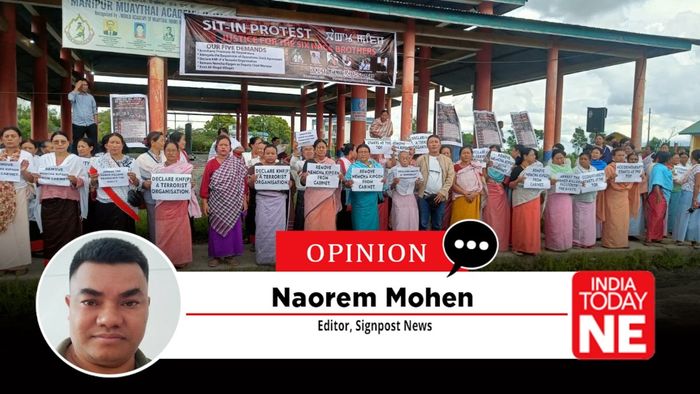
The abduction, captivity and killing of six Liangmai Naga civilians cannot be treated as another tragic footnote in Manipur’s continuing crisis. It is a grave test of whether the rule of law still has meaning in a state where armed groups, land disputes, institutional hesitation and community insecurity have created a dangerous vacuum.
- Jul 01, 2026,
- Updated Jul 01, 2026, 2:57 PM IST
The abduction, captivity and killing of six Liangmai Naga civilians cannot be treated as another tragic footnote in Manipur’s continuing crisis. It is a grave test of whether the rule of law still has meaning in a state where armed groups, land disputes, institutional hesitation and community insecurity have created a dangerous vacuum.
Justice for the six victims is not only a demand of the Liangmai Naga community. It is a constitutional obligation, a test of public trust, and a measure of Manipur’s ability to protect every civilian regardless of tribe, location or political circumstance.
The advocacy report titled Justice for the Six Liangmai Nagas is not merely a document of grief. It is an indictment of institutional failure in a state where civilians continue to pay the price for unresolved conflict, contested land claims, armed group impunity, and administrative hesitation.
Prepared by Resurgent Manipur in June 2026, the 94-page report documents the abduction, prolonged captivity and subsequent deaths of six Liangmai Naga civilians between 13 May and 10 June 2026. The victims included two pastors and one church deacon. The report identifies them as Pr. Kenpibou, Rev. Manu, Phenrongwibou Thiumai, Dilip Thiumai, Kaliwangbou Abonmai and Ch. Phenrilung. It records that they were civilians and not members of any armed organisation.
This fact must be placed at the centre of public discussion. In a conflict situation, narratives often move faster than evidence. Armed actors, civil society organisations and political formations all attempt to frame events in ways that serve their immediate positions. But the death of civilians cannot be absorbed into propaganda. It must be examined as a failure of law, governance and human protection.
According to the report, twenty Liangmai Naga civilians were reportedly abducted from Leilon Vaiphei on 13 May 2026. The abducted group included women, one child and six adult men. The women and children were later released, while the six men remained in captivity. Their bodies were recovered on 10 June 2026, after nearly four weeks. The incident reportedly occurred near the Leimakhong military installation, a detail repeatedly cited by community representatives while questioning the adequacy of the security response.
This chronology alone raises grave questions. How could six civilians remain missing for twenty-seven days in a highly sensitive zone? What search mechanisms were activated? Which agencies were responsible for coordination? Who was negotiating, and with whom? Why were the captives not recovered alive? These are not emotional questions. They are institutional questions.
The report is careful to state that it does not replace the work of investigative agencies, forensic experts, judicial authorities or commissions of inquiry. It acknowledges that some information is based on witness accounts, community documentation and public statements that could not always be independently verified in full. It also recognises that final legal responsibility must be determined by competent authorities.
That caution is important. Manipur does not need another cycle of accusation without evidence. It needs a credible process in which evidence is preserved, witnesses are protected, forensic records are examined and institutional responsibility is established. Justice cannot be built on anger alone. It must be built on facts.
At the same time, caution must not become an excuse for inaction. The report finds sufficient grounds to demand an independent and comprehensive investigation into the abduction and deaths, the role of individuals and organisations alleged to have been involved, the adequacy of the security response, the broader circumstances that enabled the incident, and the concerns relating to land disputes, settlement expansion and the Suspension of Operations framework.
The most disturbing part of the report is not only the crime itself, but the context in which it occurred. The deaths did not take place in isolation. They unfolded in a zone marked by historical land claims, settlement expansion, forest-related disputes and concerns over the operation of armed groups under the SoO framework.
The report places Konsakhul at the centre of this wider context. It describes Konsakhul as a legally recognised Liangmai Naga village with documentary records relating to land ownership, customary rights and administrative recognition. It also discusses the historical relationship between Konsakhul and Leilon Vaiphei through the Land Lease Agreement of 19 October 1920.
According to records cited by the Konsakhul Village Authority, the agreement was executed between Mr Phengamang, Chief of Konsakhul Cherin, as landlord, and Mr Shonglal Khoute of Vaiphei, as tenant. The agreement is described as a document permitting the establishment of a Vaiphei settlement within land claimed by Konsakhul.
The report further notes that the agreement reportedly specified a lease duration of one hundred years, with obligations including annual payment of paddy and adherence to the customary authority recognised under the arrangement. The Konsakhul Village Authority interprets this to mean that the lease expired in 2020 and that continued occupation or expansion requires fresh legal or customary authorisation. The report does not present this interpretation as a final legal conclusion. It correctly states that such questions require examination by competent legal and administrative authorities.
This distinction matters. Historical documents should not become instruments of mob justice. But neither should they be ignored by the state. When land documents, customary rights and settlement histories remain unresolved for decades, they become raw material for future conflict. A responsible government cannot allow such disputes to drift until they are settled by intimidation, demographic pressure or violence.
The satellite map on page 3 of the report visually presents Konsakhul surrounded by several Leilon Kuki villages. That image is more than a geographical illustration. It captures the anxiety at the heart of the dispute: a recognised Liangmai Naga village feeling encircled by expanding settlements, while competing communities advance different interpretations of history, rights and presence. Such disputes cannot be solved by slogans. They require transparent land records, lawful adjudication and administrative courage.
The report also records concerns regarding settlement expansion. According to documentation compiled by the Konsakhul Village Authority, the area once containing a single Leilon Vaiphei settlement has grown substantially over several decades. The authority argues that this has altered the demographic and administrative character of the area and generated disputes over customary rights, land use, forest resources and jurisdiction.
Whether every claim is accepted or challenged, the public significance is clear. Manipur urgently requires a credible mechanism to examine settlement recognition, protected forest disputes and customary land claims. The state cannot continue to treat land administration as a technical matter when it has become one of the foundations of ethnic insecurity.
The second major issue is the Suspension of Operations framework. The report records allegations by several civil society organisations that armed groups operating under SoO have engaged in activities inconsistent with the purpose of the agreement. It notes concerns that weak monitoring and accountability have undermined public confidence. It does not make a final legal determination, but it presents these concerns as serious matters requiring investigation.
This is a central point. The SoO framework was meant to reduce violence and create conditions for political dialogue. If communities now perceive some SoO camps as sources of intimidation, extortion, land pressure or armed impunity, then the framework requires urgent review. Peace arrangements cannot survive on paper while civilians live under fear. A ceasefire mechanism that does not protect civilians becomes a source of resentment rather than stability.
The report’s advocacy demands are therefore not excessive. It calls for investigation and accountability, review of institutional response, review of the SoO framework, examination of land and settlement issues, support for victims’ families, and long-term institutional reform. It also calls for compensation, counselling, legal support and public recognition for the victims’ families.
These demands are practical. They are also necessary. Justice is not only the arrest of perpetrators. It is also the restoration of public confidence. Families must know what happened. Communities must know that the state is not indifferent. Citizens must know that armed actors, regardless of affiliation, cannot operate beyond law.
The killing of the six Liangmai Naga civilians should also compel all communities in Manipur to reflect on the moral cost of silence. In ethnic conflicts, people often condemn only the suffering of their own community. They explain away crimes committed by those seen as allies. They demand justice selectively. This habit has damaged Manipur deeply.
The Liangmai victims were not combatants. Two were pastors. One was a church deacon. Their deaths cannot be explained away as a by-product of conflict. If allegations of armed group involvement are established through investigation, the case must be pursued with full legal seriousness. If institutional lapses occurred, they must also be examined. Accountability must not stop with the immediate perpetrators.
The report concludes that the tragedy raises questions beyond a single crime. It concerns the ability of institutions to protect citizens, uphold the rule of law and maintain public confidence during crisis. It calls for independent investigation, prosecution of those responsible, support for families and reforms to prevent similar tragedies.
That is the correct frame. Justice for the six Liangmai Nagas is not a Liangmai issue alone. It is not only a Naga issue. It is a Manipur issue. It is a test of whether the state can still protect civilians caught between armed groups, competing territorial claims and weakened institutions.
Manipur has endured too much grief since May 2023. Villages have been burned. Families have been displaced. Communities have been segregated. Public trust has collapsed. In such a condition, every unresolved atrocity becomes fuel for the next round of mistrust.
The way forward must begin with truth. The government should order an independent investigation with clear terms of reference. The investigation must examine the abduction, captivity, killing, recovery of bodies, alleged role of armed groups, security response and possible institutional negligence. It must also examine the operational realities of the SoO framework in the affected area.
Second, land and settlement disputes in the Konsakhul and Leilon Vaiphei area must be reviewed through lawful procedures. Historical documents, customary claims, forest notifications and administrative records must be examined together. No community should be allowed to settle disputes through force. No community should be denied a fair hearing.
Third, victims’ families must receive meaningful support. Compensation alone is not enough. They need legal assistance, counselling, official recognition and assurance that the case will not disappear into files.
Fourth, Manipur needs conflict resolution mechanisms that work before violence occurs. Administrative silence has become too costly. When land disputes, settlement claims and armed presence overlap, the state must intervene early, transparently and lawfully.
The six Liangmai Naga civilians died in a moment when institutions failed to reassure the living and protect the vulnerable. Their memory now imposes a public duty. The state must answer. Armed actors must be held accountable. Communities must reject selective justice. Civil society must insist on evidence, not rumour.
Justice delayed in this case will not only wound the families. It will weaken whatever remains of public trust in Manipur.
The six Liangmai Nagas deserve truth. Their families deserve accountability. Manipur deserves institutions strong enough to ensure that no civilian, from any community, disappears into captivity while the state watches helplessly.