Justice for Zubeen: Promises Fade, But Assam’s Heart Refuses to Forget
The election drums have fallen silent. The banners are torn down, the loudspeakers packed away, and the fierce battles of April 2026 now belong to history books and WhatsApp forwards. Assam has voted.
- Apr 17, 2026,
- Updated Apr 17, 2026, 4:56 PM IST
The election drums have fallen silent. The banners are torn down, the loudspeakers packed away, and the fierce battles of April 2026 now belong to history books and WhatsApp forwards. Assam has voted.
The results will be out soon, governments are forming or consolidating, and life, as they say, moves on. But for lakhs of us — the die-hard fans who grew up humming “Ya Ali” in college hostels, who felt our blood stir with “Bihu” rhythms, who saw in Zubeen Garg not just a singer but the raw, unfiltered conscience of our land — nothing has moved on. The pain lingers. The questions burn brighter like "Mayabini" than ever.
And then came the Bongaigaon Central Rongali Bihu. Rongali Bihu is not just a festival; it is Assam’s heartbeat — a celebration of new beginnings, of the earth waking up, of songs that bind communities. Zubeen’s voice had lit up countless Bihu stages. This year, he was absent. The void was palpable.
Thousands gathered anyway, seeking to honor his memory in the only way they knew: through song, through emotion, through collective voice.What unfolded was raw and powerful.
In the midst of the celebrations, fans raised slogans — “Justice for Zubeen!” “Joi Zubeen Da!” The massive crowd turned the cultural ground into a living protest. Emotions ran high. The air filled with chants demanding answers, demanding that the system not forget the man who never forgot Assam.
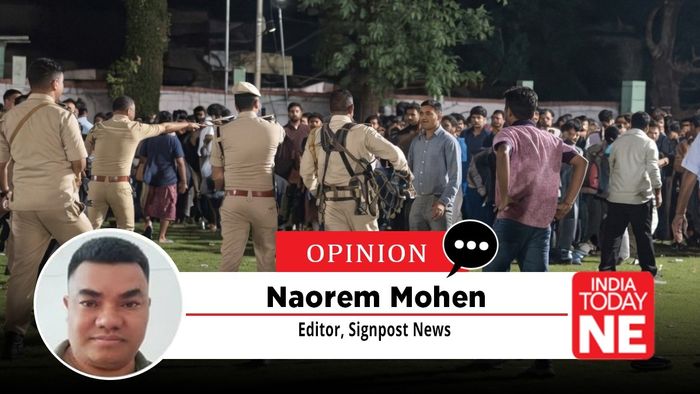
The situation turned chaotic. Police, tasked with maintaining order, resorted to a lathi-charge. Batons swung. People scattered. Some fans were injured. Videos and eyewitness accounts spread quickly — grieving supporters, not rioters, being pushed back at a festival meant for joy and remembrance.
It was a heartbreaking sight. Let me be clear here. It is wrong — deeply wrong — to lathi-charge fans who were expressing their pain peacefully at a cultural event. These were not stone-pelting mobs or disruptors seeking violence.
They were ordinary Assamese people, many young, many who had grown up listening to Zubeen’s songs of resistance and belonging. Their slogans were not threats to law and order; they were cries from the heart.
Zubeen’s music brought people together across divides. Using force against those honoring that legacy only deepens distrust. It sends a message that once elections are over, uncomfortable questions will be silenced rather than answered. This incident at Bongaigaon is not an isolated one.
It symbolizes a larger malaise. Elections turn human tragedies into electoral fodder. Parties promise the moon — swift justice, 100-day guarantees, or bold warnings about voting them out. Once the polling is done, the urgency evaporates. The fast-track court continues its hearings, Singapore’s coroner’s report clashes with Assam’s murder charges, and fans are left wondering: where is the closure?
Zubeen Garg left us in September 2025 under circumstances that still feel shrouded in mystery and betrayal. Singapore authorities called it accidental drowning, influenced by intoxication. Assam’s Special Investigation Team (SIT) saw it differently — a “plain and simple murder,” as Chief Minister Himanta Biswa Sarma himself declared in the Assembly. Arrests followed.
A massive 3,500-page chargesheet was filed in December 2025. Four of the seven accused, including key figures linked to organizers and management, face murder charges. A fast-track court was set up with daily hearings. On paper, the system appeared to be working.
However, for those of us who loved Zubeen da, justice is not a file, not a chargesheet, not even a court verdict delivered in cold legal language. Justice is truth — full, uncompromising, and delivered without political calculations. And right now, that truth feels painfully delayed, diluted, or conveniently set aside now that the votes have been counted.
Let’s rewind to the months before the 2026 Assam Assembly elections. The air was thick with grief and anger. Zubeen’s death had shaken the state like few events ever have. He was more than a musician; he was a cultural warrior who sang for unity in a land often divided by language, tribe, and politics. He spoke against hatred, against corruption, against anything that sought to fracture Assam’s soul.
His fans — young and old, from Guwahati’s bustling streets to remote villages in Upper Assam — saw him as one of their own. Chief Minister Himanta Biswa Sarma, sensing the public pulse, took a strong stand. He called the death murder, not accident or culpable homicide. He promised swift action.
In September 2025, he went further by announcing if his government failed to deliver justice by election time, the people of Assam should not vote for the BJP. It was a bold, almost risky statement. The government highlighted the SIT probe, arrests, and plans for a memorial at Zubeen Kshetra.
For a while, it seemed accountability was on the horizon.The Congress, smelling an opportunity in the emotional vacuum, went all in. In its “Five Guarantees” manifesto, the party prominently promised justice for Zubeen Garg within 100 days of forming the government. Mallikarjun Kharge, Rahul Gandhi, and state leaders repeatedly invoked Zubeen’s name.
Rahul Gandhi said the Congress philosophy mirrored Zubeen’s — uniting people through love, not hatred. Protests, marches, and emotional rallies followed. Zubeen became a poll plank, a symbol of unfinished justice against an allegedly slow or selective ruling dispensation. Some even whispered that had elections been held closer to the tragedy, the “Zubeen factor” might have swept the BJP away.
Both sides played the game masterfully. BJP positioned itself as the government that acted decisively with an SIT and chargesheet. Congress painted itself as the true inheritor of Zubeen’s unifying spirit, ready to deliver faster, cleaner justice.
However, for fans, it was bittersweet. We appreciated the attention, but many of us saw through the lens. Zubeen da had always warned against turning everything into politics. Yet here he was, posthumously, at the center of one of Assam’s most charged electoral battles.Then the elections happened on April 9, 2026.
The results waiting. Political narratives shifted. Development, alliances, and other local issues took center stage again. The fiery promises? They began to fade into the background.
The SIT did its job on time — a detailed chargesheet, arrests, financial probes into Bihu contracts and payments. Accused include organizers, managers, and others close to the events leading to Singapore. Four face murder charges. That is progress, no doubt.
But justice cannot end with paperwork. It needs transparency, speed without compromise, and above all, public faith that no political connection or influence is shielding anyone.
Many fans feel a sense of betrayal. BJP’s earlier strong words now seem tempered by the realities of governance and court processes. Congress’s 100-day promise feels like campaign rhetoric that will lost soon.
Both sides accused each other of politicizing Zubeen’s death — and perhaps both were right in parts. But the real crime is treating a cultural icon’s tragedy as a temporary vote-catcher rather than a matter of truth and accountability.
Zubeen Garg was never a politician. He was a voice that rose above party lines. He sang for the marginalized, criticized power when it deserved criticism, and dreamed of an Assam where identity did not become division.
His fans — across tribes, communities, and regions — reflect that same spirit. We are not asking for vengeance. We are asking for truth: what exactly happened in Singapore? Were there lapses by organizers? Were there deeper connections? Why does the official narrative from abroad differ so sharply from what many in Assam believe?
The lathi-charge at Bongaigaon was not just an administrative action; it was a symbolic failure. It told grieving fans that their emotions are manageable only through force once the political utility is exhausted. That is dangerous.
Suppressing voices won’t kill the questions — it will only make them louder in quieter corners, in social media, in future gatherings.
Assam has lost a giant. The least we can do is ensure his legacy is not reduced to election-season slogans. A true tribute would be a judicial process that is seen as impartial, fast, and thorough.
Memorials are good, but justice is better. Fast-track hearings are welcome, but public confidence matters more.
Zubeen gave us songs that still echo in our valleys and cities. He gave us courage to speak truth. The least Assam owes him is honest justice — not selective memory, not baton charges on his admirers, not forgotten promises.The election is over.
But the quest for justice for Zubeen has only just begun in earnest for those who truly loved him. Joi Zubeen Da. Justice for Zubeen Garg.
The views expressed in this article are those of the author and do not necessarily reflect the views of India Today NE or its affiliates.