Leilon Vaiphei Operation Must Not Become Another Unanswered Chapter in Manipur
In a state where trust between communities and institutions has already been deeply weakened, every unexplained security failure carries consequences far beyond the immediate event.
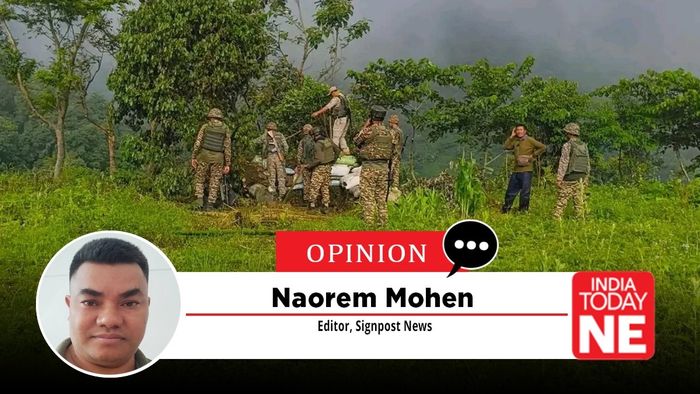
- Jun 24, 2026,
- Updated Jun 24, 2026, 3:48 PM IST
The reported security operation at Leilon Vaiphei on 21 June 2026 has raised questions that cannot be brushed aside as routine operational confusion. In a state where trust between communities and institutions has already been deeply weakened, every unexplained security failure carries consequences far beyond the immediate event.
The Foothills Naga Coordination Committee has expressed shock and outrage over what it described as a staged and ineffective operation by the COBRA Unit of the CRPF and the Assam Rifles against armed Kuki groups allegedly belonging to KNF(P), UKNA and KRA. According to the committee, security forces came under attack, exchanged fire, and used explosives during the operation.
The more serious allegation is that nearly 100 armed persons were reportedly surrounded. If true, this was not an ordinary encounter. It was a rare opportunity to apprehend armed individuals allegedly linked to the abduction of 18 Naga civilians and the brutal killing of six innocent Nagas. That opportunity, according to the FNCC, was lost.
The committee has alleged that the operation moved towards a negotiated surrender after the intervention of Deputy Chief Minister Nemcha Kipgen. It further claimed that senior political and security authorities were contacted, including the Director General of Assam Rifles, the GOC of 57 Mountain Division at Leimakhong, and Chief Minister Yumnam Khemchand Singh. Deadlines were reportedly fixed and extended, but no meaningful outcome emerged.
These are grave allegations. They involve armed groups, central security forces, political authority, and the failure to secure justice in cases of abduction and killing. Such matters cannot remain trapped in rumours, private briefings, and competing community narratives.
The public deserves a clear official account. Who ordered the operation? What was its objective? How many armed persons were actually present? Were the armed groups identified? Was any surrender being negotiated? Were weapons recovered? Were arrests made? Who ordered the withdrawal? Why were the suspects not apprehended if they were surrounded?
These questions do not weaken the security forces. They are necessary to protect their credibility. The CRPF, Assam Rifles and other central forces operate under difficult conditions in Manipur. Their personnel face danger, hostile terrain, competing pressures and a fractured social environment. But respect for security institutions cannot depend only on the risks they face. It must also depend on results, transparency and lawful accountability.
In Manipur, the credibility of the state is already under strain. Communities increasingly believe that justice is selective, enforcement is uneven, and armed actors are treated differently depending on political convenience. Such perceptions may not always reflect the full truth, but they cannot be dismissed. When the public sees no arrests after a major operation, suspicion grows naturally.
The most painful part of the FNCC statement concerns the victims. Eighteen Naga civilians were reportedly abducted. Six innocent Nagas were killed. These are not figures for political argument. They represent families, villages and communities living with fear and grief. For them, the question is simple: when will the perpetrators be arrested and prosecuted? If the state cannot answer that question, its moral authority weakens.
The reported withdrawal from Leilon Vaiphei has therefore become more than a security issue. It has become a test of whether the government and central agencies can act without fear or favour. The allegation that armed persons were allowed to escape and relocate to the KNF(P) Ebenezer Camp and adjoining areas has deepened public anger. If this claim is false, the authorities must refute it with facts. If it is true, responsibility must be fixed.
No armed group, whether under any ceasefire, suspension arrangement, camp regulation or political understanding, can be allowed to function above the law. Peace arrangements are meant to reduce violence and create space for dialogue. They cannot become safe corridors for those accused of abduction, murder, intimidation or attacks on civilians.
This distinction is vital for Manipur. The state has lived for decades with multiple armed groups, overlapping claims of identity, fragile ceasefire arrangements and uneven enforcement. Such complexity cannot become an excuse for paralysis. The law must remain the common ground, especially when communities no longer trust one another.
The FNCC’s anger reflects a deeper anxiety among Nagas living in vulnerable foothill areas. They fear that their civilians can be abducted or killed while the perpetrators remain beyond reach. They fear that operations may be announced but not completed. They fear that political intervention may dilute accountability. These fears deserve serious attention.
At the same time, anger must not push any community towards private justice. The FNCC’s warning that if the COBRA unit, Assam Rifles and central security forces cannot handle the armed groups, Nagas will handle it, reflects deep frustration. But it also shows the danger of institutional failure. When citizens begin to feel that they must replace the state, the road ahead becomes more unstable.
The answer is not community retaliation. The answer is a lawful, transparent and decisive response by the state. The Union Home Ministry and the Manipur government must therefore act quickly. A time-bound inquiry should be ordered into the Leilon Vaiphei operation. The inquiry must examine the intelligence input, the chain of command, the decision to negotiate, the reported political intervention, the extension of deadlines, and the final withdrawal. It must also establish whether the armed persons escaped, were permitted to leave, or were never surrounded in the manner alleged.
The findings should not be buried in official files. A summary must be placed before the public. Manipur does not need another episode where truth disappears behind administrative language.
There must also be a separate and focused investigation into the abduction of 18 Naga civilians and the killing of six Nagas. The investigation should identify suspects, locate hideouts, examine command responsibility, and proceed towards prosecution wherever evidence exists. Justice cannot depend on community pressure. It must follow from the seriousness of the crime.
Political leaders must also maintain distance from active security operations. In a conflict situation, even the perception of political interference can damage public confidence. Security decisions must be taken through proper institutional channels. If elected representatives intervene to prevent bloodshed, such intervention must be recorded, lawful and transparent. It cannot result in impunity.
Manipur’s present crisis has shown that the state cannot be governed through selective silence. Every unexplained failure feeds another rumour. Every rumour hardens into distrust. Every instance of distrust becomes a future flashpoint. This is how conflict societies become trapped in cycles of suspicion.
The Leilon Vaiphei episode must not be allowed to follow that path. The government must place facts before the people. Security agencies must explain the operation. Those responsible for crimes against civilians must be brought before the law. Communities must be assured that justice does not depend on ethnic identity, political access or armed capacity.
The FNCC press release is therefore not merely an expression of anger. It is a warning about the collapse of public confidence. When communities begin to believe that armed groups enjoy protection or immunity, the legitimacy of the state suffers. Restoring that legitimacy requires more than statements. It requires arrests, prosecution, accountability and visible fairness.
Manipur has suffered enough from violence, displacement and competing narratives of victimhood. The people need institutions that can rise above pressure and act according to law. They need security forces that complete operations with clarity. They need political leaders who strengthen accountability rather than complicate it. Above all, the families of the abducted and the killed need justice.
(The views expressed in this article are those of the author and do not necessarily reflect the views of India Today NE or its affiliates.)