Manipur University Leads the Way in Conserving Indigenous Fish and Strengthening Manipur’s Economy
As Manipur prepares for Ningol Chakouba, a university initiative in scientific fish breeding offers new hope for conserving indigenous species, supporting farmers and building a more self-reliant local economy.
- Nov 04, 2026,
- Updated Nov 04, 2026, 10:35 AM IST
Manipur University is demonstrating how scientific research can move beyond classrooms and laboratories to address some of the state's most pressing environmental and economic challenges. Its latest initiative to promote the sustainable culture of indigenous fish brings together three important concerns: the conservation of Manipur's declining freshwater biodiversity, the creation of livelihood opportunities for local farmers and the need to reduce the state's growing dependence on imported fish.
At a time when the survival of several indigenous species is becoming increasingly uncertain, the University's effort offers a promising direction for protecting the state's natural wealth while strengthening its economy.
The initiative is particularly relevant as Manipur prepares to celebrate Ningol Chakouba, a festival in which fish occupies a special place in family gatherings and traditional meals. Every year, the demand for fish increases considerably during the festive season, prompting the government to organise its annual fish fair to ensure adequate supplies at reasonable prices.
This year, the Directorate of Fisheries is preparing to hold the State Fish Fair-cum-Fish Crop Competition at Hapta Kangjeibung on November 10, a day before Ningol Chakouba, with a target of selling two lakh kilograms of fish through around 200 stalls. The fair provides an important opportunity for consumers and fish farmers alike. Yet it also reminds us of a larger challenge that deserves attention beyond the festival.
Despite possessing extensive freshwater resources and a rich diversity of indigenous fish, Manipur continues to depend heavily on supplies from outside the state. Hundreds of crores of rupees are spent annually purchasing fish from other parts of India, while many of our own indigenous species are becoming increasingly difficult to find in local markets.
This presents an economic challenge as well as an environmental and cultural concern. The money spent on imports represents an opportunity to strengthen local production, create rural employment and support businesses associated with fish farming. Equally important is the responsibility to preserve species that have been part of Manipuri food habits, religious traditions and aquatic ecosystems for generations.
It is against this background that the two-day capacity-building programme on sustainable culture of indigenous fish, launched by Manipur University on November 3, assumes wider significance. Organised by the Freshwater Ichthyology and Sustainable Aquaculture Laboratory of the Department of Zoology in collaboration with the ICAR–National Bureau of Fish Genetic Resources, Lucknow, the programme goes beyond providing technical training to Scheduled Caste farmers and entrepreneurs.
By bringing scientific breeding techniques, conservation research and practical aquaculture knowledge directly to local communities, the University is creating an opportunity to transform its academic expertise into tangible economic and environmental benefits.
The significance of this initiative lies not merely in the training of farmers but in the larger direction it offers for Manipur's future. If indigenous fish can be successfully bred and cultivated through affordable, scientifically managed methods, the state could gradually improve local production, reduce pressure on wild fish populations and retain a greater share of its fisheries expenditure within the local economy. More importantly, it could demonstrate how Manipur University, as a public institution, can contribute directly to the state's development through research, innovation and sustained community engagement.
During the inaugural programme, Dr. Rameshori Yumnam, the programme coordinator, presented figures that should concern policymakers. According to her assessment, Manipur faces an annual fish production deficit of approximately 19,500 metric tonnes, requiring imports from states such as Andhra Pradesh, Assam and West Bengal. She estimated that around ₹400 crore flows outside Manipur to meet the state's fish requirements. Even allowing for differences in estimates and changing annual demand, the economic implications are considerable. Money that could support local fish farmers, hatchery operators, feed producers, transporters and rural entrepreneurs is instead being spent on supplies from elsewhere.
This is not an argument against trade with other states. Manipur will continue to need commercial exchanges with the rest of India. The issue is whether the state is making sufficient use of its own resources and scientific capabilities to produce what it can reasonably produce. Even a gradual reduction in fish imports could retain substantial expenditure within the local economy, provided local production becomes competitive in price, quality and reliability.
The opportunity becomes more significant when we consider the diversity of fish found in Manipur. Dr. Rameshori pointed out that the state possesses approximately 200 freshwater fish species, including around 40 endemic species. These figures tell us something about the richness of our aquatic environment, but they also raise a troubling question about its future.
Many indigenous fish populations have declined under pressure from pollution, shrinking habitats, deteriorating water quality, environmental degradation and invasive species. Unless these pressures are addressed, future generations may know certain fish only through photographs, scientific records or stories told by their elders.
The programme's particular emphasis on Pengba, the State Fish of Manipur, and Ngakrijou is therefore important. Both have cultural and commercial value, but their declining availability has made them increasingly expensive. Dr. Rameshori indicated that Pengba may sell for ₹500 to ₹700 per kilogram and sometimes considerably more, while Ngakrijou can command prices of ₹2,000 to ₹2,500 per kilogram. Such prices indicate a potentially valuable market for farmers, although successful breeding and commercially viable production cannot be taken for granted.
If researchers can develop dependable breeding techniques, produce healthy fish seed and establish culture practices that farmers can adopt at affordable costs, these species could become a source of sustainable income. At the same time, properly managed captive breeding and aquaculture could reduce harvesting pressure on wild populations. Conservation and economic development need not always be competing objectives. With scientific guidance, they can reinforce each other.
Prof. N. Mohilal Meitei, Dean of the School of Life Sciences, Manipur University, drew attention to another important shift in aquaculture: the growing recognition of indigenous fish species after years of excessive dependence on exotic varieties. He observed that native fish are important not only for biodiversity conservation but also for food security, local economies and the traditional diets of ordinary people. Recalling his childhood, he spoke of simple meals prepared from locally available vegetables and fish, reminding the gathering that nutritious food does not necessarily have to be expensive or imported.
Indigenous fish have long sustained rural households, particularly those living near ponds, rivers and wetlands, while their adaptation to local climatic conditions makes them valuable resources for sustainable aquaculture. His observations also carried an important economic message. A farmer who raises indigenous fish is not merely producing something for the market but contributing to local food security and keeping traditional knowledge alive.
Prof. Mohilal welcomed the initiative as a step towards biodiversity conservation, economic self-reliance and the development of Manipur's blue economy. He also stressed that capacity-building programmes must bridge the gap between textbook knowledge and the practical realities faced by farmers.
Drawing attention to the availability of government assistance schemes, he suggested that farmers should be helped to understand and access institutional support rather than being left to navigate these opportunities on their own. His message reinforces an important responsibility of Manipur University: scientific knowledge should not remain confined to academic institutions but must reach the communities whose livelihoods and future depend upon it.
Prof. Ksh. Birla Singh, Head of the Department of Zoology, brought another important dimension to the discussion by linking indigenous fish conservation with employment, climate change and future food security. He observed that academic qualifications alone can no longer guarantee employment and that practical skills have become increasingly important for young people seeking sustainable livelihoods. His emphasis on cultivating locally important species such as Pengba, Ngakichou, Ngamu and Meitei Sareng deserves attention at a time when several indigenous fish populations are declining.
These species are not merely commodities to be sold in the market; they are part of Manipur's natural heritage and have adapted to its freshwater environment over generations. Prof. Birla's observations remind us that the challenge is not simply to produce more fish, but to develop the scientific knowledge and practical skills necessary to preserve species that could otherwise disappear from our waters.
With climate change and food insecurity emerging as major concerns, bringing these indigenous species into sustainable aquaculture could help protect biodiversity while creating employment and strengthening local food production. This is precisely where Manipur University's research and extension programmes can make a lasting contribution.
Prof. Laishram Rajendrakumar Singh, Finance Officer of Manipur University and a biomedical scientist formerly associated with the Dr. B.R. Ambedkar Centre for Biomedical Research, University of Delhi, brought another important perspective to the discussion by placing indigenous fish conservation at the intersection of history, tradition and science.
He recalled how generations of Manipuris had depended on lakes, wetlands, rivers and ponds for food and livelihoods, and how the gradual disappearance of these water bodies through urbanisation and pollution had weakened the state's ability to meet its own fish requirements. His reflections went beyond economics. Indigenous fish, he observed, are deeply woven into Manipuri food habits, hospitality and religious customs.
Traditional preparations such as eromba and kangsoi derive much of their character from locally available fish, while certain species remain important in customary ceremonies. He also referred to their nutritional significance, including protein, Omega-3 fatty acids and vitamins, recalling the points raised by Dr. Rameshori Yumnam. The declining availability and rising prices of these fish therefore represent not merely a commercial problem but a gradual loss of culinary and cultural heritage.
For Prof. Rajendrakumar, modern science offers an opportunity to reverse this decline. He appreciated the breeding technologies, hatchery facilities and prototype culture models developed by Dr. Rameshori and her research team despite the infrastructural difficulties faced in Manipur, including unreliable electricity and water management.
Equally important was his emphasis on translating these scientific advances into practical models suitable for small ponds and local water bodies. He identified a crucial role for entrepreneurs in developing affordable fish feed, improving processing and packaging, and finding markets for increased production. His argument offers a useful direction: Manipur must draw upon its history, preserve its traditions and apply modern science, while enabling farmers and entrepreneurs to turn conservation into sustainable economic activity.
There is another encouraging development. Dr. Rameshori disclosed that Manipur University has secured a centrally sponsored project worth approximately ₹4 crore under the Pradhan Mantri Matsya Sampada Yojana for infrastructure related to indigenous fish breeding and production. The proposed two-year project aims to strengthen breeding facilities, standardise culture practices and facilitate fish seed production for eventual distribution to farmers at subsidised rates.
This investment has the potential to become an important beginning. But its real achievement will not be measured by the infrastructure established or the amount of money spent. It will be measured by whether viable indigenous fish seed becomes available, whether farmers successfully raise these species, whether production increases and whether the benefits reach local communities. A project that produces research papers without producing lasting results in farmers' ponds would fall short of its larger purpose.
In this context, the message delivered by Manipur University Vice-Chancellor Prof. R.K. Hemakumar Singh deserves particular appreciation. He stressed that universities must not confine their responsibilities to classrooms and laboratories. Scientific knowledge should reach ordinary people and contribute to their welfare. More importantly, he reminded researchers that their responsibility should not end with a two-day training programme. Farmers who receive technical instruction must continue to have access to experts when practical difficulties arise.
His suggestion that researchers maintain contact through WhatsApp, video calls and field visits is both simple and meaningful. A farmer may understand the basic principles of fish breeding during a training session but encounter problems when applying them in an actual pond. Water quality may deteriorate, oxygen levels may fall, fish may develop diseases or feeding practices may prove unsuitable. Without timely technical assistance, an otherwise promising venture can fail. Continued interaction between university scientists and farmers could make the difference between temporary enthusiasm and lasting success.
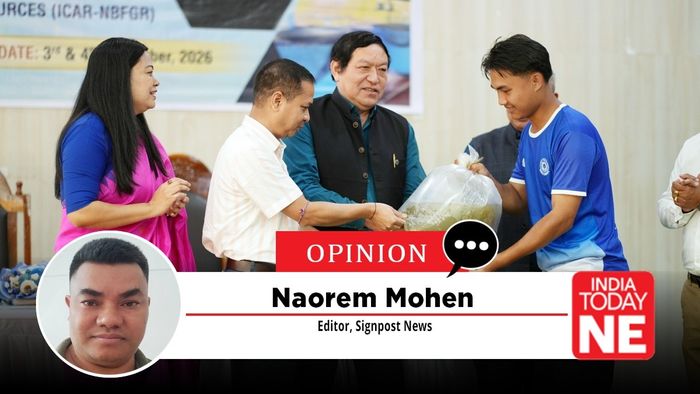
The distribution of fish seed, fish and water-quality testing kits during the programme was a useful first step in this direction. It showed an intention to provide participants with something practical rather than sending them home with certificates alone. But the next stage is even more important. Participating farmers should be followed up, their progress assessed, and the difficulties they encounter documented. Successful farms could become demonstration centres for other communities, gradually expanding the reach of the programme.
This is where Manipur University's extension activities can acquire greater significance. A university contributes to society not only by producing graduates, conducting examinations or publishing research. It also possesses scientific expertise that can solve everyday problems affecting agriculture, fisheries, health, the environment and local industries. When that expertise reaches communities and helps them improve their livelihoods, the university becomes an active participant in the state's development.
The indigenous fish initiative offers an opportunity for such cooperation. The Department of Fisheries could work closely with Manipur University and ICAR institutions to identify suitable farming areas, support hatcheries, provide technical assistance and help farmers access government schemes. Local entrepreneurs could develop affordable feed, fish processing, cold storage and marketing facilities. Farmers' groups and cooperatives could help organise production and distribution. Conservation agencies could monitor the ecological impact of expanding aquaculture and ensure that fragile natural habitats are protected.
The annual Ningol Chakouba Fish Fair could also become part of this longer-term effort. It already provides an important platform connecting fish producers directly with consumers. The government has announced a cash award of ₹50,000 for the highest indigenous fish producer at this year's competition, an encouraging recognition of native species. In the years ahead, the fair could become an occasion to assess the progress of indigenous fish breeding, showcase successful farmers trained through university programmes and create wider public awareness about species that need protection.
Imagine a Ningol Chakouba a few years from now when a growing proportion of fish sold at the annual fair comes from locally managed farms, when Pengba and other indigenous species are more readily available at reasonable prices, and when more households earn income from fish culture. Such an outcome cannot be achieved through a single university programme or government scheme. It requires sustained cooperation, scientific monitoring, investment and patient work over several years.
The environmental dimension must remain central to this ambition. Producing more fish should not come at the cost of further polluting wetlands or damaging natural breeding grounds. Hatchery development and pond aquaculture must go hand in hand with habitat restoration, water-quality protection and the conservation of wild fish populations. Fish farming can help reduce pressure on natural stocks, but it cannot replace healthy rivers, lakes and wetlands. Without protecting those ecosystems, the long-term future of Manipur's indigenous fish will remain uncertain.
The wider economic possibilities are substantial. A stronger local fisheries sector could create opportunities for young entrepreneurs, provide supplementary income to rural families and reduce the vulnerability of consumers to disruptions in supplies from outside the state. Import substitution would not happen overnight, but every additional tonne of fish produced sustainably within Manipur would represent an opportunity to strengthen local livelihoods. Part of the money currently spent on imports could circulate among our own farmers, workers and small businesses.
At a time when Manipur is struggling to recover economically and socially from prolonged instability, such initiatives deserve sustained institutional support. Development need not always begin with large industries or major infrastructure projects. Sometimes it can begin with a small pond, a reliable supply of fish seed, a farmer willing to learn and a university researcher prepared to offer guidance beyond the laboratory.
The significance of the programme inaugurated at Manipur University lies in precisely this possibility. Dr. Rameshori and her research team have brought scientific expertise to a problem that directly affects the state's ecology and economy. Prof. Mohilal has placed indigenous fish culture within the larger framework of environmental sustainability and the blue economy. Prof. Rajendrakumar has reminded us that the species we are losing are also part of our cultural inheritance. And Vice-Chancellor Prof. Hemakumar has provided the institutional direction by insisting that university knowledge must serve the people beyond the campus.
Their messages converge on a larger responsibility. Manipur must learn to protect its natural wealth while using scientific knowledge to improve the lives of its people. The state cannot afford to treat biodiversity conservation, food security and economic development as separate concerns when they are so closely connected.
As Ningol Chakouba approaches, the government's fish fair will once again help families celebrate an important tradition. But the greater achievement would be to ensure that, year after year, Manipur becomes increasingly capable of meeting its own fish requirements while restoring the indigenous species that have sustained its people for generations.
The fish fair meets the needs of a festival. Manipur University's initiative has the potential to serve the needs of an entire generation. The challenge now is to turn that potential into a lasting contribution to the state's environment, livelihoods and economy.