Manipur University Must Become India’s Intellectual Bridge to Southeast Asia
At a Manipur University seminar, speakers urged the campus to deepen India's links with Southeast Asia through research and cultural ties. They said peace, scholarship and sustained exchanges are essential if the region's strategic location is to deliver economic value.
- Aug 21, 2026,
- Updated Aug 21, 2026, 5:54 PM IST
Among the many observations made during the two-day international seminar on “Fostering Economic Linkages between North East India and South East Asia through Religious and Cultural Ties” at Manipur University, one should remain with the institution long after the seminar concludes. Prof. Kuldip Chand Agnihotri has said that Manipur University must become a bridge between India and Southeast Asia. It is a simple statement, but it carries a demanding institutional responsibility.
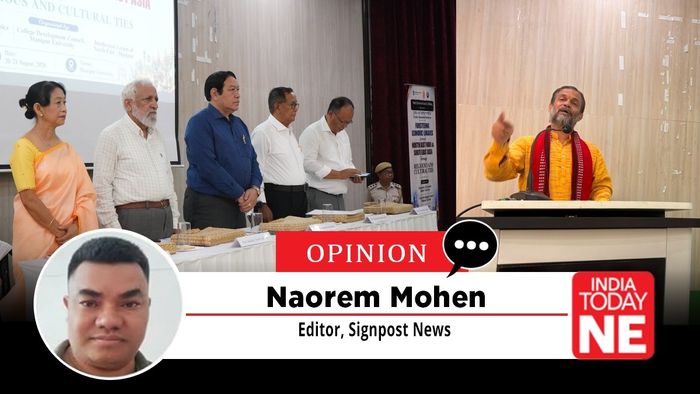
The two-day seminar (20-21 August, 2026) featured a distinguished gathering of academicians, former policymakers, administrators, researchers and cultural experts. The inaugural dignitaries included Dr Rajkumar Ranjan Singh, former Union Minister of State for External Affairs and Education; Prof. R.K. Hemakumar Singh, Vice-Chancellor-in-Charge of Manipur University; and Prof. Kuldip Chand Agnihotri, former Vice-Chancellor of the Central University of Himachal Pradesh.
Prof Memcha Loitongbam, Dean of the School of Social Sciences and Prof Damodar Nepram, Chairman, Organising Committee and Head, Department o Economics, Manipur University also graced the inaugural function of the seminar. Prof Hanjabam Isworchandra Sharma is the seminar convenor while Prof Sougrakpam Dharmen Singh is one of the co-convenors.
The academic sessions also brought together Dr Sunil Mohanty, Former Assistant Professor, Department of Political Science, University of Delhi; Khwairakpam Rajen Singh, Prof. M.C. Arun Kumar, Sorokhaibam Manglemmjao Singh, Dr Nongthombam Jiten, Dr Yaiphaba Ningthoujam, Wangam Somorjit, Dr Anuradha Oinam, Prof. L. Suraj Singh, Dr Thiyam Bharat Singh, Thangjam Anil, Dr Atom Sunil Singh and Dr Shreeda Chongtham, besides faculty members, research scholars and students.
Manipur has frequently been described as India’s gateway to Southeast Asia. The expression appears whenever the Act East Policy, border trade, regional connectivity or India–Myanmar relations are discussed. Yet a gateway is useful only when people, knowledge and ideas can pass through it. Geography may give Manipur a strategic location, but geography alone cannot transform the State into a centre of regional engagement.
Manipur University Vice-Chancellor-in-Charge Prof RK Hemakumar Singh placed the seminar within the largely untapped economic potential of Northeast India’s historical religious and cultural connections with Southeast Asia. States such as Assam, Manipur and Tripura, he observed, have long-standing links with Myanmar and the wider region, but their potential to serve as a cultural and religious hub in India’s eastern engagement has yet to be fully realised.
He gave this argument a practical economic direction. Pilgrimage circuits and pilgrimage tourism could encourage infrastructure investment, while cultural tourism could generate direct and indirect employment in the hospitality, transport and artisan sectors. Handloom, handicrafts, ethnic products and locally produced agricultural goods could also find wider national and international markets.
Cultural similarities with neighbouring countries, including Myanmar, could facilitate greater economic integration and trade. By studying and supporting these connections, Prof. Hemakumar said, Manipur University could emerge as a knowledge hub linking India with Myanmar in particular and Southeast Asia more broadly.
Prof Memcha Loitongbam, Dean of the School of Social Sciences and president of the inaugural function, explained why culture must remain central to this economic vision. Commerce, she observed, rarely travelled alone. It travelled with faith, language, festivals, craftsmanship, food and shared cultural practices. Long before modern diplomacy, human relationships created the trust upon which economic exchange could flourish.
For Manipur, therefore, location is only the beginning. Prof Memcha argued that the State’s cultural heritage, indigenous knowledge systems and ability to build meaningful regional partnerships must transform its geography into lasting economic advantage.
The Act East Policy has opened new possibilities, but sustainable regional integration must be people-centred. Local communities, artisans, entrepreneurs, women-led enterprises, young innovators and cultural institutions should become active participants. Economic cooperation becomes more resilient when it is grounded in mutual respect and shared human relationships.
Her emphasis on cross-border cultural and educational exchanges, heritage tourism, creative industries, regional value chains, local entrepreneurship and collaborative research also gave the university a clear academic agenda. International seminars, she reminded the gathering, are valuable not merely because they produce papers, but because they create conversations that can continue long after the event concludes.
Prof Damodar Nepram, Head of the Department of Economics and chairman of the organising committee, grounded these larger arguments in a personal encounter with the shared history of Manipur and Myanmar. Recalling a 2018 research visit to study Myanmar’s border trade with India and Thailand, he described coming across Maha Bandula Park during a morning walk in Yangon. His subsequent inquiry into the Burmese general after whom the park was named led him back to the histories of the Burmese campaigns in Manipur and Assam.
For Prof. Damodar Nepram, the encounter illustrated how difficult it is to study Myanmar’s history without also encountering Manipur. Citing W.S. Desai’s A Pageant of Burmese History, he referred to historical accounts of Manipuri influence on Burmese silk weaving and to the Ponnas—Manipuri Brahmins who served as astrologers and advisers in the Burmese court. These connections, he argued, have acquired renewed economic and strategic relevance under India’s Act East Policy. The seminar should therefore enable scholars, teachers and policymakers to move beyond general statements of cultural affinity and explore new areas of cooperation between Northeast India and Southeast Asia.
Dr RK Ranjan Singh’s keynote address gave the discussion its most direct diplomatic and policy dimension. As someone who represented Manipur in Parliament and served as Union Minister of State for External Affairs and Education from 2021 to 2024, he had what he described as a ringside view of India’s changing engagement with its eastern neighbourhood.
The Northeast, he argued, should not be treated as the periphery of the Indian Union looking towards a distant Southeast Asia. It is itself the civilisational bridge—the region where the stories of India and Southeast Asia have always overlapped.
India’s Act East Policy, therefore, cannot succeed as a policy drafted in New Delhi and merely delivered to the Northeast. It must flow from the Northeast outward.
This reversal of perspective is important. The eight Northeastern states share nearly 5,500 kilometres of international borders with Myanmar, Bangladesh, Bhutan, China and Nepal. Manipur alone shares a 398-kilometre border with Myanmar—a boundary across which families, clans, faiths and cultural practices have historically extended.
The Moreh–Tamu crossing, in Dr Ranjan’s formulation, is not merely a customs gate. It is a threshold between two halves of a cultural continuum.
He also drew a distinction between the hard infrastructure of connectivity and the softer infrastructure that allows it to function. Highways, transit corridors, ports and pipelines can move goods, but they can travel only as far as trust, historical memory and shared belief allow them.
Economic linkages cannot be engineered through trade statistics and logistics alone. They must also draw strength from Buddhism, Vaishnavism, Sanamahism, oral epics, textile traditions and centuries of migration and marriage across the hills and river valleys connecting the two regions.
Long before Independence and before ASEAN was conceived, Northeast India was already Southeast Asia’s neighbour in every meaningful sense. Dr Ranjan referred to the Tai origins of the Ahoms of Assam, the Buddhist connections extending from Arunachal Pradesh towards Bhutan, Myanmar and Thailand, and the coexistence of Manipur’s Vaishnavite tradition with the older Sanamahi faith and Lai Haraoba.
Manipur’s Ras Leela, the UNESCO-inscribed Sankirtana tradition and Assam’s Sattriya dance are among the artistic forms through which Southeast Asian audiences may encounter cultural familiarity rather than distance.
This, he argued, is the Northeast’s soft power—not something India needs to manufacture, but something the region must have the confidence to project. India’s distinctive strength in Southeast Asia lies not in competing over hard power, but in the legitimacy of civilisational relationships whose custodians include all eight Northeastern states.
Dr RK Ranjan also explained how attempts were made to translate this premise into policy during his ministerial tenure. He cited the Kaladan Multi-Modal Transit Transport Project, linking India’s eastern coast through Sittwe and the Kaladan river system towards Mizoram, and the India–Myanmar–Thailand Trilateral Highway. Such projects should not merely move goods; they should revive historical relationships among communities separated by modern boundaries.
A significant example was the launch of the ASEAN–India Network of Universities at the ASEAN Secretariat in Jakarta on August 29, 2022. Dr Ranjan jointly launched the network with the ASEAN Secretary-General, with Nalanda University designated as the nodal institution.
The network was intended to connect leading universities across India and ASEAN through faculty exchanges, student mobility, collaborative research and joint doctoral programmes. Nalanda was an appropriate institutional anchor because its ancient predecessor had once attracted scholars from across Asia.
This example has direct relevance for Manipur University. If Nalanda can anchor a network of universities across India and ASEAN, Manipur University should seek a meaningful place within that academic architecture. Its location, existing expertise and proximity to Myanmar make it well suited to host research, language training and regular exchanges concerning borderlands and Southeast Asia.
The keynote, however, did not treat soft power as a decorative addition to economic policy. Dr Ranjan argued that cultural and religious diplomacy is the mechanism through which trust is built. Without trust, no border crossing, highway or transit corridor can fully deliver its promised economic value.
This observation led him to the most immediate and difficult question for Manipur: peace as a precondition.
A confident, outward-facing Northeast capable of becoming a civilisational bridge depends upon peace and stability within the region. Ethnic harmony, trust among communities and a shared sense of belonging are not separate from foreign policy; they are its foundation. No transit corridor can prosper through prolonged turmoil, and cultural diplomacy abroad will lack credibility if mutual trust is not practised at home.
The same cultural resources that can bind Northeast India with Myanmar, Thailand and other Southeast Asian countries—shared faith, festivals, memory and kinship—must also be used to rebuild relationships among the communities of Manipur.
This gives Manipur University another responsibility. It must become not only an external bridge to Southeast Asia but also a credible internal space where difficult questions can be examined through evidence, scholarship and respectful dialogue.
Dr Sunil Mohanty brought a personal dimension to this civilisational argument. Recalling the two years he spent in Southeast Asia during his doctoral research on ethnicity and national integration in Indonesia, with particular reference to East Timor, he spoke of witnessing the political upheaval, violence and economic uncertainty surrounding the period leading to Timor-Leste’s independence in 2002.
His first arrival in Singapore became the beginning of an inquiry into the region’s cultural connections with India. The name Singapura—derived from the Sanskrit words for lion and city—led him to examine Indic influences visible across Southeast Asia.
He referred to Angkor Wat in Cambodia, the cultural world of Java and Bali, the naming of Indonesia’s first President Sukarno after Karna of the Mahabharata, and his Indonesian academic supervisor, Devi Fortuna Anwar, whose name reflected the layered cultural inheritance of a Muslim-majority society.
Mohanty also recalled the old maritime relationship between Kalinga, present-day Odisha, and Bali. Memories of merchants sailing towards Southeast Asia continue to survive in Odisha’s festivals, folklore and the story of Tapoi. His examples showed how names, legends, rituals and cultural memories can preserve evidence of older exchanges even after political and religious landscapes have changed.
These connections should not be used to flatten Southeast Asia’s enormous diversity or to suggest that every society in the region possesses a single identity. Their relevance lies in showing that India’s engagement with Southeast Asia did not begin with contemporary foreign policy. It has a much older human foundation.
Cultural familiarity, however, will not automatically create economic linkages. Shared memories can create trust and curiosity, but universities, governments and businesses must translate them into research, tourism, educational exchange, creative industries, entrepreneurship and legitimate trade. This is where Prof. Agnihotri’s call acquires practical meaning.
In his vote of thanks, Prof. Hanjabam Sukhdeba Sharma, Director of the College Development Council and co-convener of the seminar, placed the initiative within Manipur University’s continuing academic engagement with Southeast Asia. He described it as the university’s second international-level attempt to reconnect India with the region.
The first initiative concentrated on Manipur and Myanmar and resulted in two published volumes examining their relations and historical connections. The present exercise expands that academic field from Manipur–Myanmar relations to the wider Northeast India–Southeast Asia region. This continuity shows that the university is not merely hosting an isolated seminar but has already begun creating a body of research capable of supporting a larger regional role.
This continuity matters. It shows that the university is not merely hosting an isolated seminar but has already begun creating a body of research that can support a larger regional role. The North Eastern Council’s support for the present initiative provides an opportunity to give that effort a more permanent institutional form.
Prof. Agnihotri’s call takes this responsibility further. He described Moreh as India’s eastern gateway to Southeast Asia, just as the northwestern routes historically connected the subcontinent with Central Asia. Manipur University’s location, in his view, gives it an intellectual responsibility similar in spirit to that performed by the great universities of the past: creating connections across geographical and cultural frontiers.
He suggested that cultural and pilgrimage circuits could help restore some of these connections—linking India through Moreh with Myanmar, Thailand and Angkor Wat, and exploring a cultural route between Kaina and Vrindavan. Whether framed as pilgrimage, heritage tourism or cultural exchange, such proposals deserve serious academic and economic examination rather than remaining ideas expressed at a seminar.
If Manipur occupies such an important civilisational and strategic space, which institution will study it systematically, explain it to the rest of India and convert that knowledge into policy? Manipur University should be the natural answer.
The university is not beginning from nothing. It already has a Department of South East Asian Studies and a Centre for Myanmar Studies. These provide an academic foundation. The challenge is to connect their work with economics, history, political science, foreign languages, cultural studies, anthropology, national security studies and environmental science.
A border cannot be understood through a single discipline. A road to Myanmar is simultaneously an economic route, a security concern, a cultural passage and an ecological intervention. Migration involves not merely statistics but also history, law, livelihood, identity and public anxiety. India’s engagement with Southeast Asia cannot be sustained if universities are not producing the scholars, translators, entrepreneurs and regional specialists needed to understand these complexities.
Manipur University should therefore develop an integrated research and policy platform on Manipur, Myanmar and Southeast Asia. It could bring together its existing departments and centres while establishing partnerships with institutions in Myanmar, Thailand, Indonesia, Cambodia and other countries of the region.
Joint research projects, faculty exchanges, student fellowships, language and translation programmes and a regular Manipur–Southeast Asia dialogue would give continuity to an engagement that otherwise risks ending with occasional seminars.
The university should also systematically document Manipur’s historical links with the wider region. Oral histories, traditional trade routes, manuscripts, performing arts, wartime memories and migration patterns remain scattered across families, villages and institutions. Unless they are collected and digitally preserved, much of this knowledge may disappear with the generations carrying it.
The bridge envisioned by Prof. Agnihotri must also connect Manipur with New Delhi. Manipur University should regularly produce policy papers for the State government, the North Eastern Council and relevant Union ministries instead of allowing valuable research to remain confined to dissertations and library shelves.
Equally important, the bridge must work in both directions. Manipur should not simply receive policies formulated elsewhere. Knowledge produced in Manipur must travel outward and contribute to national and international debates. Scholars from the State should be recognised not merely as local informants but as authorities on borderlands, Myanmar, Northeast India and Southeast Asian relations.
The two-day international seminar, “Fostering Economic Linkages Between North East India and South East Asia Through Religious and Cultural Ties,” was sponsored by the North Eastern Council (NEC), Shillong, under the Ministry of Development of North Eastern Region (MDoNER), Government of India. It was jointly organised by the Department of Economics and the College Development Council of Manipur University, along with the Intellectual Forum of North East–Manipur. The NEC’s support was both appropriate and timely: an institution mandated to advance the Northeast’s development should encourage precisely such efforts to transform the region’s historical and cultural connections with Southeast Asia into research, regional cooperation and sustainable economic opportunity.
The seminar has identified the historical foundations, diplomatic relevance and economic possibilities. The responsibility now is to ensure that this conversation does not conclude with the valedictory function.
Prof. Kuldip Chand Agnihotri’s call, supported by Dr R.K. Ranjan Singh’s diplomatic perspective and Dr Sunil Mohanty’s experiences in Southeast Asia, places a larger responsibility on Manipur’s highest institution of learning: to transform the region’s history, culture and strategic geography into scholarship, dialogue and economic opportunity.
The task is to build modern institutions and infrastructure worthy of a relationship that is already ancient. A bridge is not created by repeatedly calling Manipur a gateway. It is built through scholarship, exchange, documentation, enterprise, peace and trust.
Manipur University must now begin building that bridge.
(The views expressed in this article are those of the author and do not necessarily reflect the views of India Today NE or its affiliates.)