Student support and international placements is key to Manipur University's NAAC comeback
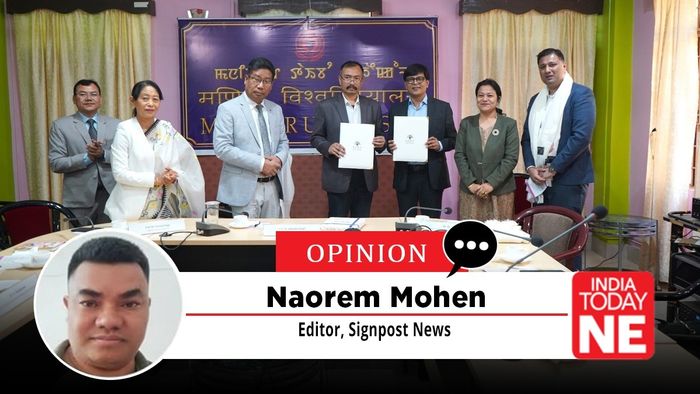
A landmark development occurred on December 15-16, when the Department of Vocational Studies and Skill Development (DVSSD) signed an agreement with NSDC International to establish an on-campus Japanese Language Training Centre.
- Dec 29, 2025,
- Updated Dec 29, 2025, 11:58 AM IST
As India’s higher education sector sees a wave of successful NAAC grade upgrades through appeals in late 2025, Manipur University has a timely opportunity to leverage its recent achievements.
The university’s current B+ grade with a CGPA of 2.63 (from the 2023 cycle, valid for five years until approximately 2028) reflects challenges from past administrative issues and ethnic unrest, which notably impacted its Student Support and Progression score (dropping to 1.74 from 3.20 in 2016).
However, significant post-2023 progress in vocational training and international placements signals emerging resilience and potential for improvement. A landmark development occurred on December 15-16, when the Department of Vocational Studies and Skill Development (DVSSD) signed an agreement with NSDC International to establish an on-campus Japanese Language Training Centre.
Witnessed by Vice-Chancellor Prof. N. Lokendra Singh, Registrar Prof. M. Premjit Singh, NSDCI CEO Alok Kumar, and state officials, this initiative reduces training costs by nearly 50% (from Rs 3 lakh off-campus to Rs 1.10 lakh), with support via skill loans.
The centre, launching in January 2026, targets 250 candidates annually for Japan’s Specified Skilled Worker (SSW) program in sectors like healthcare, hospitality, agriculture, and manufacturing—requiring JLPT N4/N3 proficiency, cultural orientation, and sector-specific skills. Japanese recruiters are scheduled for on-campus visits in February 2026.
Building on existing momentum, 28 DVSSD alumni over the past two years have secured hospitality roles in Japan with average annual salaries of Rs 12 lakh, contributing substantial remittances. Graduates have also thrived in aviation, banking, teaching, manufacturing, and entrepreneurship (with 29 startups incubated across Manipur and Meghalaya).
These documented 2024-2025 strides in student placements and global skill development provide strong evidence for a NAAC appeal or reassessment, particularly to boost the Student Support and Progression criterion.
Even a modest 1-point gain could meaningfully elevate the overall CGPA, aligning with national trends where appeals have recently upgraded institutions to A+ or A++ (e.g., CGPA thresholds: 3.51+ for A++; 3.01+ for A or higher).While NAAC transitions toward a new Binary Accreditation (accredited/not accredited) followed by Maturity-Based Graded Levels (MBGL) in 2025—potentially shortening validity periods—existing cycles remain under the current framework.
Manipur University stands as a premier institution in Northeast India's higher education ecosystem, having evolved from a state university in 1980 to central status in 2005. Its NAAC accreditation history encapsulates both achievement and adversity. In 2016, it earned a solid 'A' grade with a CGPA of 3.02, reflecting balanced strengths amid growth.
By 2023, however, the CGPA fell to 2.63, yielding a 'B+' grade—a downgrade that mirrors the profound disruptions from administrative crises (2016–2020) and the ethnic violence erupting in May 2023. Now, Manipur University administrations and every stakeholder must seize this positivity: sustain placement drives, revitalise research, and streamline administration.
Let us analyze deeply into each of the seven NAAC criteria, comparing 2016 and 2023 scores, dissecting underlying causes for changes, and evaluating potential for improvement. The analysis highlights how institutional fragility in conflict zones can undermine quality, while highlighting pockets of resilience, particularly in vocational initiatives, that could fuel recovery if leveraged through NAAC's appeal mechanism.
1. Curricular Aspects
· 2016 Score: 2.87
· 2023 Score: 3.13 (Improvement of +0.26)
This criterion assesses curriculum design, flexibility, integration of feedback, and alignment with regional/national needs. The upward trajectory here is one of the few unequivocal positives in Manipur University's 2023 assessment. Despite campus disruptions and regional instability, the university evidently prioritized curricular reforms, possibly incorporating elements of the National Education Policy (NEP) 2020, such as multidisciplinary approaches, skill-based modules, and stakeholder input.
This gain reflects administrative foresight in academic planning—a domain less vulnerable to immediate violence than on-ground activities like research fieldwork. It demonstrates that even in turmoil, focused efforts on syllabus updates, choice-based credit systems, and relevance to Northeast-specific issues (e.g., biodiversity, cultural studies) can yield dividends. This criterion's resilience offers a blueprint: sustained curricular innovation could anchor future improvements, insulating core academics from external shocks.
2. Teaching, Learning and Evaluation
· 2016 Score: 2.90
· 2023 Score: 2.87 (Decline of -0.03)
Evaluating faculty adequacy, pedagogical methods, student engagement, and fair assessment processes, this criterion remained remarkably stable. The marginal dip is negligible statistically but telling contextually. Prolonged protests in 2018 disrupted classes, examinations, and faculty-student interactions, while the 2023 violence further hampered regular teaching through curfews, displacements, and security fears.
Yet, stability here speaks to enduring faculty commitment and adaptive measures like online/hybrid modes during lockdowns. This near-hold is commendable but masks lost potential: uninterrupted semesters could have elevated scores through enhanced outcome-based education and continuous internal assessments. Restoring normalcy is crucial; any future appeal should highlight post-2023 adaptations to argue for marginal uplift.
3. Research, Innovations and Extension (2016) / Research, Innovations and Extension (2023)
· 2016 Score: 3.40 (Highest in cycle)
· 2023 Score: 2.13 (Decline of -1.27; steepest drop)
This was Manipur University's pinnacle in 2016, bolstered by robust publications, consultancy projects, and extension activities addressing regional challenges like ethnic studies and environmental conservation. The catastrophic fall reflects multifaceted breakdowns: administrative instability stalled funding and collaborations; 2018 protests demoralized faculty; and post-2023 violence restricted fieldwork, conferences, and community outreach in divided territories.
The renaming subtly shifts emphasis, but the score plunge is indefensible without contextualizing conflict's impact, scandals, resource disputes, and safety concerns crippled innovation. This criterion's erosion is the most alarming, as research defines a central university's stature. Recovery demands safe corridors for collaboration and targeted grants; without them, Manipur University risks perpetual marginalization in national rankings.
4. Infrastructure and Learning Resources
· 2016 Score: 3.00
· 2023 Score: 3.21 (Improvement of +0.21)
Encompassing libraries, laboratories, IT facilities, hostels, and sports amenities, this criterion's gain is a testament to tangible investments from central funding post-2005 elevation. Upgrades in digital resources, perhaps accelerated by pandemic necessities, likely contributed.
Amid violence-induced disruptions, physical infrastructure proved durable—a relative safe haven. This resilience is heartening: well-maintained facilities provide a scaffold for revival. In appeals or future cycles, emphasizing sustained enhancements (e.g., e-libraries accessible remotely) could solidify this as a stronghold.
5. Student Support and Progression
•2016 Score: 3.20
•2023 Score: 1.74 (a decline of 1.46 – the most significant drop among NAAC criteria)
This criterion evaluates key aspects such as scholarships and financial aid, mentoring and counselling, career guidance, placement support, alumni engagement, and student progression to higher education or employment. The sharp decline in 2023 reflected the profound impact of prolonged administrative challenges and ethnic unrest in Manipur, which disrupted academic calendars, delayed examinations, caused displacement, and strained welfare, counselling, and career services.
Yet, this is the criterion with the strongest potential for recovery, driven by recent initiatives in vocational training and international opportunities. An important milestone was reached on December 15, 2025, when NSDC International (NSDCI) and Manipur University's Department of Vocational Studies and Skill Development (DVSSD) signed an agreement to establish a state-of-the-art on-campus Japanese Language Training Centre. The ceremony marks a transformative step for accessible global skill development.
These measurable outcomes – enhanced placement rates, international progression, alumni contributions, and entrepreneurial ventures – directly strengthen metrics under Criterion.
6. Governance, Leadership and Management
· 2016 Score: 2.70
· 2023 Score: 2.66 (Decline of -0.04)
Assessing strategic planning, financial management, leadership efficacy, and welfare policies, persistently low scores trace to the 2016–2020 Vice-Chancellor controversy involving mismanagement allegations, leading to protests and dismissal. Lingering opacity and instability hindered reforms.
Under President's Rule, opportunities for transparent governance emerge, but ethnic divides complicate implementation. This criterion demands urgent overhaul: impartial leadership selection and stakeholder inclusion are non-negotiable for trust restoration.
7. Innovations and Best Practices (2016) / Institutional Values and Best Practices (2023)
· 2016 Score: 2.70
· 2023 Score: 2.91 (Improvement of +0.21)
Focusing on innovative practices, inclusivity, gender equity, and environmental sustainability, this rise embodies enduring commitments to cultural preservation, community values, and ethical initiatives attuned to the diversity of Northeast India. Much like curricular dimensions, these gains highlight the persistence of soft strengths even amid hardship. Advancing best practices in conflict resolution and inclusive outreach could further consolidate these achievements, ensuring that resilience is translated into broader social transformation.
Against this backdrop, the Women’s Studies Centre at Manipur University successfully convened a one-day national seminar titled “Women, Conflict and Society (NSWCS 2025)” in December, 2025. Similar seminars which highlighted the urgent need to integrate gender perspectives into peacebuilding and community reconciliation, situating women’s voices at the heart of dialogue on conflict and society is one of the factors for improving the scores. Such national and international forums, by advancing best practices in conflict resolution and inclusive outreach, hold the potential to amplify these achievements, ensuring that resilience evolves into meaningful and lasting social transformation.
With these criterions, the Manipur University retains strong prospects for improving its NAAC ranking in the next cycle. Success hinges on sustained focus in three critical areas: student support and progression, faculty recruitment to fill vacancies, and minimising administrative hindrances.
It is believed that recovery is possible and urgent. NAAC's appeal mechanism has proven effective; in October-December 2025, several institutions successfully revised scores upward after challenges. Even a one-point jump in Student Support (feasible with scaled placements) could push CGPA toward 3.01+, restoring 'A' status. Hypothetically, stronger evidence might yield more. Let us focus on positive momentum, expanding vocational programs, reviving research via safe collaborations, and transparent administration, is essential. Stakeholders, from faculty to students, must unite for stability.
Manipur University's decline is a cautionary tale for Indian higher education: no institution is immune to leadership failures or societal fractures. Its journey from an 'A' grade in 2016 to the challenges of recent years is a sobering reminder of how quickly institutional progress can be disrupted. Yet the surge in student support and international placements, epitomised by affordable skill training, on-campus recruitment from Japan, and alumni earning substantial incomes abroad, signals a powerful comeback.
The time for Manipur University to rise again is now!