Marjing Hill Ropeway Project : Forest Approval Secured, Environmental Exemption in Place
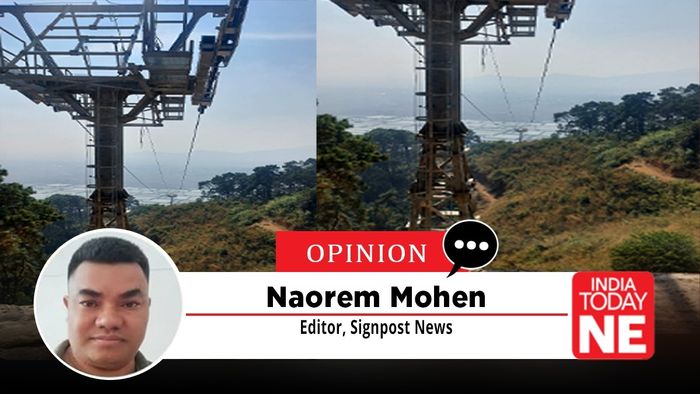
The Marjing Hill Ropeway Project in Heingang, Imphal East, has become one of the most talked-about infrastructure developments in Manipur. Designed as an aerial cable car system linking the base of Marjing Hill to the sacred Ibudhou Marjing Polo Complex and the iconic 122-foot Marjing Polo Statue, the ropeway aims to provide safe, eco-friendly access to a culturally vital site while easing road pressure on steep hill paths and supporting tourism growth.
- Mar 14, 2026,
- Updated Mar 14, 2026, 5:09 PM IST
The Marjing Hill Ropeway Project in Heingang, Imphal East, has become one of the most talked-about infrastructure developments in Manipur. Designed as an aerial cable car system linking the base of Marjing Hill to the sacred Ibudhou Marjing Polo Complex and the iconic 122-foot Marjing Polo Statue, the ropeway aims to provide safe, eco-friendly access to a culturally vital site while easing road pressure on steep hill paths and supporting tourism growth.
The project now enjoys complete legal clearance on both forest and environmental fronts. Full forest clearance has been secured through the two-stage process under the Forest (Conservation) Act, 1980: Stage-I (in-principle) approval was granted on 17 January 2023, followed by final Stage-II approval on 3 October 2024 after verified compliance, legally permitting diversion of 0.9001 ha of deemed forest land with 33 enforceable conditions covering afforestation, pollution controls, audits, and ongoing safeguards.
On the environmental side, no separate prior Environmental Clearance (EC) is required, as aerial ropeways were formally exempted from mandatory EC by MoEF&CC Notification S.O. 1953(E) dated 27 April 2022; the accompanying Office Memorandum mandates binding safeguards, many of which are directly incorporated into the Stage-II forest clearance, ensuring environmental protection remains fully in place through this official exemption framework.
What often gets overshadowed in public discussion is the project's formal clearance journey, particularly on the forest and environmental fronts, which has now reached a legally sound position.
The project required diversion of 0.9001 hectares of deemed forest land, triggering the mandatory two-stage clearance process under the Forest (Conservation) Act, 1980 (subsequently updated to Van (Sanrakshan Evam Samvardhan) Adhiniyam, 1980).In January 2023 the Ministry of Environment, Forest and Climate Change’s Integrated Regional Office in Shillong issued Stage-I (in-principle) approval (F. No. 3-MN B 047/2022-SHI).
This was not a blank cheque. It came loaded with precise conditions like payment of Net Present Value (NPV) for the diverted land, compensatory afforestation (CA) over 1.8002 hectares in a designated compartment of Heingang Reserved Forest (Khabam Block, Central Forest Division, Imphal East), demarcation of boundaries at project cost, deposit of tree-felling expenses, special measures to prevent landslides and soil erosion (biological and mechanical), monitoring by the Regional Office prior to Stage-II, and no establishment of labour camps on forest land.
Additional safeguards covered alternate fuel supply for workers, boundary demarcation on the ground, and strict violation clauses referencing the Ministry’s comprehensive handbook.
Compliance took time, NPV and CA funds were delayed, and formal handover of the forest land remained pending into 2023 and much of 2024, reason being Manipur violence. This lag is precisely what the CAG audit (covering up to March 2023 with some observations extending into 2024) captured when it described early construction as irregular and flagged pending payments (₹18.72 lakh for NPV/CA as of August 2023). The audit was factually correct for its timeframe, but the story did not end there.
By September 2024 the Tourism Department had submitted its compliance report. The State Government forwarded it on September 20 / October 3, 2024. On October 3, 2024, the Regional Office issued Stage-II (final) approval, confirming that the stipulated conditions had been met to its satisfaction.
This final letter legally permits diversion and handover of the 0.9001 ha forest land. It attaches 33 detailed, ongoing conditions that go far beyond mere paperwork: permanent demarcation before handover, uploading of KML files to e-Green Watch, no labour camps, provision of alternate fuels, air pollution control systems for dust at all transfer points, enclosed DG sets compliant with emission norms and stack-height rules, baseline noise surveys conforming to the 2000 Noise Pollution Rules.
No open discharge of wastewater with proper treatment systems, integration of energy conservation measures including solar power at upper and lower terminals to reduce carbon footprint, detailed traffic management and decongestion plans around the project site, a board-approved environmental policy with defined infringement-reporting mechanisms.
Plus, annual self-environmental audits plus third-party audits every three years, no expansion or transfer of the diverted land without Central Government approval, reversion of the land to the Forest Department if no longer needed (with restoration to original status), and explicit revocation clauses if any condition is breached.
The proposal (FP/MN/Others/152680/2022) is now officially marked APPROVED on the national forest clearance portal and Parivesh platform. Forest clearance is therefore complete and current.
On the environmental clearance side, the narrative has been dominated by claims of a major lapse. The CAG report and subsequent local media coverage (March 13-14, 2026) repeatedly stated that the project proceeded without Environmental Clearance under the EIA Notification, 2006, describing this as a key irregularity.
Those observations were grounded in the regulatory position that existed before mid-2022, when aerial ropeways were still listed in the EIA Schedule (Item 7(g)) and required prior EC.That changed decisively on April 27, 2022, when the Ministry of Environment, Forest and Climate Change published Notification S.O. 1953(E).
The notification explicitly exempted aerial ropeways from the requirement of prior Environmental Clearance. The same day, the Ministry issued Office Memorandum F.No.22-17/2021-IA.III(Pt.), which spelled out the intent behind the exemption, to facilitate low-impact, sustainable transport infrastructure in hilly and tourist areas, and listed mandatory environmental safeguards that must still be followed during construction and operation.
These safeguards are comprehensive and binding. All statutory compliances and laws must be obeyed; a Disaster Management Plan must be approved by the competent authority; plantation (where required by state law) should prioritise heavy-foliage, broad-leaved, wide-canopy species; appropriate air pollution control systems must address dust at loading, unloading, transfer points and other vulnerable sources.
Diesel generator sets (if used for backup power) must be enclosed, conform to Environment (Protection) Act, 1986 norms, have adequate stack height for combined capacity, use low-sulphur diesel, and be located in consultation with the State Pollution Control Board; baseline noise level surveys must precede construction and ambient levels must meet 2000 Noise Pollution Rules.
Besides, no wastewater can be discharged untreated or in the open, with proper treatment systems required; energy conservation must be built into project design and operational before commissioning; solar energy should be used to the extent feasible at terminals to lower carbon footprint; adequate parking and traffic management/decongestion plans must be implemented to the satisfaction of state urban development and transport departments.
A well-documented environmental policy approved by the board must include standard operating procedures, checks and balances, and mechanisms to report infringements/deviations/violations of environmental, forest, or wildlife norms; annual self-audits are mandatory, with third-party audits every three years. Crucially, the exemption does not remove oversight—it shifts it.
The safeguards remain enforceable through other regulatory channels, including forest clearance conditions, state pollution board consents, and general environmental laws. In the case of the Marjing Hill Ropeway, a large number of these safeguards appear almost word-for-word in the October 2024 Stage-II forest clearance letter: air pollution control, noise surveys, wastewater treatment, solar integration, traffic planning, audits, plantation preferences, disaster plan references, and more.
This integration ensures that the spirit and substance of environmental protection are upheld even without a separate prior EC process.
Parivesh records showing “EC application yet to be submitted” are therefore not evidence of non-compliance; they reflect the post-2022 reality that no such application is required for aerial ropeways.
The CAG audit and media reports from March 2026 were accurate snapshots of the situation as it stood in 2023, before full forest closure and without emphasis on the 2022 exemption, but they do not capture the updated legal position.
Today, the Marjing Hill Ropeway project stands on solid ground, with full forest clearance secured in 2024 after compliance verification, and environmental obligations met through the 2022 exemption framework with safeguards actively incorporated into the operating conditions.
Early procedural and financial irregularities highlighted by the CAG deserve continued public and institutional attention, but they do not alter the fact that the ropeway at Marjing Hill is now cleared, both on forest and environmental parameters, to move toward full operation.
As cabins glide over the green contours of Marjing Hill in the coming months, they will carry more than passengers. They will carry the story of a project that navigated delay, scrutiny, and regulatory evolution to deliver a modern link to an ancient heritage site, proof that persistence, compliance, and updated policy can ultimately align development with environmental accountability.